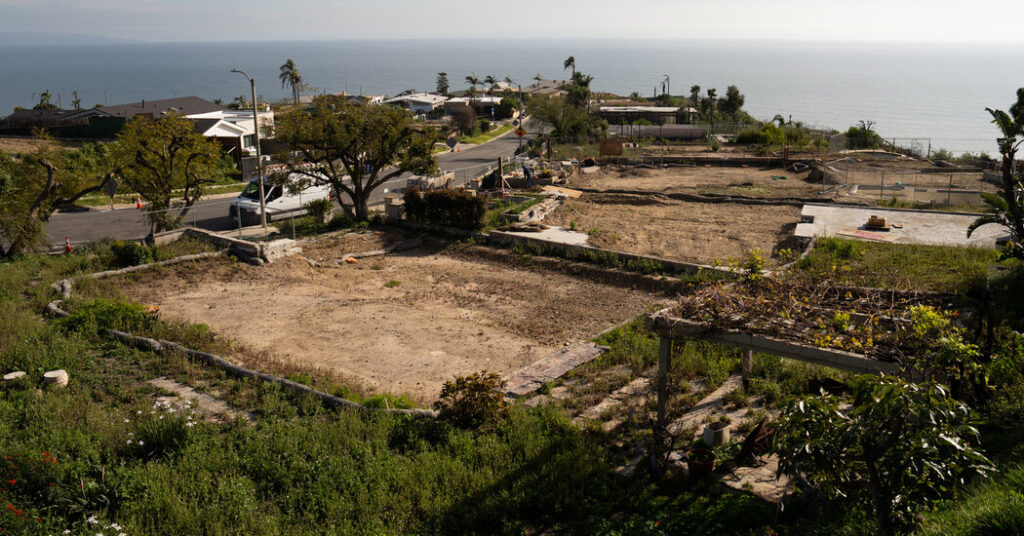
Francesca Beer, a Los Angeles resident for three decades, felt alone and overwhelmed at the thought of rebuilding her family home in Sunset Mesa, a neighborhood of modest, low-slung houses above the Pacific, after last year’s devastating fires.
When the January conflagration swept through, entire runs of houses burned in sequence, leaving some 300 leveled plots cut into the slope. Beer, her husband, Glen, and nearly two dozen neighbors decided that rebuilding individually would be slower, more expensive and more daunting than they could manage. Instead they have opted for a “group rebuild” in a partnership with an architect and a homebuilder.
“I was telling everybody that there’s no way our insurance was going to cover to rebuild the home that we just lost,” she said. That’s when a friend told her, “You should call Clive,” referring to Clive Wilkinson, a noted Los Angeles architect who had designed offices for Beer’s former employer, the advertising agency Chiat/Day, in 1998.
“Somebody like Clive is not going to want to be involved in our tract home development,” she thought. But Wilkinson would eventually do just that, devising a few simple but soulful designs for single-family homes at a steep discount from the cost of a custom house. Construction for 21 families is beginning this month.
What’s unfolding across the fire zones of the city is a wide field of experimentation not seen since California attempted to reinvent the single-family house after World War II, a time when the United States was facing a severe housing shortage.
In Los Angeles, back then, Arts and Architecture magazine sponsored the Case Study House program, which brought together famous designers like Richard Neutra, Pierre Koenig, and Charles and Ray Eames to rethink conventional living through innovative, industrially inspired homes.
Around the state, the developer Joseph Eichler worked with elite architects to marry modern design with a homebuilder’s economic efficiency. In L.A.’s Mar Vista neighborhood, the architect Gregory Ain developed tract homes that communed with their peaceful surroundings, with the help of the landscape architect Garrett Eckbo. And in Palm Springs, Alexander Construction Company created steel-framed concrete houses designed by William Krisel and Donald Wexler that fused wartime manufacturing methods with desert minimalism.
In the aftermath of Southern California’s fires, which destroyed more than 16,000 homes in Altadena, Pacific Palisades, Malibu and Topanga, the pressures are fiercer than they were 80 years ago.
For thousands of families like the Beers, insurance payouts have covered only a portion of what rebuilding will require, while material costs are surging, the labor supply can’t keep up, and stricter (and badly needed) wildfire codes are adding expenses and delays. In response, architects, builders and homeowners are going back to the future, drawing on strikingly similar strategies to those of the past, including collective building and even predesigned catalog homes.
Pooling Resources
Concerned about cost, and the threat of speculative building altering their neighborhood’s character, the Sunset Mesa homeowners decided to develop a set of standard home models for the group.
They talked to about 10 architects, Beer said, before coming back to Wilkinson. “The one person that didn’t fall off into the deep end of the pool was Clive,” she said. “I don’t know if he was a little crazy or used to being with crazy people, but he seemed to be really captured by the story of helping our group pull this together.”
Meeting with the group via Zoom, Wilkinson developed four house models — two single-story and two double-story. They roughly echo the shapes and sizes of the area’s original homes but look decidedly modern, leaning into the California indoor/outdoor lifestyle with huge windows, big balconies, rhythmic trellises and open plans. Owners can opt for stucco cladding, or move up to cement board or metal, and a variety of colors.
“The idea was to get the financial benefits of a tract house but the quality level of a custom home,” Wilkinson put it. The group signed with a medium-size local builder, Comstock Homes.
At first, the merger of custom architect and homebuilder presented some challenges. Comstock’s assembly-line model contrasted with the project’s scattered home sites and Wilkinson’s refined, custom design ethos. “These were people whose goals were about making something nicely, but not too well,” Wilkinson said of the builders.
“We were pushed out of our comfort zone a little bit,” acknowledged Nicholas Long, Comstock’s chief financial officer. Comstock often builds tracts of houses for about $250 a square foot, Wilkinson said, while his firm’s singular homes often cost over $1,000 per square foot.
But the two have come together, merging some of Wilkinson’s refined details — complex roof components put together on site and cabinets from Italy — with Comstock’s skill for ordering materials in bulk and using similar foundations and framing systems for each. Homeowners, meanwhile, have had to “sacrifice some of their personal ideas for the better good,” said Long. Those cabinets, for instance, cannot be customized.
Their early pricing estimates have reached $500 per square foot, which is still less than half that of a custom home in Los Angeles’s Westside, Wilkinson said.
“I knew maybe three of these families before this started,” Beer said. “We have found a way to share knowledge, share resources, share strengths. We are collaborating, and it has become an overwhelmingly beautiful relationship.”
Other collective experiments have had varying degrees of success. Case Study: Adapt, a nonprofit initiative drawing on the vaunted Case Study name and concept, has paired 10 local architects — including nationally known firms — with 16 families to design homes under 3,000 square feet. They are conceived, like the original Case Study program, as prototypes for new ways of combining materials, systems and strategies.
They’re also attempting to showcase resilience against fire. All are built to the construction standards of the Insurance Institute for Business & Home Safety, which are stricter than local codes.
Some participating designers are wrapping warm, light-filled interiors with facades or roofs of metal or concrete. Others are experimenting with prefabricated and modular construction systems.
Among the most ambitious are two homes by the architect Geoffrey von Oeyen, made from RSG-3D, a concrete-edged composite panel that integrates structure, insulation and enclosure into a single fire-resistant assembly.
“The analogy I use is a surfboard,” said von Oeyen, a longtime surfer who helped rebuild his brother’s home after it burned in Malibu’s 2018 Woolsey Fire. “Everything works together.” His designs carve out space for interior gardens, using irrigated planters. Homes feature small pools, which can feed rooftop sprinkler systems during emergencies. As with the original Case Study program, innovation doesn’t always come cheap. Few houses in the program are likely to dip below $1,000 per square foot, said Dustin Bramell, a co-founder of Case Study: Adapt, adding they are “more in line with custom home prices.”
Case Study: Adapt currently has only a single client located in less affluent Altadena: Erin Takeuchi, an art teacher so overwhelmed by loans, insurance payouts, and trauma from the fire that she recently retired.
“Someone told me, ‘You’ve got to stop because you’ve been in fight or flight for months and it’s not healthy,’” Takeuchi said.
Her architects, Silvia Kuhle and Jeffrey Allsbrook of Standard Architecture, are focusing less on new technologies and more on creating light-filled indoor/outdoor living using block walls with fiber cement siding designed to resist fire penetration.
The Altadena Collective
Many innovations emerging in Altadena are focused on lowering building prices while offering quality construction that respects the area’s cherished local character.
This includes the building professionals pooling their talents in the initiative known as the Altadena Collective. After the Eaton Fire, three architects — Chris Driscoll, Chris Corbett and Tim Vordtriede — loosely affiliated their firms, sharing office space, ideas and sometimes revenue, and collaborating with local designers and consultants like the group Brass Tacks, an owners’ representative that helps clients communicate with builders.
The collective merges custom design work with standard components (from windows and doors to floor plans), and is now working on 78 homes, Driscoll said, including rebuilding Altadena’s beloved, storybook-inspired “Janes Cottages” and other new projects that are still historically minded. About 11 have begun construction, hovering around $500 per square foot.
Morgan Soloway and her fiancé, Kenneth Rotter, signed on with the Altadena Collective after losing their house, purchased in 2024. Their future home — a fire-hardened structure with deep overhangs that merge midcentury modern’s simplified forms with the pitched roof and exposed joinery of Craftsman — was designed on their $800,000 budget. (Insurance has so far paid for about half the cost.) But it includes some custom touches, like an extra-large covered porch where they will spend time with their foster dogs, a “great room,” and a tiki bar on the garage roof. They’re planning to get married inside the home’s shell as it goes up.
“I feel like I have a safety net,” Soloway said. “These were people we wanted to go through the process with. It’s like we’re visiting friends.” She added: “They understood what we were going through. Our lives stopped on Jan. 7.”
Catalogs, Revisited
Catalog housing — long a part of California’s history — has re-emerged as a rebuilding innovation. In the early 20th century, Pacific Ready-Cut Homes shipped thousands of pre-designed houses across the West, inspired by catalogs popularized nationally by Sears. In the new iterations, owners choose designs from digital catalogs, pay for the plans and find a local builder.
“What people want most right now is confidence,” said Cynthia Sigler, an architect who is co-founder of the Foothill Catalog Foundation. “They don’t want to invent a house. They want to understand what it will cost and how long it will take.”
The catalog offers 38 home designs and seven “accessory dwelling units” — 25 preapproved for permits by local officials. The concept designs were created by about a dozen architects, drawing on the area’s existing housing stock of Craftsman style, Spanish, Tudor, midcentury modern, Victorian and ranch. But it uses new and more robust materials and techniques.
Ronald Gary Dunlap, a visual artist whose saltbox house burned in the Eaton Fire, and his wife, Lynda, chose “the Lewis,” a California bungalow with a porch and “the feel of Altadena.” The foundation and frame, built by the contractor 5blox, are now up, and he’s hoping it will be completed by June.
The Foothill Catalog Foundation, funded largely by grants and donations, has 40 homes in pre-construction and six in construction, Sigler said, at around $450 per square foot.
A modern catalog collection, Case Study 2.0, offers designs aggregated from more than 60 architecture firms and connects owners to local builders to realize the plans. The architect Stephen Phillip’s Case Study 2.0 house, designed for his sister Claire, has butterfly roofs which will let in soft light from overhead and echo the forms of mountains beyond. The cost of her house is $1.1 million for 2,000 square feet including landscaping.
What Comes Next
Across this range of initiatives, homeowners have been slower to commit than organizers initially hoped. Case Study 2.0 has only about 16 families working with architects, and three homes under construction. Its co-founder, Steven Somers, said people were wary of locking themselves into a plan before insurance claims, financing and neighborhood conditions stabilized.
“People want certainty,” Somers said. “And certainty is exactly what’s hardest to offer after a fire.”
A Los Angeles architect, James Hughes, who is coleading Sunset Mesa Collaborative, a group rebuilding effort focusing on modular construction, said that only four families have formally signed on, far short of the threshold of 10 needed to drive costs down.
“The economics fall apart,” said Hughes, who noted the homes will now likely be built employing a mix of traditional and modular construction.
The bureaucracy has added another layer of friction. Even modest departures from standard construction can trigger extended regulation reviews and code issues, eroding savings. “A lot of innovation dies in plan check,” Bramell, of Case Study: Adapt, said. “Every delay adds cost.”
Such innovations are far from the norm. Most homes being erected are products of traditional builders and custom architects (and many residences are not being rebuilt at all). But the innovators are continuing to test techniques including composite concrete, adobe, prefabricated panels and modular systems, aimed at reducing labor and cost while increasing fire resistance.
Like the group builds and catalogs, they point toward a home construction culture beginning, cautiously, to evolve. “Trauma forces learning,” von Oeyen said. “If we don’t change how we build after something like this, then we’re not really paying attention.”
The post Rebuilding After Fires, L.A. Neighbors Join Forces and Innovate appeared first on New York Times.