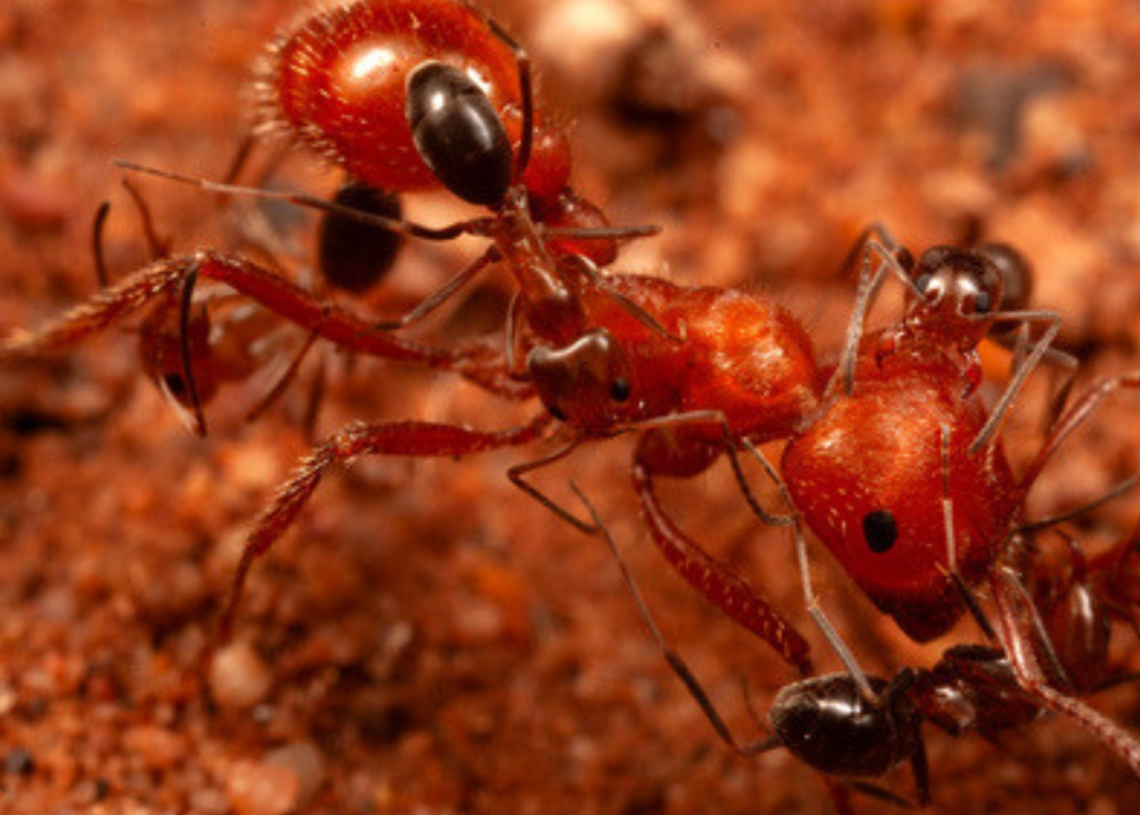
Back in the early 2000’s, a researcher named Mark Moffett took some pictures of ants. Twenty years later, he was looking at them again with fresh eyes and noticed that the large red harvester ants he had photographed in the Arizona desert were doing a weird thing he had never noticed before.
As reported by the New York Times and originally published in the journal Ecology and Evolution, through all the pictures, Moffett kept noticing that these ants, which were usually always on the move, occasionally stood completely still while outside of their nests as a much smaller species of ant known as a cone and would climb all over the larger red harvester and start licking and nibbling at them. There would be a line of red harvester ants behind it, seemingly waiting its turn.
It took over two decades, but Moffett finally realized what he was looking at: an ant carwash. At first, it seemed like a randomized behavior, but over time, he noticed a pattern. Starting in the morning and peaking before midday and then fading as the heat set in, harvester ants would approach the smaller ants, assume a stiff posture, and then just wait as the cone ants would respond within seconds, quickly rushing over to swarm a single harvester. The harvester would endure the licking and pecking and swarming for a few minutes before getting tired of the whole thing and shaking them off, like a cat that’s begging for some pets and then realizing he’s totally over it a minute later.
What Do the Ants Running the Car Wash Get Out of It?
Moffett tells The Times that the behavior reminds him of cleaner fish, species of fish that remove parasites and debris from larger fish and coral reefs. Some species perform similar nibbling behavior to human feet in spas. It’s a mutually beneficial relationship that has been well documented across several species on both land and sea, but seeing it play out among bugs on land is rare.
The behavior would make more sense if it were immediately clear what each side is getting out of the deal. Harvester ants groom themselves and each other, so outsourcing the job to another type of ant altogether doesn’t make a lot of sense. Moffett has his theories. One possibility is that cone ants were better at accessing those hard-to-reach areas, providing red harvester ants with a deeper, more satisfying clean than they could ever give to themselves.
Another theory is that the cone ants were feeding on whatever the harvester ants got all over them, and the harvester ants don’t seem to mind it. There’s also the chance that it might not be a form of maintenance at all, but rather a kind of microbial or chemical exchange that is closer to a form of communication than a cleaning.
The best part of the story is that it goes to show that you don’t have to make fascinating scientific discoveries by conducting sprawling studies filled with datasets collected using high-tech tools. Sometimes discovery is as simple as noticing something you’ve never noticed before.
The post Scientists Found an Ant Car Wash in the Desert, and It’s Exactly What It Sounds Like appeared first on VICE.