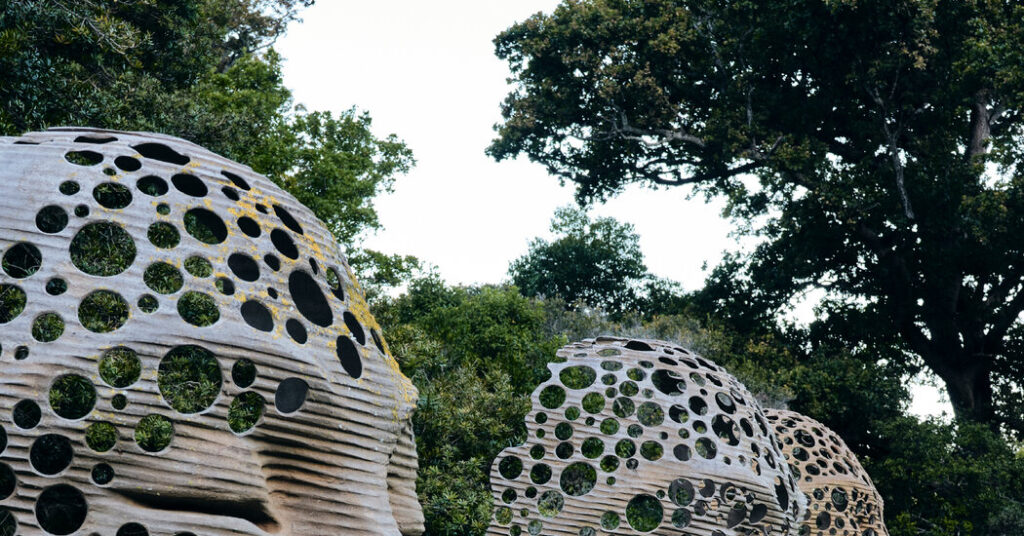
My first view of the Kirstenbosch National Botanic Garden in Cape Town was dramatic, to say the least.
Before me spread a wide crescent bed of tall blue agapanthus with a great lawn behind it, and then the land swooped up a mountainside with trees sheltering beds of plants and freshwater streams. Beyond, a deep forest rose to the highest point, the craggy peaks of Table Mountain. Like all of Cape Town, the garden is in the lee of this majestic mountain, part of the extensive Cape Fold range.
This 1,300-acre mecca dedicated to South Africa’s biodiverse, indigenous plant world is on many visitors’ lists of things to see in Cape Town. I was also there, though, to meet with Werner Voigt, the garden’s seventh curator, and the first Black person to hold that role.
Mr. Voigt was raised in Cape Flats, an arid, sandy area of the city that was relegated to nonwhites during apartheid, where the only trees he knew were invasive Port Jackson evergreens from Australia. Now nearly 50, he recalls the first time he visited Kirstenbosch at age 18, on a class trip. He and his classmates drove up to the entrance on Rhodes Drive, named for last private owner of the garden’s land, Cecil John Rhodes, who during his time as South Africa’s prime minister in the 19th century restricted the rights of the country’s Black population.
“I felt like I had arrived in a utopian green world and wondered what it would take for a person to work at Kirstenbosch,” Mr. Voigt said.
Mr. Voigt’s appointment is part of a shift in South Africa’s green spaces, which have historically been seen as the province of the white population (though much of the labor has come from Black and colored workers). On a recent trip, I visited three sites where I was able to witness this change while at the same time exploring the remarkable landscape of South Africa and seeing the efforts to revive some of its native plants.
Mr. Voigt grew up in a family who loved the outdoors and camping trips, and his mother snipped plants wherever they went.
“She would place cuttings in her bra to hide them,” he told me with an affectionate gleam in his eyes. “She and my grandmother created a beautiful rockery, and I loved watching the plants grow.”
After earning degrees in horticulture and interning at Kirstenbosch, he made the circuit of other South African botanic gardens in leadership positions before becoming Kirstenbosch’s curator in June 2019.
Now he says his aim is to modernize the facilities, with a continued emphasis on a seed bank and conservation. He is particularly proud of the completed boardwalk over a previously overgrown wetland, which has now been restored.
“The rise in the water table has brought back the water-loving birds and insects to Kirstenbosch,” he said.
As I left him, a tour was about to begin, and I joined the guide, who drew us along avenues of planting beds.
The rich Cape Floristic region boasts 9,000 species of plants, of which more than two-thirds occur nowhere else in the world. About 2,600 are in a unique category called fynbos, a botanical term inherited from the early Dutch settlers and translated as “fine bush” — protea-like shrubs, heathers, reeds and bulbous plants.
In strangely beautiful shapes with spiky or tubular blossoms and leathery leaves, these plants provide the colorful mix in the grasslands of the famous South African plains called the veld. Finally, fynbos are burned periodically to stimulate the release of seeds for renewed germination.
At each bed at Kirstenbosch, many of them filled with fynbos, the guide spoke of the individual plants and their pollinators. After learning about them here, I would see them everywhere, in the wild in national parks and even along city streets.
Mr. Voigt had told me about one fynbos that had become extinct in the wild, called Erica verticillata (whorled heath, literally) with gorgeous mauve-pink tubular blossoms. In the coming years, he said, he hoped the plant might be restored.
Curious about the disappearance of Erica verticillata, I stopped at the Compton Herbarium, part of Kirstenbosch’s research institute, where John Manning, a research botanist, pulled out sheets of the last known plants found in the wild in 1908. Though dried and mounted, and a deep red now rather than pink, these last specimens movingly confirmed the reality of their disappearance.
A restored wetland
Shortly after my visit to Kirstenbosch, I went to the southern suburbs of Cape Town to meet Denisha Anand, the biodiversity and restoration project manager of the 222-acre Princess Vlei Wetlands Park (vlei is the Afrikaans word for wetland). An environmental anthropologist and conservation specialist for the City of Cape Town, Ms. Anand is a leader of the new generation of social ecologists in South Africa.
The Princess Vlei area commemorates a princess of the Khoisan, the indigenous, pastoral people of South Africa. One day late in the 15th century, the legend goes, she descended from her mountainous cave to graze her cattle and bathe when she was attacked and killed by Portuguese sailors. Her spirit allegedly cast a spell, taking men’s lives in revenge. Now she is honored by one of the most successful rehabilitated wetlands of the post-apartheid period.
During apartheid, this bleak area of the Cape Flats was relegated to people of color, and the wetlands, with their inland waterway, were the only recreational area open to residents, who would celebrate baptisms and birthdays there, along with swimming and fishing. The area became derelict, and, at one point, there were plans to build a shopping mall.
The residents protested, Ms. Anand said, and began their own effort to clean up the area and remove invasive plants. They formed an organization called the Princess Vlei Forum and, with plans for the shopping mall canceled, turned the area into a sumptuous wetland.
On a refreshing walk through the waving dune grasses with the strong scent of rosemary in the air, I could see the creamy-green flower heads and soft pink blossoms of various fynbos plants tucked in. Ms. Anand hopes to add a heath field, especially with the missing Erica verticillata, when seeds become available again. Out on the water stands an abstract sculpture of Princess Vlei in wood with metal supports, her staff in hand to lead her new flock.
Making gardens out of the veld
I found the wild South African veld near Stellenbosch, about 30 miles east of Cape Town, on the Spier Estate, one of the oldest wine farms in the Western Cape, dating to 1692. I went there to meet the Johannesburg landscape architect, Patrick Watson, who had restored the old farmland to its natural ecological system with indigenous plantings and fynbos, a 1,606-acre veld as far as the eye could see.
A new book about Mr. Watson, “Veld,” quotes him as saying, “I’m still doing exactly what I did when I was a child — making gardens out of the veld.”
“As a designer,” Mr. Watson said, “I create a concept, and then I engage someone to see it through.”
The someone here for the last 18 years has been the head gardener, Wilton Sikhosana, and his staff of 31 gardeners, increased to 40-some during planting season from autumn to spring. He began working with Mr. Watson in 2002 on the ecological rehabilitation of North Island, a private luxury resort in the Seychelles.
Together at Spier, they lowered an existing lake and created canals and various wetland features. According to Mr. Watson, they have grown more than 80 species of plants, nurturing them from seeds in a massive nursery. Acres of both blue and white agapanthus are signature plantings throughout the estate’s landscaping, and the veld is a tapestry of bright green or somber brown grasses with the vivid colors of large patches of fynbos poking through. It is a walk through the real South Africa.
Restoring an extinct species
Before I left Cape Town, I made a final visit to Kirstenbosch. With the garden map in hand, I mounted the steep pathways, stopping by a remnant of the wild almond tree hedge that formed the 1660 boundary line of the original Dutch settlement. After crossing the aerial tree canopy walkway over the arboretum, I headed toward the fynbos beds, with the proteas and ericas at the top.
To my great relief, l came across a display titled “The Return of Erica verticillata; Saved from Extinction.” Evidently, plants discovered growing in the Belvedere Palace Gardens in Vienna were propagated from seeds originally collected in the wild at the Cape by palace gardeners on an expedition in the 18th century. Forgoing the customary difficulties of transporting plant material into South Africa, the Austrian minister of agriculture and the environment in 2001 handed a number of the plants over to the South African ambassador.
After long years of local propagation, Erica verticillata is back in Cape Town gardens this year — and available at Kirstenbosch’s retail nursery, Happy by Nature.
Follow New York Times Travel on Instagram and sign up for our Travel Dispatch newsletter to get expert tips on traveling smarter and inspiration for your next vacation. Dreaming up a future getaway or just armchair traveling? Check out our 52 Places to Go in 2026.
The post At Cape Town’s Stunning Gardens, Change Is in Bloom appeared first on New York Times.