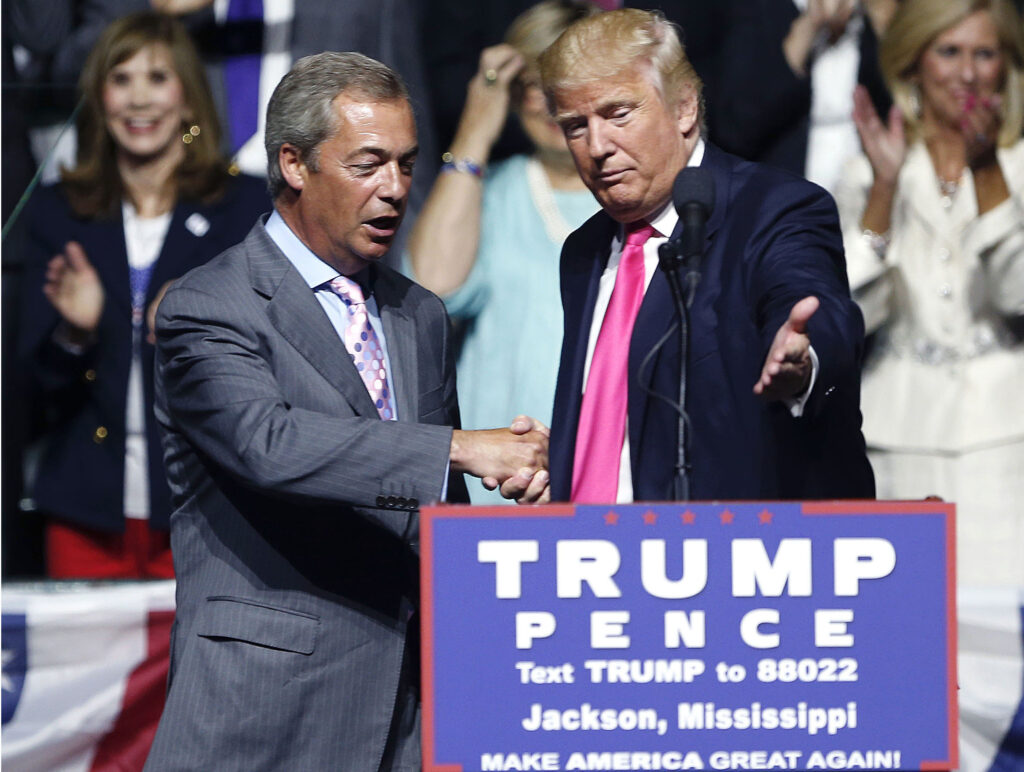
LONDON — Nigel Farage, who led the charge on Brexit, Britain’s push to quit the European Union, and more recently founded the anti-immigration Reform UK party, was euphoric when Donald Trump swept back into the White House. Farage had campaigned for Trump, visited him at his Mar-a-Lago estate and compared him, favorably, to Winston Churchill.
Trump’s return, Farage crowed, was “the beginning of a golden age.”
That was then.
“I happen to know him, but that’s by the by,” Farage said last week, describing his support for Trump to the Financial Times, as the U.S.-Israeli war against Iran sent gasoline and grocery prices soaring in Britain.
Farage was an early supporter of Trump’s strikes on Iran, but as anger at the war — and at the president — grows among Britons, who will vote in local elections May 7, he is backtracking. Reform UK’s standing has dipped in recent weeks, according to surveys, in part because of what some pollsters call “the Trump effect.”
Farage is not alone. Across Britain and Europe, nationalist leaders are retreating from Trump after having hailed his second term as something of a second coming for populists. Fifteen months in, the symbiosis between Trump’s MAGA and Europe’s nationalist parties has reached a potential breaking point.
Pro-Trump politicians from London to Rome — who were already squirming around the Europe-bashing president’s punitive tariffs, threats to seize Greenland and surprise attack on Iran — have found starker red lines in his conduct of the war, genocidal rhetoric and verbal broadside against Pope Leo XIV, the first American pontiff.
Tino Chrupalla, co-chair of Germany’s ascendant right-wing populist Alternative for Germany party (AfD), accused the Trump administration of potential “war crimes” in targeting civilian infrastructure in Iran.
Alice Weidel, the AfD leader who hosted Vice President JD Vance at a meeting last year and celebrated Trump’s vocal support for “patriotic European parties,” said recently on social media, “The renewed destabilization of the Middle East is not in Germany’s interest and must be brought to an end.”
Previously, Weidel lamented the administration’s military raid in Venezuela and threats against Greenland as having “violated a fundamental campaign promise — namely, not to interfere in other countries.”
Marine Le Pen, matriarch of France’s National Rally party, condemned Trump’s “erratic” war goals in Iran and warned of “catastrophic consequences” on fuel prices. “It is becoming apparent that very little preparation was done,” La Pen told the French daily Le Parisien. Le Pen’s protégé, Jordan Bardella, the young National Rally leader seen as a prime contender for the French presidency next year, recently condemned Trump’s “imperial ambitions.”
Trump’s return to office started with high hopes for Europe’s nationalist politicians, who believed they had regained a patron whose “America First” credo validated their calls for tighter borders, weaker E.U. institutions and an end to all manner of multilateral meddling in their countries’ domestic affairs.
Vance flew to Munich shortly after the U.S. inauguration and gave a speech denouncing Europe’s mainstream politicians as antidemocratic — suppressing free speech and repressing political opponents. Vance referred to E.U. officials as “commissars” and asserted that Europe’s own retreat from democracy was a bigger threat than Russia or China.
Trump’s National Security Strategy explicitly named support for nationalist parties as a U.S. foreign policy priority. Leaders of those parties envisioned a transnational conservative revolution led from the White House lectern, with Trump’s social media feed as a booster rocket. For many, that dream has curdled.
Trump seems to be “a nationalist who does not understand nationalism, particularly the nationalism of others,” Ivan Krastev, a Bulgarian political scientist based in Vienna, said on CNN.
The same party leaders who cheered Trump’s hard line on immigration and his culture war offensives now find themselves repulsed by his military interventions in Latin America, the Middle East and Africa.
“There was a view at the start that the administration would provide a tailwind, because you now had a U.S. administration that shares their values, their policy goals, their political agenda,” said Mujtaba Rahman, managing director for Europe at the Eurasia Group consultancy. “That’s totally fallen apart now.”
For some of Trump’s closest allies, his unprecedented — in recent centuries, at least — public spat with a sitting pope was the step too far.
After Leo condemned Trump’s threat that “a whole civilization will die” in Iran, the president lashed out Sunday with a Truth Social post saying he “should get his act together as Pope, use Common Sense, stop catering to the Radical Left.”
Trump claimed personal credit for last year’s selection of Leo, because he is American, and then shared — before deleting after a backlash — an AI-generated image depicting himself in a white robe performing a Christ-like healing.
That brought a rare rebuke from Italian Prime Minister Giorgia Meloni, a Trump favorite who has spent a year carefully positioning herself as a bridge between Trump and European leaders.
“I find President Trump’s words towards the Holy Father unacceptable,” said Meloni, a devout Catholic. “The pope is the head of the Catholic Church, and it is right and normal for him to call for peace and to condemn every form of war.”
Italian Deputy Prime Minister Matteo Salvini, head of the populist League party, who like Meloni previously had called for Trump to receive the Nobel Peace Prize, broke with him sharply over his attack on the pontiff. “If there is one person striving for peace, it is Pope Leo,” Salvini said.
The rift could be long-lasting. Trump unleashed on Meloni in a call Tuesday with Italy’s Corriere della Sera newspaper, lambasting her along with other NATO leaders for refusing to help sufficiently against Iran.
“She doesn’t want to help us with NATO, she doesn’t want to help us get rid of nuclear weapons,” Trump said. “She’s very different from what I thought. She’s no longer the same person, and Italy won’t be the same country.”
All of the politicians have their eyes on polls and election calendars.
Trump’s unfavorability ratings are stratospheric across the continent as of March surveys by YouGov: 78 percent unfavorable in France, 86 percent in Germany, 80 percent in Italy. Across the continent, 73 percent of Europeans viewed Trumps as a threat to peace and security in Europe, according to YouGov polling last summer, just nine percentage points behind Russian President Vladimir Putin’s 82 percent.
Some political analysts think that Meloni’s previously close ties to Trump — she was the only European leader to attend Trump’s second inauguration — contributed to a defeat of a Meloni-backed judicial reform referendum in March.
In Hungary, Prime Minister Viktor Orban’s close bonds with Trump and the MAGA movement could not save Orban from a landslide election defeat Sunday. The election focused heavily on a failing economy and corruption, but the White House went all out to back Orban: Trump endorsed him, and Vance and Secretary of State Marco Rubio visited Budapest to boost the campaign.
“I love Hungary, and I love Viktor. I’m telling you, he’s a fantastic man,” Trump said in a call that was blasted live at a razzle-dazzle Vance-Orban rally five days before the vote.
The Trump factor was not decisive, said Victor Mallet, author of a recent book on the French and European far right. But the defeat of Orban — who campaigned on the slogan “Make Europe Great Again” and was considered a template of Trump-style populism — shows that Trump’s approach may no longer be a useful guide for European nationalists.
“Trump looked to Orban as a kind of model for how to run things, so the fact that Orban is out is really interesting because it may show that the model doesn’t work, at least not in the long run,” Mallet said. “I don’t think there’s anywhere in Europe where being a friend of Trump is a good thing politically, except possibly Russia.”
Trump’s toxicity is particularly sharp in Britain, where more than 80 percent of residents view him unfavorably, according to YouGov. Conservative leaders are backpedaling.
Conservative Party leader Kemi Badenoch, remarkably, came to the defense of Prime Minister Keir Starmer, of the Labour Party, over what Badenoch called Trump’s “childish” personal attacks on Starmer for refusing to join the Iran operation. David Frost, once the country’s chief Brexit negotiator, last week repudiated his past Trump support.
“A moral line has to be drawn somewhere and this week Trump went beyond it,” Frost wrote in the Daily Telegraph, specifically referring to the U.S. president’s promises to strike civilian infrastructure and his civilizational threats against Iran. “Sadly — and I say it with deep regret — we in Europe have to acknowledge that this is now part of a pattern.”
Farage, for his part, is watching with alarm as his party seems to be slipping three weeks before the local elections in England and Wales. Reform UK, which has surpassed both the Labour and Tory parties in national surveys, is on track to make historic gains. But the party’s support has fallen to as low as 21 percent this month from 31 percent last autumn, about equal with Labour, with multiple pollsters pointing to Farage’s Trump ties and the Iran war as factors.
Labour leaders, pressing their advantage, have grown bolder in their critique of the war. Chancellor Rachel Reeves described Trump’s Iran planning as “a folly.”
Starmer himself, always cautious in criticizing Trump, leveled his bluntest reproach yet Thursday on Britain’s ITV. “I’m fed up with the fact that families across the country see their bills go up and down on energy, businesses’ bills go up and down on energy, because of the actions of Putin or Trump across the world,” he said.
Pitrelli reported from Rome.
The post Even for Europe’s populist firebrands, Trump might be going too far appeared first on Washington Post.