RASPUTIN: The Downfall of the Romanovs, by Antony Beevor
More than a century after his murder, Grigori Rasputin remains an object of fascination: the lascivious “mad monk,” disheveled and clairvoyant, beloved by Russia’s last monarchs.
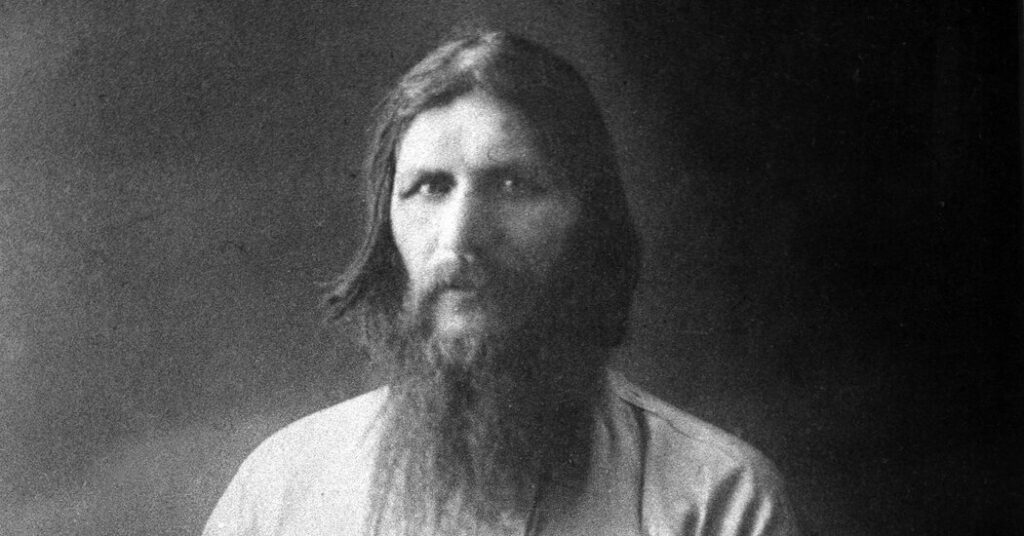
With his matted hair and straggly beard, in photos Rasputin resembles a Halloween Jesus. He is a mystery but also a joke. Is it possible that this bizarre character changed the course of Russian and even European history? Is there more to be said?
Early in “Rasputin,” Antony Beevor — an eminence prolific enough that he became a running gag on the cult British comedy “Peep Show” — remarks that Rasputin “contributed more than any other individual to the collapse of the greatest autocracy in the world” and that “seldom has the cause-and-effect chain of history been so influenced by a single man of humble origins.” Insistence on Rasputin’s centrality, common in popular writing but rare in academic research, relies on the idea that the fall of the Romanovs was a matter of contingency.
Beevor’s narrative goes on to show that in fact, the downfall of Emperor Nicholas II and Empress Alexandra was overdetermined. Their reign was a parade of disasters, from the fatal stampede after Nicholas’s coronation that killed more than a thousand people to Nicholas’s decision to continue playing dominoes as the revolution began in February 1917. Beevor quotes one cleareyed contemporary who observed that “the problem was not Rasputin, but the regime that made Rasputin’s influence possible.”
Alexandra started life as the beautiful German princess Alix of Hesse, granddaughter of Queen Victoria. The shy, often tearful princess and the diminutive, gullible, self-doubting young czarevich were madly in love, but Alexandra would prove rigid and puritanical, devoid of charisma.
Nicholas had no talent for politics, either; he was incurious and fatalistic. The couple preferred to stay home with their growing brood, but their joy at the birth of a son was marred by the discovery that he suffered from hemophilia.
Alexandra abhorred the idea of a constitutional monarchy, and she exhorted her already conservative husband to hold the autocratic line. She adorned her boudoir with a portrait of Marie Antoinette. Prone to severe depression, she was easy prey for mystics — then hugely popular throughout Europe — and con artists.
Born in 1869, the peasant Grigori Rasputin was a boozer from an early age, known for causing trouble in his Siberian village. Married in his teens, he lost four children in infancy — tragedies that may have stimulated his decision to become a pilgrim-wanderer.
He tested his faith by lying in bed with naked women or going with them to the bathhouse. On the frequent occasions when he succumbed to base desire, he persuaded his partners that, luckily, real repentance required sin. Physical touch was central to his charisma, which worked much better on women than on men. “I can’t do without caressing,” he said, “as it is through the body that I learn somebody’s soul.” He had the charisma of a cult leader or master seducer — indeed, many believed that he was possessed of a literal magnetism, the source of his healing and hypnotic powers.
When Rasputin arrived in St. Petersburg, Nicholas and Alexandra were immediately charmed. He won their lifelong devotion when he twice seemed to save their son’s life after near-fatal accidents. The intimate friendship of the louche soothsayer and the unpleasant empress soon became a tabloid staple. Salacious rumors about Empress Alexandra, her four beautiful daughters and Rasputin became a means of discrediting the monarchy as an institution.
Monarchists, meanwhile, were furious at Rasputin’s apparent political influence. Alexandra followed his advice slavishly, and seems to have influenced Nicholas to do so as well. She implored her husband to run Rasputin’s comb through his hair before making major decisions.
Some of Rasputin’s counsel was good; he warned Nicholas not to fight the Austro-Hungarian Empire after the assassination of Franz Ferdinand. When Nicholas refused to listen, taking command of the armed forces, it left Alexandra in a position of alarming authority. A newly appointed minister of the interior heard voices and talked to the dead; the transport system stopped functioning; food prices soared; soldiers traded pornographic images of the empress and Rasputin.
Convinced that Rasputin was to blame for Nicholas’s bad decisions, the immensely wealthy Prince Felix Yusupov conspired with Grand Duke Dmitry Pavlovich and the reactionary Duma member Vladimir Purishkevich to murder the mystic. Their clumsy crime — Trotsky called it “a moving picture scenario designed for people of bad taste” — was exposed almost instantly, but it was met with widespread celebration.
Much of Rasputin’s fascination lies in his transgression of class boundaries. At home in St. Petersburg, Beevor writes in some of the book’s most engaging sections, he loved to serve fish soup, and “he would dip into the large tureen with his unwashed hands, picking out chunks of fish to offer to his highborn lady followers.” For Alexandra, Rasputin’s love was a sign that Russia’s common people (mute, distant, imagined) adored her, even if it was quite clear that the intelligentsia and much of the ruling class did not.
Any portrait of Rasputin is complicated by the fact that he left behind almost no unedited writing and exists primarily through the accounts of others — who were often either besotted or repelled. He lived much of his life in a swirl of rumors, conspiracy theories and disinformation. Beevor’s bibliography includes over 40 books on Rasputin in English, Russian, French and German, and there are scores more on the fall of the Romanovs.
It is hard to find anything new to say about Rasputin, but this story of credulous, out-of-touch monarchs steering their country into disaster never loses its sinister appeal.
RASPUTIN: The Downfall of the Romanovs | By Antony Beevor | Viking | 361 pp. | $35
The post Russia’s Greatest Love Machine? Probably Not. appeared first on New York Times.