Neither snow nor rain nor Russian glide bombs have kept Oleksiy Klochkovsky from making his appointed rounds for Nova Poshta, a private postal service in Ukraine.
For four years, Mr. Klochkovsky, 37, has been delivering parcels near the front line in northeastern Ukraine. Russian strikes have torched three of his trucks, and he’s had numerous close calls — shelling, land mines, drones.
The stress, he acknowledged, is constant. But he is naturally upbeat. “I don’t know what would stop me, honestly,” he said with a smile. “Maybe only a bullet.”
Mr. Klochkovsky braves the dangers for about $450 a month. He sees a larger mission.
“It’s about the people” who cannot leave or “simply have nowhere else to go,” he said.
In frontline areas, local Nova Poshta branches are often the last remaining private businesses. Many Ukrainians view the company, which competes nationally against the state-owned mail service, Ukrposhta, as a shining success story and a lifeline for a country that has done its best to carry on.
Safety First
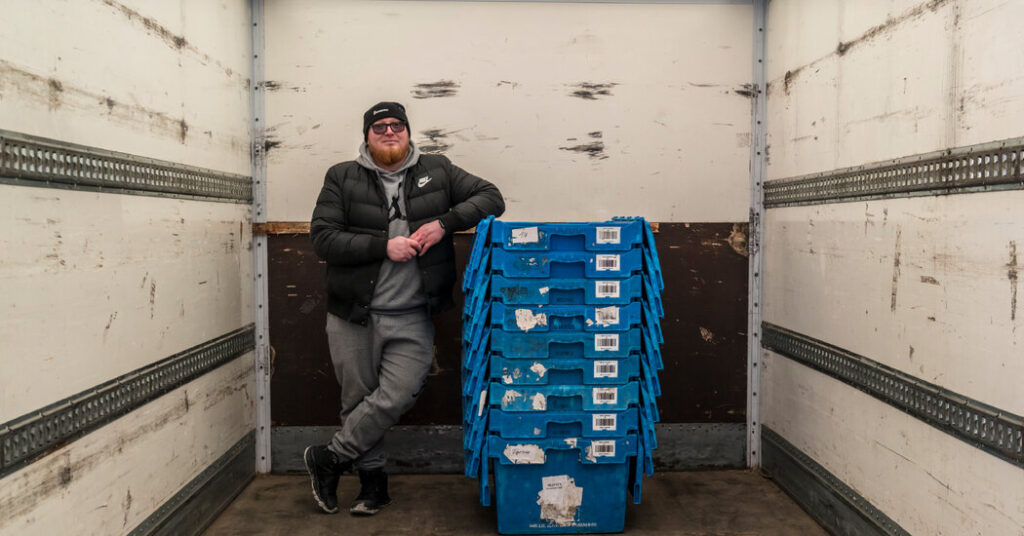
Mr. Klochkovsky gets up every day at 8 a.m. (after hitting snooze twice, he says) and starts his coffee machine. He throws on one of his many matching Nike sweatsuits, downs a cup of coffee and hits the road. He checks his watch repeatedly — he imposes a strict schedule on himself.
A large crack from shrapnel snakes up the windshield of his truck; skull-shaped air fresheners hang with a toy rat in the cab. Stuffed into the driver’s side door is a trauma kit with two tourniquets, blood-clotting agents and strong painkillers.
“You never know” when you might need them, he said.
He drives without music. An AirPod in his right ear is only for phone calls. “I always keep my left ear open so I can hear the drones,” he said.
Doing so saved him over the summer, when one flew in overhead, he said. He stopped, and it exploded right in front of him.
“If I’d had music playing,” he said, “we probably wouldn’t be speaking right now.”
He’s made other adjustments to his driving style, too. Before the war, his eyes were on the road, signs and speedometer. Now? “You look up, you look to the sides, you look for a drone, you look for a missile,” he said.
And sometimes, speeding is safest.
Staying Put
Mr. Klochkovsky admits that he thought about leaving Ukraine after Russia invaded in 2022. He said he was classified as unfit to fight because of a back injury. But he felt compelled to find another way to serve.
“I realized that if I won’t do this job,” he said, “no one will.” And the job, driving, “is my life.”
He got his first car before he even had a license: a white Zaporozhets, a small Soviet-era, Ukrainian-built model. He bought it with friends and modified it to look like a hot rod.
These days, he drives a white Mercedes truck, with none of Nova Poshta’s distinctive red branding.
“In this area,” he said, “I don’t want to attract attention.”
Mr. Klochkovsky was raised by a single mother in a village close to the one where he now works. Back then, he said with a laugh, he was “both a hooligan and a nerd.”
“I come from a poor family, so I had two options: either to study well or to become an alcoholic,” he said. “So I tried to study well.”
He focused on electromechanics, since he loved cars. But he was also prone to fistfights, and his mother had him repeatedly switch schools.
Now, the violence they worry about comes from Russian missiles. When air alarms sound, Mr. Klochkovsky immediately calls to check on his mother, who he says has come to accept the risks of his work.
“She’s used to it,” he said. “She knows that I drive everywhere.”
These days, that means taking the road out of the city of Kharkiv, rolling past checkpoints and barbed-wire-laced trenches with “dragon’s teeth” anti-tank defenses to a small, battered village with a tiny Nova Poshta branch.
Liberation
Early in the war, the village was briefly occupied by Russian forces. Soldiers camped in the Nova Poshta storeroom and broke into the safe.
The branch owner, Andriy Voroniansky, found their trash and belongings after the village was liberated in September 2022.
“Every time I come here, I see it,” he said, standing in the shrapnel-scarred loading dock. “Russian boots. Plundered, everything.”
After the Russians were gone, Mr. Voroniansky wanted to restart the business quickly. He needed a driver. Five men said no before he called Mr. Klochkovsky, who said, “Why not?”
The two men have known each other since high school, when they met playing soccer. They finish each other’s sentences. Interspersed with teasing is a clear tenderness.
“He has tolerated me for a long time,” Mr. Klochkovsky said.
“I’m his personal therapist,” Mr. Voroniansky replied, half joking.
After the Russian occupation, they set up a shipping container as a temporary branch. Their business was the village’s first to reopen after liberation, they said.
“People would come to us to charge their phones, to call their relatives to say they are alive,” Mr. Voroniansky recalled.
“We were the link to the world,” Mr. Klochkovsky added, describing how people would wait in the cold for the packages of medicine and warm clothes inside his truck.
It took months to repair the office, which later sustained more damage from a Russian drone. Mr. Voroniansky was, and still is, determined to stay.
“Yes, it’s dangerous,” he said, interrupted by an artillery boom from the front line, which is less than 12 miles away. But people in the village still need help, he went on, as three more booms sounded, “so we keep working.”
‘Good People’
The branch opened one day in late January at 9 a.m. Customers started filtering in at 9:02 — one with a small envelope to ship, another a large painting.
About 100 to 200 parcels go out each day, according to the branch manager, Maksym Kleshchov. Weapons and gas cylinders cannot be shipped. Also prohibited is frozen lard, which Mr. Kleshchov called “the weirdest thing” that people try to mail — until he remembered that someone once tried to send a small Spitz dog.
Mr. Kleshchov is 22. He is a manager perhaps because he is a hard worker, he said, or because “not many people want to work” amid all the Russian strikes.
The best thing about Nova Poshta, he said, is the speedy delivery — often the same day within some regions.
Nova Poshta says it constantly innovates, testing technology like robots and deploying mobile branches in containers or even cars.
But Mr. Kleshchov thinks the company’s success is more about heart than logistics. “We have good people,” he said.
Sixteen of its workers have been killed on the job since the war began in 2022, the company said, and many others have been injured. Russian strikes have damaged or destroyed more than 400 of its locations.
Yet Nova Poshta has continued to expand. It has 33,000 employees and nearly 16,000 branches, including many in frontline areas. It delivers, on average, about 1.5 million shipments each day, the company added.
“Nova Poshta is critical infrastructure,” a spokeswoman, Olha Baburina, said. “In wartime, logistics is not just a service, but the foundation of the country’s resilience.”
Mental Toll
Friends call Mr. Klochkovsky “Cheshire Cat” because of his wide smile. He has a booming, ready laugh.
But he is not immune to the strains of his job. He has had breakdowns.
“My nerves just gave way from the constant shelling,” he said.
Later, over a coffee after his final package run of the day, he shifted again from cheerful to introspective.
“We aren’t made of steel,” he said, pulling at his red beard.
Last year, he suffered a mini-stroke, attributed to stress. After a brief hospitalization, he returned to work.
When the constant Russian strikes mess with his head, Mr. Klochkovsky said, he de-stresses by going to the gun range and shooting his AR-15, or by playing video games.
Other times, he sits alone in silence at home with his cat, “to reload my brain, my thoughts.”
Those thoughts had recently turned to four colleagues who were killed when Russian missiles slammed into Nova Poshta’s sorting hub in Kharkiv. Mr. Klochkovsky called their deaths a pity, but said that the attack would not stop him from driving his route.
“It sounds harsh, but we’ve grown used to this reality,” he said.
“I hope,” he added, “if I die, God forbid, my friends will remember that I did something to help.”
The post Dodging Bombs and Drones, This Postman Still Delivers appeared first on New York Times.