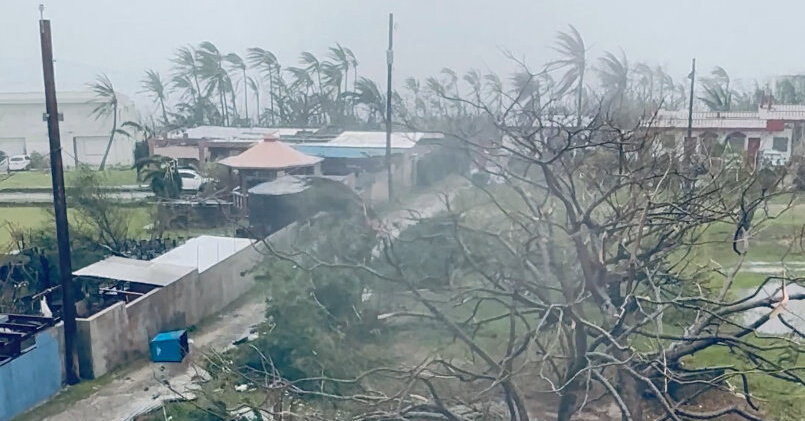
The super typhoon overturned cars, uprooted trees and ripped metal roofs from their fasteners as it lashed Saipan, the biggest of the Northern Mariana Islands, with heavy rain and near constant wind, leaving much of the island of about 43,000 people without power.
Hours after the storm, named Sinlaku, made landfall overnight, Mayor Ramon Camacho of Saipan said he was out on the streets on Wednesday morning, assessing the damage. He added that there had been no reports of fatalities.
“The majority of the roads are unpassable,” he said in an interview over Zoom.
The typhoon made landfall over Saipan, the capital of the Northern Mariana Islands, which is a U.S. territory about 1,600 miles east of the Philippines, on Tuesday evening. It brought widespread rain and wind speeds of up to 130 miles per hour, the National Weather Service said. The storm also passed over Tinian, a smaller island.
By Wednesday afternoon, the storm was moving away from the area at 5 miles per hour and was expected to weaken in the coming days. A typhoon warning remains in effect for parts of the Northern Mariana Islands, an island chain that is home to nearly 50,000 people.
Guam, another U.S. territory in the western Pacific, was under a typhoon watch.
“Due to the size of the storm, the latest forecast has tropical storm force winds continuing” through Thursday night local time in Saipan, the Weather Service said, urging people to stay indoors until an “all clear” order is given.
Michael Pham, a pediatrician who has lived in Saipan for two years and works at the Commonwealth Healthcare Corporation, said the worst of the storm occurred in the early hours of Wednesday morning.
“The hospital windows were rattling. We had to evacuate a couple of the units, put them somewhere else to make sure people were safe,” he said. Water had spilled into the emergency room but staff stepped in to stop it, he added. “Given how long the duration of this storm was and how limited resource of an area we are, I think we actually did pretty damn well.”
Dr. Pham added that it will be some time before he can get home and see whether his home sustained any damage.
In Tinian, Mathew Masga said his greenhouse was destroyed, the telephone pole outside his home had snapped, and the junglelike area that surrounds his home had been stripped bare. Parts of Mr. Masga’s home flooded, while tin roofs from surrounding buildings had been ripped off.
“There’s a lot of mess,” he said. “I didn’t sleep last night at all — I didn’t want the flood to overwhelm the house.”
Mr. Masga, 55, said he has not been able to leave his home yet to fully assess the damage because of the intense rain and wind. He said he was hoping for relief by Wednesday afternoon, not just from the wet weather but also from the constant sound of the wind, as the typhoon tracks further north.
“I’m hoping and praying there’s no casualties on the island, and everybody survived this,” he said. “We’re resilient. We’ve gone through this many, many times. ”
Laura Chung is a Sydney-based reporter and researcher for The Times, covering Australia, New Zealand and the Pacific.
The post Super Typhoon Slams Northern Mariana Islands, Causing Widespread Damage appeared first on New York Times.