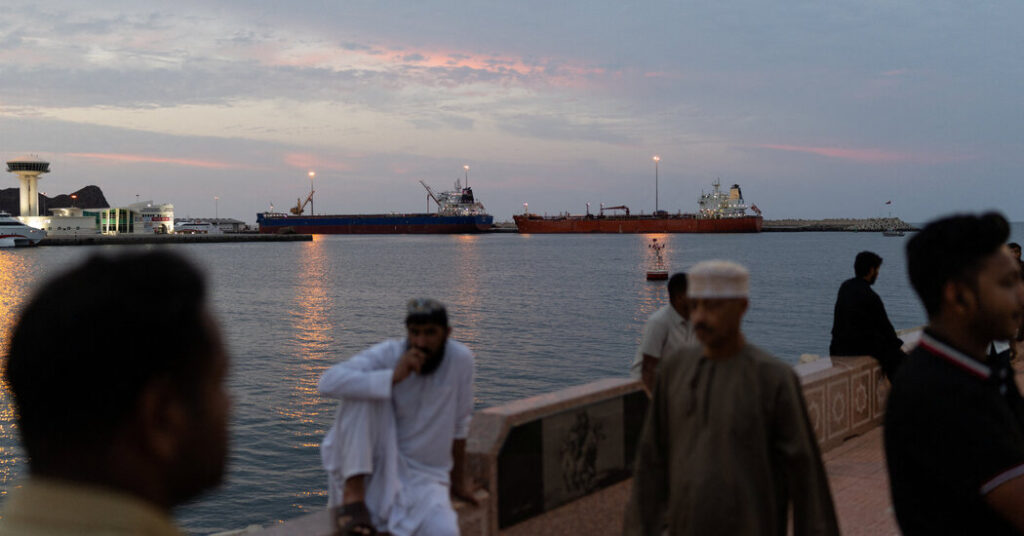
The United States said on Tuesday that no ships had made it through its blockade of vessels using Iran’s ports.
The announcement, from U.S. Central Command, came as ship tracking data showed that several Iran-linked vessels had traveled through the Strait of Hormuz after the blockade began on Monday, but that some of those vessels had stopped after emerging east of the strait, along Iran’s southern coast. That was a possible indication that U.S. forces were telling them not to proceed, shipping analysts said.
It was also unclear exactly when those ships had left port relative to the start of the blockade at roughly 10 a.m. Eastern time on Monday.
Central Command said on Tuesday that six merchant vessels had complied with directions by radio from U.S. forces to turn around and re-enter Iranian ports. It did not identify the ships or the ports.
In a separate notice, Central Command said the blockade would be enforced from the Gulf of Oman and the Arabian Sea, both east of the Strait of Hormuz, a crucial waterway through which over 120 ships transited daily before the war with Iran began at the end of February. That traffic carried a fifth of the world’s oil and gas.
A U.S. official, speaking on condition of anonymity to discuss operational matters, said that more than 12 American military vessels were stationed in international waters in the Gulf of Oman.
After the war began, Iran blocked nearly all commercial traffic through the strait by threatening and attacking vessels, causing a drastic reduction in the amount of oil and gas getting out to world markets. That has sharply increased the prices of gasoline, diesel and other energy products around the world, shaking economies and governments.
To help stabilize prices, the United States had not previously sought to block Iranian tankers, so Iranian oil continued to pass through the strait at a volume of crude similar to prewar levels. But now, the United States is seeking to stop that flow and remove the lifeline it provides to the Iranian economy.
Central Command also appears to be seeking to establish secure passage through the strait for non-Iranian ships, which have stayed away out of fear of attacks from Iran.
The U.S. official said on Tuesday that more than 20 commercial vessels not linked to Iran had transited the strait in the first 24 hours of the blockade, including tankers, cargo carriers and container ships. The official did not identify the vessels.
Shipping experts said they had not seen that level of traffic. Kpler, a maritime data firm, said that it had tracked six ships through the Strait of Hormuz on Monday. But some experts cautioned that other ships may have turned off their transponders, devices that allow enable tracking.
One commercial vessel under U.S. sanctions, the Chinese tanker Rich Starry, traveled eastward through the strait on Tuesday but then turned around. That suggested that the ship was responding to U.S. directives, according to Noam Raydan, a senior fellow at the Washington Institute for Near East Policy. “This can be linked to the blockade,” she said.
Another Iran-linked ship, the Elpis, also appeared to make it through the strait during the blockade. But Ms. Raydan said the vessel was offline on Tuesday, so it was not clear what its path had been.
Salvatore Mercogliano, a maritime historian and an associate professor at Campbell University in North Carolina, said that any Iran-linked vessels were probably reluctant to venture into the waters east of the strait because of the U.S. warships on patrol.
“They don’t want to come out,” he said.
Though Central Command said that neutral vessels would be allowed to traverse the strait, shipping companies said they had received no instruction from the U.S. military on how to make the journey.
Nils Haupt, a spokesman for the German shipping company Hapag-Lloyd, said on Tuesday that the company had not received any official communication from U.S. officials on how to ensure safe passage for its six vessels currently stranded in the Persian Gulf.
Instead, the company was relying on the news media for information, he said.
“We need to know: Is it safe?” Mr. Haupt asked. “Have all the mines been removed? Do we expect attacks from Iran? Will ships be accompanied?”
Jenny Gross contributed reporting.
Peter Eavis reports on the business of moving stuff around the world.
The post U.S. Blocks Iranian-Linked Ships From Sailing Through the Strait of Hormuz appeared first on New York Times.