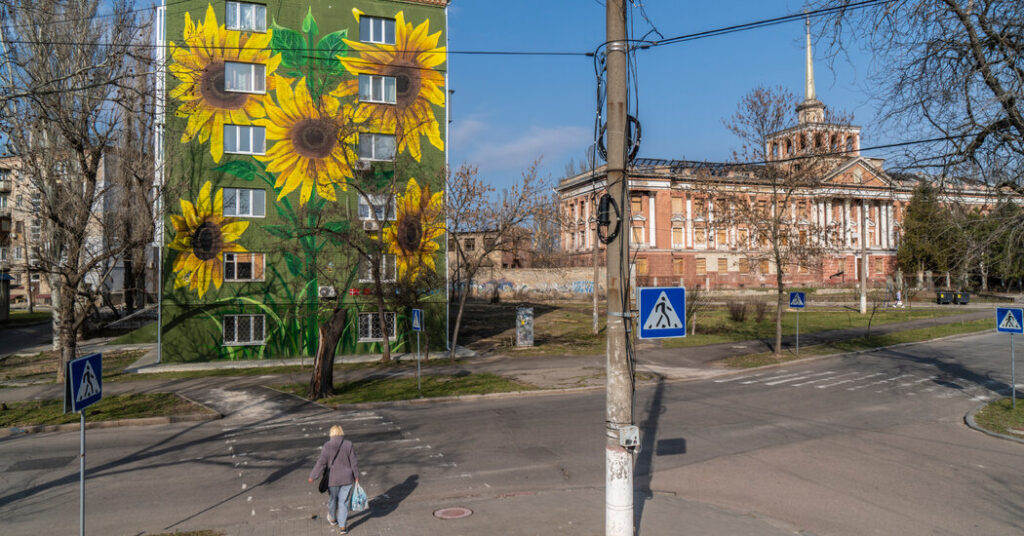
For a time, a city of half a million people on the plains in southern Ukraine wavered on the edge of uninhabitable.
Electricity blinked on and off. Orange, salty water sputtered from kitchen faucets. Out in the darkened, deserted streets, jagged ruins of bombed buildings appeared as omens of a grim future.
Then came an improbable twist. The city, Mykolaiv, was adopted by the Danish government a month into the war. Denmark has since directed 60 percent of all its Ukraine reconstruction aid to this one city, using it as a test bed for assistance policies that could be applied across the country.
The Danish project is a traditional country-to-country aid program that contrasts with a Trump administration plan that would focus on for-profit ventures in rebuilding Ukraine. Denmark’s work is aimed at mending both the physical landscape and the social fabric. And the city is now bouncing back.
“I don’t know why Denmark chose us, but it’s the best luck we ever had,” said Dmytro Tarasenko, an adviser to the regional governor.
Rebuilding war-damaged Ukraine is likely to become the largest reconstruction effort in Europe since the Marshall Plan after World War II. It will require hundreds of billions of dollars in aid and investment.
The Danish project began in March 2022 after President Volodymyr Zelensky asked the Danish Parliament to partner with Mykolaiv, a port on the Black Sea. By last year, Denmark had invested nearly $250 million in the city and the surrounding region.
Denmark’s effort, which is done in coordination with other international donors but is the dominant aid program in the city, involves a long list of construction, green energy, education, vocational training, demining and small-business development initiatives.
It focuses on engagement with local government, civil society groups and Ukrainian businesses, such as building contractors and farmers. All assistance is funneled through nonprofit groups such as the Danish Refugee Council and international agencies like the United Nations.
The Trump administration is taking a different tack in its proposal for Ukraine’s reconstruction. Called the Prosperity Plan, it foresees the formation of a multi-billion-dollar fund advised by a private-sector manager. Money could come from frozen Russian assets held in Europe, E.U. aid and commercial investment.
The proposal, according to a draft seen by a senior Western diplomat, suggests that the fund could attract more than $500 billion. For-profit aspects could include a “high growth” division that would invest in Ukrainian technology companies, data centers and artificial intelligence ventures, according to the draft.
Diplomats and Ukrainian officials say they appreciate the approach, which was drafted in part by BlackRock, the American asset management company, for reframing Ukraine as an economic opportunity and not merely a basket case in need of endless charity. The program is seen as opening Ukraine to American investment in mining, energy and data centers.
Denmark’s aid effort runs in parallel with Danish business interests in southern Ukraine, including in building wind farms and in shipping. But the program’s mandate does not include commercial promotion of Danish companies.
The regional governor, Vitaly Kim, argued that the two approaches to rebuilding could be complementary. He said in an interview that the charitable aid from Denmark and other countries had opened future opportunities for business in southern Ukraine. He said he had promoted the region to investors eyeing Ukraine’s military technology industry, the port and agricultural ventures.
“In the future, we will not ask for support but we will earn money together” with foreign investors, he said.
For now, Mykolaiv still relies on the generosity of the Danish government, and signs of its presence pop up on nearly every street.
On one newly restored building, a small Danish flag is painted on a corner of a wall. A few blocks away, a Danish flag flaps in the wind at an office complex. Denmark has opened a diplomatic outpost just off the city’s main square.
War damage is still easily spotted. Facades are chipped with shrapnel, and roofs are caved in from explosions.
When the Danish program started, Mykolaiv was in dire need.
Russian forces partially encircled the city in 2022, and that April they blew up a water main connecting the seaside community to its fresh water supply from the Dnipro River. That act of sabotage was perceived as an effort to force the civilian population to flee. Most did. For three months, the pipes were dry. The population dropped by more than half, to 180,000 people.
In desperation, the city authorities pumped saltwater from an estuary through the waterworks to at least provide water suitable for sanitation and washing. In doing so, they created one of the largest infrastructure breakdowns of the war, after the saltwater corroded hundreds of miles of pipes.
Rust flowed through them. What came from the tap “was salty, yellow and smelled like yesterday’s shrimp,” said a resident, Yurii Futerman. As the local water company pumped estuary water, crayfish could sometimes be found swirling in the intake pools at the city filtration plant.
Mr. Futerman resorted to hauling well water that his daughter, who was 6 when the troubles started, used for baths.
To persuade residents to return, the Danish government focused aid on the city’s water supply. But what began as an effort embraced in both Denmark and Ukraine hit a setback in 2023. A video popped up online showing the daughter of the director of the city water company driving a Mercedes while celebrating her birthday. She threw paper bills out of a rolled-down window as the car drove on a street in Odesa, another Black Sea port city.
The water company was not a direct recipient of aid, but its subcontractors were. Residents wondered whether local corruption was sending Danish aid money out the window.
The director died last fall, and his daughter has moved from Mykolaiv and could not be reached for comment. The deputy director, Viktor Pisotskyi, said in an interview that the Mercedes was borrowed for the birthday celebration and that the money fluttering about was fake.
Nonetheless, the episode prompted a review of the water company’s finances by Deloitte, the auditing agency, under the auspices of the European Union Anti-Corruption Initiative. The audit found no fraud but identified half a dozen areas for improving financial oversight.
Denmark took the episode in stride, and the aid continued. The Danish government paid for solar panels for schools and hospitals, to improve resilience during blackouts; built bomb shelters at schools; and sent demining teams into fields to allow farmers to return to work.
The Danish Foreign Ministry declined to comment on the aid program. The country held elections late last month, and the ministry said it was prohibited from making public announcements until a new government is seated.
After years of investments in filter stations and pipes, potable water is expected to be restored later this month.
Mykolaiv’s population has rebounded to 470,000, nearly its prewar level. One program that Denmark funded bought sailboats for children at a yacht club. Creating a healthy environment for children would encourage displaced people to return, the thinking went.
“It wasn’t just like snapping fingers,” Mr. Vashchylenko said. “The Danes went deep.”
Evelina Riabenko contributed reporting.
Andrew E. Kramer is the Kyiv bureau chief for The Times, who has been covering the war in Ukraine since 2014.
The post What Happened After Denmark Adopted a Ruined City in Ukraine appeared first on New York Times.