Donald Trump ascended to office 10 years ago while publicly jousting with Pope Francis, who was routinely making headlines for the progressive Catholicism he elevated, pushing the Roman Catholic Church to focus on climate change and the rights of immigrants. The pope suggested that Mr. Trump was “not Christian”; Mr. Trump fired back that Francis was “disgraceful.”
Mr. Trump capitalized on growing discontent among conservative Christians and won the White House. The chasm only further widened between the Vatican and conservative American Catholics, who often saw in Mr. Trump a champion.
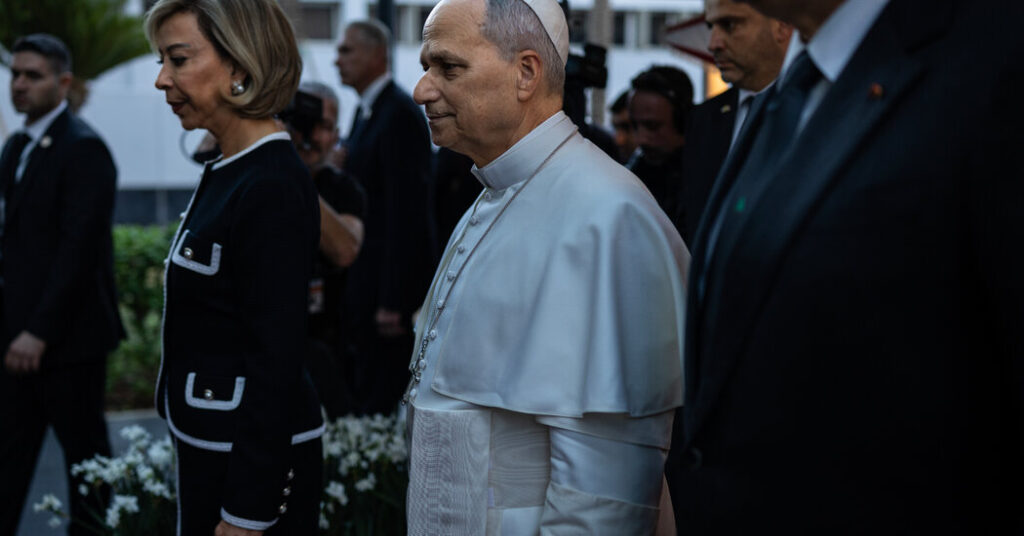
Pope Leo XIV, who was elected less than a year ago, is not Francis. For Mr. Trump, who is now in his second term, he presents a new foil at the Vatican with a markedly different standing among Catholics. As the first American in the seat of St. Peter, he has a native fluency in American politics and culture, and his leadership is supported across broad swaths of the American church.
This new dynamic was at play in a pointed exchange on Sunday night and Monday, when Mr. Trump unleashed a tirade on social media against Leo, who then stood his ground.
“I’m not sure this is ultimately going to be a positive fight for the president to wage,” said Matt Salisbury, whose firm provides strategic communications for many conservative Catholic clients.
He added that many of his Catholic friends in the Washington area who, like him, voted for Mr. Trump, including some who work in the administration, were “unanimously critical” of the president’s outburst.
Unlike his predecessor, Leo has growing support from conservative Catholics in pews across the United States. As the anniversary of his election approaches next month, he has so significantly rebuilt the Vatican’s relationship with the American Catholic right that many in Mr. Trump’s own camp rushed to the pope’s defense on Monday.
Interviews with conservatives attending Mass at Catholic parishes across the country revealed significant displeasure with the president for his harsh criticism of the pope, a dynamic hard to imagine not long ago.
Outside midday Mass at the Basilica of Our Lady of San Juan del Valle National Shrine in San Juan, Texas, not far from the border with Mexico, Rudy Gutiérrez, 68, said he had voted for Mr. Trump in each of the past three presidential elections. But the attack on the pope for speaking out against war in Iran amid the threat of escalating violence went too far, he said.
“As a Catholic, I take offense to that, and I am Republican,” Mr. Gutiérrez said.
At first, many conservative Catholics were wary of Leo’s election, worrying he might be a Francis protégé. But he quickly made it clear that he was gently returning the church to a more traditional path. He has chosen to live in the pope’s quarters of the Apostolic Palace and to renew an old practice of Pope John Paul II by carrying the cross through the Colosseum on Good Friday. He has focused on issues like artificial intelligence, a largely nonpartisan issue in the church, and has not antagonized conservatives over the Latin Mass.
When Pope Francis toured the United States in 2015, it was his first time in the country. Pope Leo, born Robert Prevost in Chicago, was elected last May after spending most of his career abroad in South America and then Rome.
“Where you’re from matters,” said Kathleen Sprows Cummings, a history professor who specializes in Catholicism at the University of Notre Dame. “He’s got friends, he’s got siblings in the United States. He understands American politics. He knows Republicans and Democrats.”
“That doesn’t mean that’s why he was elected, or he’s even approaching this as an American,” she said. “But he understands it and he would have been paying attention to Donald Trump in a way that Pope Francis wouldn’t have.”
Leo’s modest, calm style also shapes his approach to how he manages volatile American politics. Many conservative Catholics disliked Francis’ outspoken advocacy for the poor and migrants, which they viewed as coming at the expense of other priorities. Although Leo also speaks out for the poor and migrants, he is less dramatic in his speeches.
“He’s a very disciplined, reserved person, and that makes his criticism that much harder to dismiss,” said David Gibson, director of the Center on Religion and Culture at Fordham University. “This isn’t, ‘There goes Pope Francis again.’ You can’t say that about Leo. This is a person who thinks, who deliberates and says what he means.”
Leo is showing that Catholic teaching does not fit neatly into American political boxes, said Ashley McGuire, a senior fellow at the Catholic Association, a small nonprofit that promotes conservative causes.
“This continues to vex the president, who is treating him like a political adversary,” she said. “If anything, however, that he is American and still defying American political agendas is demonstrating all the more that the papacy is a spiritual, not a political, office.”
Leo has an 84 percent favorability rating among American Catholics, with overwhelmingly high support regardless of political party, according to a Pew Research Center survey from last year. Francis’ favorability rating was just as high the first year of his papacy, but by the time of his death it had dropped to 78 percent.
At Mass at St. Lawrence Catholic Church in Cincinnati, Ohio, on Monday, Fernanda Moreira said she voted for President Trump in 2016 and again in 2024, but now had strong concerns.
“It’s scary,” Ms. Moreira said. “I was for him very much, but I think he’s going in the wrong direction. It’s sad because he’s done so much that is good.”
Theresa Thien said she voted for Mr. Trump in 2016 because she was tired of career politicians, but after his first four years he lost her support. Now Ms. Thien believes that the president is in a “downward spiral.”
“What kind of leader preaches Christ and Christian behavior and threatens to annihilate a population?” asked Ms. Thien, a lifelong Catholic, referring to Mr. Trump’s recent comments about Iran. “Where people say ‘He’s the best’ or ‘He’s appointed by God,’ I don’t know — I have a hard time with that. He threatened the pope.”
At least one conservative Catholic — perhaps the most prominent one — did not seem to object to the president’s outburst.
Leo should “stick to matters of, you know, what’s going on in the Catholic Church,” Vice President JD Vance, who converted to Catholicism in 2019, said on Monday night on Fox News.
Reporting was contributed by Gabriel Cardenas from San Juan, Texas; Jonathan Higuera from Phoenix; Carrie Blackmore and Kevin Williams from Cincinnati; Elizabeth Stawicki from Minneapolis; and Maya King from New York.
Elizabeth Dias is The Times’s national religion correspondent, covering faith, politics and values.
The post In Leo, Trump Faces a Different Kind of Papal Opponent appeared first on New York Times.