“The devil,” William Shakespeare wrote in The Merchant of Venice, “can cite Scripture for his purpose.” As we’ve seen in recent weeks, so can Pete Hegseth.
Late last month, during the first Christian worship service at the Pentagon since the Iran war began, the secretary of defense cast the conflict as essentially religious and spiritual in nature. The focus of his remarks was less the righteousness of our side of the war than the necessity of mercilessly inflicting vengeance and pain on the other.
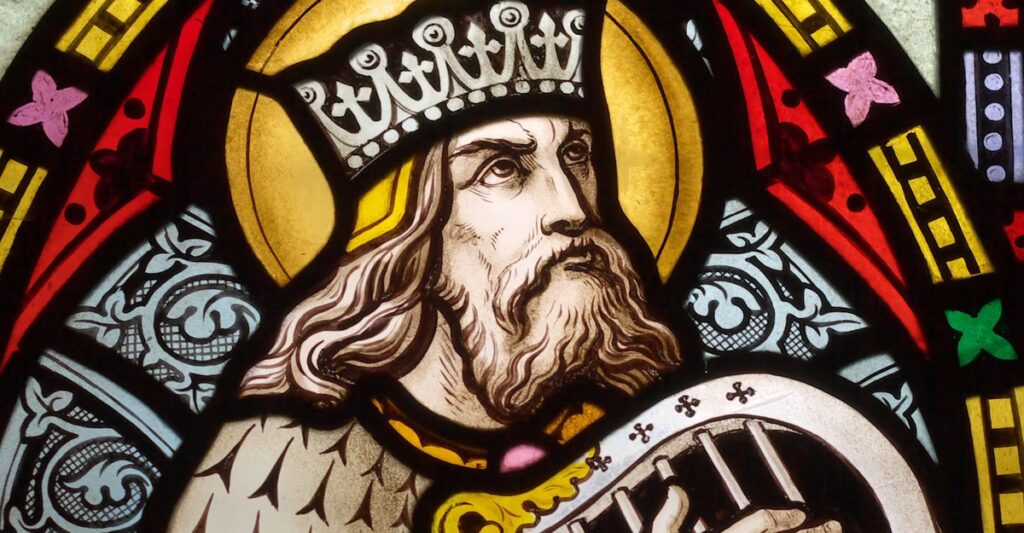
Hegseth invoked Psalm 18, in which King David says he did not turn back until his enemies were “consumed.” His enemies “cried for help, but there was none to save them.” Hegseth read passages in which David exults that he “beat them fine as dust before the wind” and “cast them out like the mire of the streets.”
Hegseth also read a prayer composed by a chaplain—relying on imprecatory psalms, including 35, 58, and 144—requesting God’s “overwhelming violence of action against those who deserve no mercy.” Hegseth prayed that “every round find its mark against the enemies of righteousness.” He requested that God “break the teeth of the ungodly.” By “the blast of your anger,” he said, God would “let the evil perish.” The Almighty should “pour out your wrath against those who plot vain things and blow them away like chaff before the wind.” Hegseth beseeched God to act so “evil may be driven back and wicked souls be delivered to the eternal damnation prepared for them.”
The man who refers to himself as the secretary of war concluded his prayer with “we ask these things with bold confidence in the mighty and powerful name of Jesus Christ, king over all kings, and amen. Amen.”
To be clear, then: Secretary of Defense Hegseth is praying for “overwhelming violence” and “no mercy” in the “powerful name of Jesus Christ,” the Prince of Peace.
As Ronit Stahl, a historian of the military chaplaincy, told Greg Sargent of The New Republic, “It’s highly unusual for high-ranking officers or civilian military leaders to relish killing and violence in God’s name as a religious duty.”
But Hegseth is different. Last month, Hegseth said that the United States would give “no quarter, no mercy for our enemies,” which would constitute a war crime under both international law and U.S. military codes. Pentagon offices designed to prevent civilian harm during combat operations are being dismantled. And in Donald Trump’s first term, Hegseth lobbied the president for pardons for three members of the military who were facing charges related to, or had been convicted of, war crimes. He defended Blackwater contractors convicted of murdering Iraqi civilians. He appears to relish the ability to inflict destruction and death.
Trump, for his part, has threatened to bomb Iran’s power plants, desalination stations, oil wells, roads, bridges, and other infrastructure. Last week, he threatened to send the Iranians “back to the Stone Ages, where they belong.” On Easter weekend, he wrote that unless the Iranians open the Strait of Hormuz, “all Hell will reign down on them. All glory to God.” And in the most crazed statement of his crazed presidency, Trump wrote on Easter morning, “Tuesday will be Power Plant Day, and Bridge Day, all wrapped up in one, in Iran. There will be nothing like it!!! Open the Fuckin’ Strait, you crazy bastards, or you’ll be living in Hell—JUST WATCH. Praise be to Allah.”
[Missy Ryan: Pete Hegseth delights in violence]
The day after Easter, Trump intensified his threats to devastate Iranian bridges and power plants if Iran’s leaders didn’t agree to a cease-fire. “Every power plant in Iran will be out of business, burning, exploding and never to be used again,” the president warned. He dismissed any concerns that such actions might constitute war crimes. “Not at all,” Trump said. The following day, the president of the United States wrote on social media, “A whole civilization will die tonight, never to be brought back again.”
In the end, Trump pulled back; a whole civilization did not die on Tuesday night. But no one can doubt Trump’s genuine indifference to the norms and laws of armed conflict that, however imperfectly, aim to restrain the worst abuses. When asked earlier this year if there are any limits on his global powers, he answered, “Yeah, there is one thing. My own morality. My own mind. It’s the only thing that can stop me.”
Hegseth has given us a lot to untangle theologically. Take his use of imprecatory psalms, which call on God to rain down calamity and destruction upon his enemies. Imprecatory psalms are emotional laments, in the voice of the desperate and the powerless—and they sound very different when recited by those in charge of the most awesome military force in history. In imprecatory psalms, it is God, not humans, being asked to execute judgment. These psalms generally express a deep yearning for justice, with vengeance placed in the hands of the Lord, freeing us of the consuming need to seek revenge ourselves.
Psalm 18 is not an imprecatory psalm. In it, David narrates his own story, telling of the destruction of his enemies and crediting God for making it possible. Hegseth’s invocation of Psalm 18 sends the message that military action is an expression of divine will, and that the attack on Iran constitutes a holy war.
The Trump administration’s invocation of scripture and allusions to the total annihilation of the enemy add yet another layer. Hegseth and Trump and their supporters, particularly the fundamentalist and evangelical Christians among them, want theological cover for targeting Iran’s power supply, which might result in mass civilian death. Hospital equipment would stop working, water purification would cease, sewage systems and food refrigeration would fail. The food supply chain would be disrupted. Urban areas might become unlivable, forcing millions to flee.
Trump hasn’t yet done those things, and perhaps he never will. But the president and his secretary of defense are already justifying such acts, just in case they decide to go down this path. They want to signal to the world, and perhaps reassure themselves, that God is on their side. That killing civilians is not just acceptable but an act of righteous obedience.
Some bells can’t be unrung.
Tucked away in this debate is a complicated interpretive dispute. Some adherents of the Christian faith believe, as many of the early church fathers did, that biblical accounts of divine violence—especially accounts of God commanding the Israelites to kill entire populations—are not literal but allegorical, representing the soul’s battle against sin. Figures like Origen argued that embracing a literal understanding of texts such as 1 Samuel 15:3, in which God commands that his people utterly destroy “man and woman, infant and nursing child, ox and sheep, camel and donkey,” would attribute monstrous qualities to God, a moral impossibility. A good rule of thumb, they would say, is that if you find yourself ascribing to God actions that are repellant and horrifying when done by humans, something is amiss.
[Peter Wehner: Pete Hegseth’s moral unseriousness]
Others, like Paul Copan, the author of Is God a Moral Monster?, believe that the language of herem—a Hebrew term for a ban, in this case meaning total destruction, or wholesale slaughter—was typical of the hyperbole found in the ancient Near East. What’s being described is a military conflict, he would say, but one sanctioned by God. The specific words in the Bible, however, reflect the military bravado employed by writers of the Hebrew scriptures. They are not to be taken literally.
The philosopher Nicholas Wolterstorff offers a contemporary example that helps illustrate this point: If a high-school-basketball player says that his team “slaughtered” its opponents, he doesn’t literally mean what he says, and he doesn’t assume that anyone would take him to be literal. He’s simply saying that his team dominated the game. Advocates of this interpretive approach point out that in the Book of Joshua, peoples who were said to have been “utterly destroyed” reappear. So, they argue, the language was either intentionally hyperbolic or the accounts false.
A third group of scholars that includes Peter Enns, a professor of biblical studies at Eastern University, believes that the portrayal of God as an advocate for total annihilation is what you’d expect from a tribal people describing God in their tribal ways. As Enns has written, “God never told the Israelites to kill the Canaanites. The Israelites believed that God told them to kill the Canaanites.”
In a blog post published last year, Enns makes what he considers to be the more important point: “The word of God as a two-edged sword is supposed to be turned inward, piercing us, not everyone around us.” He adds, “The Bible is not a weapon, a sword to be wielded against modern-day Canaanites or Babylonians. It is a book where we meet God. It brings hope, encouragement, knowledge, and deep truth for those willing to risk, and to ‘die’ to themselves, as Jesus puts it, to accept the challenge of scripture, knowing they will be undone in the process.”
Rowan Williams, the former archbishop of Canterbury, says that the Bible is “the accumulation of what you might call the interaction of God with a succession of human societies.” The biblical scholar John Barton refers to the Bible as a “dialogue among authors.” The authors say different things at different times, including about God. The Bible is a book—a library of books, really—that contains, and is meant to contain, different and at times competing theologies. The Bible preserves disagreements, and it’s no less sacred for doing so. (Among the competing accounts of this subject within scripture are 2 Kings and Hosea, which present contrasting perspectives on Jehu’s massacre of the House of Ahab, and the differences in attitude toward the Ninevites in Jonah, where we see expansive mercy, and Nahum, where we see wrath.)
Still others, like Tremper Longman III, a scholar of the Jewish Bible, accept the full historicity and divine authorization of the herem commands. Longman believes that God ordered the wholesale slaughter not just of opposing armies but of entire populations, including women, children, and infants. But, he argues, the circumstances were unique, the product of a particular historical moment, and not to be replicated. To do so would be to undo the work of Jesus. Longman relies on what he calls “spiritual continuity.” What he means by that is “the war against the Canaanites was simply an earlier phase of the battle that comes to its climax on the cross and its completion at the final judgment. The object of warfare moves from the Canaanites, who are the object of God’s wrath for their sin, to the spiritual powers and principalities, and then finally to the utter destruction of all evil, human and spiritual.”
None of these scholars, despite their other disagreements, sees holy war as normative. That should be especially obvious to those who claim to follow Jesus, who told them to “love your enemies and pray for those who persecute you, that you may be children of your Father in heaven.” The Sermon on the Mount is a repudiation of the conquest ethic.
When Peter drew his sword at the Garden of Gethsemane, during the night of Jesus’s arrest, Jesus told him, “Put your sword back in its place, for all who draw the sword will die by the sword.” Jesus affirmed a shocking thing: The kingdom he was inaugurating is not advanced by the sword. Yet Hegseth prayed that “every round would find its mark.”
Virtually all of the individuals within the various interpretive camps in Christianity I’ve discussed above would contend that it is a serious misreading of scripture to argue that imprecatory psalms and conquest accounts in books like Deuteronomy, Joshua, and 1 Samuel are endorsements of the wholesale slaughter of innocents today.
And that’s not all. Almost all rabbinical scholars—whether they affirm the historicity of the conquest accounts or not—emphatically agree that the rules of the warfare the scripture describes no longer apply. Among other things, Jewish scholars point out, the specific peoples against whom herem was commanded no longer exist as identifiable groups. That door has been bolted shut. “There is a category of milchemet mitzvah, which is a commanded war of self-defense,” Michael Holzman, the rabbi of the Northern Virginia Hebrew Congregation, told me. “But wars of annihilation no longer exist.”
Serious and thoughtful people have argued over these issues, which have bedeviled Christians and Jews for millennia. But Hegseth, Trump, and many of their fundamentalist and evangelical followers seem less interested in textual interpretation than in seeking scriptural validation for their bloodlust. They seem determined to find texts within the Bible to justify their dark passions, their emotional and psychological predilections. They believe what they believe quite apart from the Bible; its utility is to affirm what they already intend to do. Hegseth and his merry band of holy warriors aren’t interested in being on the side of God so much as they are insistent that God is on their side.
This is a constant temptation, and giving in to it almost always ends badly.
On an individual level, there’s something quite sad about people whose lives are fueled by hate and vengeance, who seem perennially unsettled, and for whom inner peace and calm contentment seem always out of reach. They are at war with the world and at war with themselves.
When these individuals assume positions of power, however—when they are able to inflict suffering on others, particularly on a mass scale; when their pathologies become society-wide and find a haven within the highest reaches of government—sympathy should give way not just to concern but to outrage.
One thing I’ve come to see, more clearly than I once did, is that understanding sacred texts does not depend solely on knowledge of the text. At least as important, and perhaps a good deal more important, are the sensibilities and temperament—the wisdom—that readers bring to the text.
In fundamentalist and evangelical circles in particular, enormous emphasis is put on reading scripture and memorizing Bible verses. That can be a blessing, of course. Christians and Jews believe that the books comprising their canon are holy. They bear witness to God—the Word behind the words—and reveal what it means to live rightly before God. In times of trial and grief, the words of the Bible can be healing. They can provide hope and grace in the journey.
But it’s also true that in the wrong hands, Bible verses can become decontextualized, or be used to sanctify preexisting biases. Scripture has on far too many occasions been used to deny scientific truths (evolution and the age of the Earth) and to advance immoral ends (slavery, segregation). People frequently use the Bible to wound others under the guise of speaking “truth in love.” Many of the greatest crimes in Christian history were committed by people who knew their Bible exceedingly well.
The Bible said it, I believe it, and that settles it is an approach to hermeneutics that can lead people astray. It rests on two mistaken presumptions: that the Bible is easy to interpret, and that our own interpretations of the Bible are inerrant. Neither is true.
The latest debate about holy war is a reminder that moral dispositions and discernment are among the most important interpretive tools Christians have. The apostle Paul seemed to hint at this when he said, in 1 Corinthians 13, that you can have all knowledge, you can fathom all mysteries, you can have faith that moves mountains, but without love, you are nothing. Those who relish mercilessness and see themselves as agents of God’s wrath are nothing.
The post Hegseth’s Unholy War appeared first on The Atlantic.