Health authorities in New York State are racing to devise strategies to blunt a new federal law that will restrict access to government health insurance programs, including Medicaid, that cover more than half of New York City’s residents.
To keep as many New Yorkers as possible from being cut from the Medicaid rolls next year, state and city officials are looking for ways to prove that patients are afflicted with addictions or are medically frail, conditions that would exempt them from the new restrictions. And they are considering how to sign people up for volunteer work — such as helping other New Yorkers navigate Medicaid’s new rules — which could satisfy the law’s work requirements.
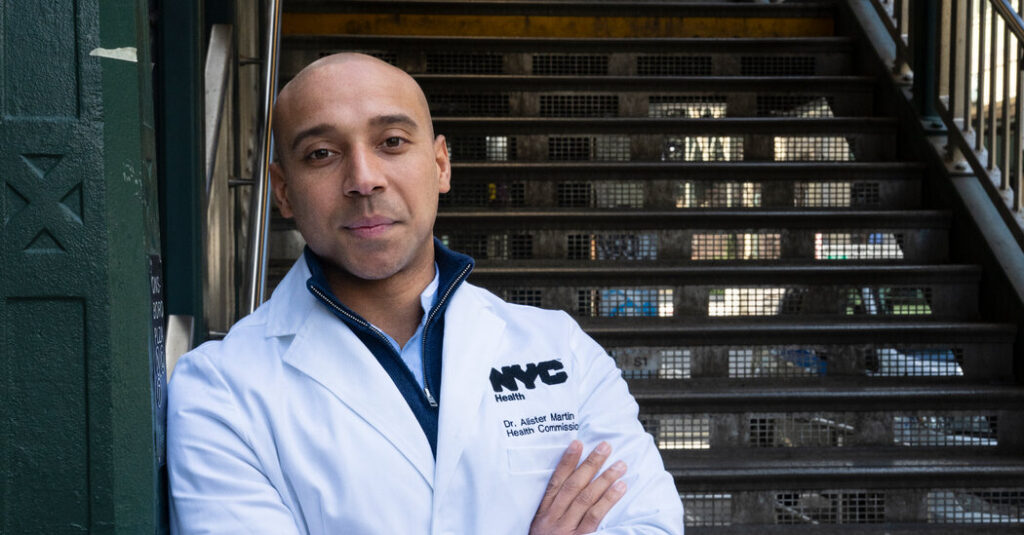
“We’re getting very creative,” Dr. Alister Martin, the city’s new health commissioner, said in a recent interview.
When President Trump’s signature domestic policy bill passed last year, state health officials feared that perhaps 1.5 million people in New York might lose health coverage. Those predictions have grown somewhat less dire as officials have come up with possible methods for keeping people insured and exempting them from the new work requirements. Those requirements and other restrictions are expected to start next year.
Under the president’s bill, many adults on Medicaid will be required to work at least 80 hours a month to keep their insurance, unless they are in school, pregnant or raising children younger than 14, or if they qualify for another exemption. The rules are intended to push more people into the work force and reduce what Republicans have characterized as waste and fraud in government programs. The regulations were introduced to help pay for the Trump administration’s tax cuts.
States must now verify twice a year that many Medicaid recipient remain eligible, a requirement that is expected to result in many people losing coverage periodically, especially if their work hours vary or they move between jobs, or have difficulty navigating the paperwork requirements.
Since 2010, when the Affordable Care Act was passed, the number of uninsured Americans has dropped substantially. In New York State, the share of adults and children without health insurance dropped from about 12 percent to 5 percent. Now, that number is expected to rise again.
The question is by how much.
“This is truly a seismic shift in Medicaid policy, the largest in the history of the program,” Amir Bassiri, the state Medicaid director, said at a panel discussion hosted last month by the United Hospital Fund, a nonprofit.
Chris Pope, a health care analyst at the Manhattan Institute, a conservative think tank, said that he expected many states — especially those with Democratic leaders who wanted to expand the social safety net — to try to blunt the law by searching for exemptions. State officials have a substantial incentive for doing so: The federal government pays 90 percent of the health coverage costs for some Medicaid recipients, with the states paying the remainder.
“My assessment of the work requirements is there is the greatest possible incentive for states to find every possible loophole,” Mr. Pope said. “A blue state like New York, I think they’re going to be looking to implement it in the loosest possible way.”
Dr. Martin said that the effort to keep New Yorkers on Medicaid — which has not previously been reported — felt particularly urgent to him, like one of those sci-fi movies in which scientists had to save everyone on Earth from an approaching asteroid.
Still, some health care analysts expressed concern that not enough was being done, given that key provisions of the domestic policy bill were going into effect over the next year.
“I’m not seeing the kind of public planning process to reassure me they are ready or that they’re going to be ready,” said Bill Hammond, a health care policy analyst at the Empire Center for Public Policy, a think tank in Albany, N.Y.
The federal Centers for Medicare and Medicaid Services said in a statement that states would be “required to implement these provisions in accordance with the law, and C.M.S. will issue guidance to ensure exemptions are applied appropriately and that eligible beneficiaries are protected.”
To reduce the number of people stymied by paperwork and red tape, New York State has been working to automatically certify residents who are already fulfilling the requirements, by accessing information not only from state databases but from payroll providers.
Elisabeth Benjamin, vice president of health initiatives at the Community Service Society, a nonprofit that supports anti-poverty policies, said that officials were confronting considerable challenges in their effort to prepare for the Medicaid changes.
“They’re doing the best they can to figure out what they can automate, but people are still going to lose coverage — a lot of people,” Ms. Benjamin said. “Many of those people are already working, but proving it will be hard.”
She predicted that agricultural laborers upstate and employees in industries with high turnover, intermittent hours or off-the-books payments — such as kitchen and construction workers — could be especially prone to losing their health insurance.
The Congressional Budget Office had estimated that 4.8 million people in the United States might eventually lose Medicaid coverage because they cannot meet the work requirements, while others will lose their insurance because of administrative hurdles or difficulty providing the necessary documentation.
In New York, health officials said that if people lost Medicaid coverage, they would forgo health care, leading to needless suffering.
Roughly 60 percent of New Yorkers on Medicaid will probably qualify for exemptions from the new work requirements, which will go into effect next January, according to a presentation that the State Department of Heath shared at the panel discussion.
People with a substance use disorder, for instance, are exempt from the work requirements under the new law. So health officials have been thinking about how to get people’s addictions properly certified and documented.
It’s possible that even addictions diagnosed or treated long ago might qualify, even if they “may seem too old,” Mr. Bassiri, the state Medicaid official, said recently. He said that his department was waiting for further guidance from the federal government. “We’re waiting to get a sense of the fine print on the regulations as to how far back things can apply,” he said.
The new federal law also exempts Medicaid recipients who are deemed “medically frail” — a vague description that physicians can interpret widely, said Dr. Martin, the New York City health commissioner.
“The medical frailty exemption is kind of squishy,” he said, explaining that the city’s Department of Health and Mental Hygiene was considering how to create a standardized and easy process for physicians to certify patients under this exemption.
“We’re looking at what are the tools and levers we can create to make it easy for physicians to really quickly write almost a form letter by clicking a button,” Dr. Martin said.
Dr. Martin’s résumé appears to make him well suited to tackle the problem. An emergency room physician, he once ran voter registration drives for patients while they waited for care. The registration form, once filled out, served as a proof of address, allowing patients to access a range of social services.
Keeping as many New Yorkers insured as possible could prove to be the main challenge of Dr. Martin’s tenure.
“This is why I’m here,” he said in a recent interview, after meeting with colleagues at a city health department clinic in Downtown Brooklyn.
For those who did not otherwise qualify for exemptions from the work requirements, Dr. Martin said he planned to partner with city officials to offer options for community service — which can satisfy the requirements, even if unpaid.
Dr. Martin has also begun thinking about how to mobilize underemployed New Yorkers to volunteer with the health department or public hospital system, as a way to keep their health insurance.
“What if the volunteering that they were doing was helping other New Yorkers stay covered on Medicaid?” he said.
Mr. Pope, the analyst at the Manhattan Institute, said he expected the provision that allowed “community service” or a “work program” in place of employment to emerge as “the biggest loophole.” He predicted that the federal government would struggle to police that.
The rule requiring 80 hours of work a month might prove flexible. That requirement, according to state health officials, is based on the federal minimum wage of $7.25 an hour, meaning someone would have to earn about $580 a month to qualify.
Health officials said that because the minimum hourly wage in New York State was more than twice that, the requirement could be satisfied with far fewer hours of work a month.
The officials also pointed out that an entire borough might be spared from the work requirement, because the law exempts residents in counties with unemployment rates of 8 percent or above. The unemployment rate in the Bronx was above 7 percent late last year.
It remains unclear exactly how many New Yorkers will lose federally subsidized health insurance under the new law. Officials have said that the state plans to cover some people who lose federally subsidized insurance. Still, public health experts expect the ranks of the uninsured to rise. “We’re not going to be able to exempt our way out of that,” Dr. Martin said.
Joseph Goldstein covers health care in New York for The Times, following years of criminal justice and police reporting.
The post Trump and New York Are in a Tug of War Over Medicaid Coverage appeared first on New York Times.