NASA’s Orion spacecraft, which is expected to splash down in the Pacific Ocean later today after careening around the Moon, isn’t exactly roomy on the inside — the capsule, which has been hosting a crew of four astronauts for the last ten days, measures a mere 16.5 feet across and has a habitable space of just 330 cubic feet.
Despite the severe spatial limitations, scientists at NASA came up with an ingenious contraption to keep the crew fit and healthy, a critical part of prolonged space travel. Researchers have long found that microgravity can result in muscle atrophy and bone loss in the long term, something that can largely be remedied with exercise.
To meet the requirements and limitations of its latest Moon mission, NASA came up with a specialized piece of exercise equipment that consists of a familiar-looking handle — the kind you’d see attached to a pulley cable or rowing machine at the gym — attached to a flywheel. The astronauts strap their feet on either side of the machine and pull.
However, that description would be underselling its versatility. As crew member and Canadian Space Agency astronaut Jeremy Hansen demonstrated in a video last year, it can be used for an astonishing variety of exercises and simulate resistance up to 400 pounds.
“Like a cardiovascular workout where you row at a lower resistance and a fast pace,” he said. “But we can also change the dynamics of this device so that we can do weightlifting with it,” such as squats, deadlifts, curls, and high pulls.
Best of all, it’s barely larger than a large shoe box, and the flywheel itself weighs only 30 pounds, adding little heft.
According to NASA documentation, the idea was to have each crew member use the device for a total of 30 minutes per day. A diagram shows how the astronaut juts their body into the center of the habitable space, maximizing use of the cramped environment.
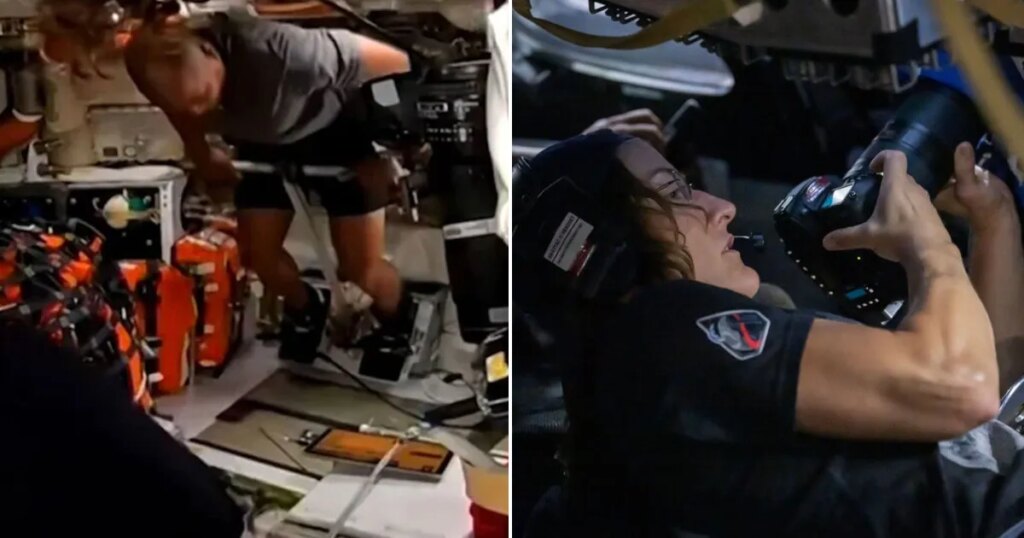
Video footage taken inside the spacecraft two days into the Artemis 2 mission shows mission specialist and NASA astronaut Victor Glover using the machine during his daily allotted time, while Hansen prepares lunch.
To be fair, the astronauts had been training hard long before they launched. A photo shared by the agency dating back to last summer that shows Moon astronaut Christina Koch training for the mission back on Earth shows her with some serious muscle definition — likely linked to her hobbies of surfing, rock and ice climbing, triathlons, yoga and backpacking.
“Holy s***, [Koch] drop your arm routine,” one user tweeted in awe.
It may sound like a trivial part of a space exploration mission to the Moon, but stressing the body in a microgravity environment is far more important than one might think.
As Memorial Sloan Kettering Cancer Center exercise physiologist Jessica Scott, who worked on early prototypes of the machine for NASA, told NPR, ten days in space without exercise is roughly the equivalent of lying in bed for ten days.
“You would feel very weak, and your muscles start to lose size very quickly,” she said.
In experiments involving participants lying in bed for days at a time, they found that adding an exercise routine using the flywheel made a substantial difference.
“What was really exciting was that the small device could prevent the declines, the same amount that a full gym could do,” Scott told NPR.
More on the mission: NASA Scientists Screamed With Delight When They Saw Something Smashing Into the Moon
The post The Moon Astronauts Have Been Working Out With a NASA Rowing Machine in Space appeared first on Futurism.