I grew up in a conservative movement that thought it had gotten the better of its worst ideological impulses.
True, there were the usual Father Coughlin throwbacks, people like Pat Buchanan, who were against free trade, sympathetic to Vladimir Putin, down on the Jews and inveterately hostile to immigration, legal or otherwise. There were outright bigots and conspiracy theorists and militia types and their assorted followers, avid or furtive. And there was an outsize share of moralizing hypocrites, inevitable among people too fond of speaking in the name of religion and character.
But that wasn’t the conservatism of the Bushes or John McCain or Mitt Romney, pragmatic men who, whether you agreed with them or not, operated on the center-right side of the liberal-democratic tradition. They were the conscience of the Republican Party, maintaining its decency by occasionally calling out the bad guys on their own side.
That was until the moment the G.O.P. chose to delete its conscience by becoming the party of Donald Trump. A similar moment may soon be upon Democrats if they aren’t careful.
Barring a political miracle, the party will next year have a new member of Congress, Darializa Avila Chevalier, who, the day after the worst massacre of Jews since the Holocaust, celebrated the event in Times Square. Another probable future representative, Claire Valdez, vowed on July 4 to “fight for liberation from Palestine to Puerto Rico.” A would-be U.S. senator, the Michigan Democrat Abdul El-Sayed, offered an alternative take on Michelle Obama’s famous line about going high when your opponent goes low: “When they go low, we don’t go high,” he said. “We take them to the mud and choke them out.” (El-Sayed is a doctor.) In Wisconsin, a democratic socialist, Francesca Hong, is the polling favorite in the race for the Democratic nominee for governor; in 2021 she said that “police exist to uphold white supremacy” and should be abolished; more recently, she has said her “perfect world would be a world without prisons.”
Against this tide, the position of many mainstream Democrats is to dodge the ideological fight with the left while warning that, outside of deep-blue districts like those in New York City, democratic socialism is an electoral loser that only provides Trump with political ammunition. In Michigan, Haley Stevens, El-Sayed’s opponent in the Democratic primary, is campaigning on the argument that “no one wants Abdul to win more than the Republicans” — that is, that Republicans see him as the more beatable opponent come November.
I remember the same case being made by mainstream conservatives against Trump when he was running in 2016: A vote for him in the Republican primary, so the argument went, was tantamount to a vote for Hillary Clinton in the general election. Then he won.
What mainstream Republicans like me missed then is what I fear mainstream Democrats miss now: that ideas older voters know have long been discredited (“America first” among conservatives; socialism among progressives) can seem fresh and appealing to younger voters; that even middle-of-the-road voters still often prefer the most extreme or uncouth candidate on their side to the most moderate candidate on the other; and that policy positions ultimately count for less than sheer charisma, the aura of being a “fighter,” even if you accomplish little of substance.
All this is especially true when the more ideologically extreme candidates are energetic, unstuffy, authentic, and able to stir up an audience. Zohran Mamdani, the New York mayor, is emblematic of the type; so was Graham Platner, the Maine Democrat, at least until allegations about his past behavior finally caught up with him.
What all this means for mainstream Democrats is that they resemble a national army under attack from an insurgency: They offer order and predictability when they need to be shocking and surprising; they seek to win by delivering incremental victories while their guerrilla opponents promise political transcendence. Unless something changes, those dynamics tend to set the army up for disaster.
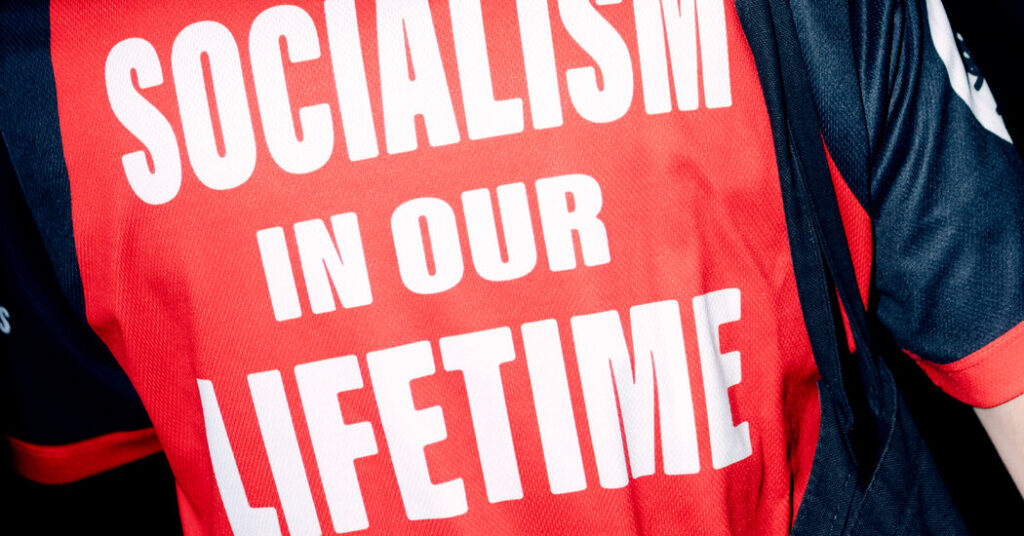
What could change the dynamics? It would help if a Democratic leader stood up to make the case that democratic socialists are neither liberals nor progressives, at least in any honest sense of those words. They are atavists, blasts from a discredited and discarded past.
Socialism as a political program was born in the 19th century and died in the 20th (including in Sweden). Democracy requires a clearly defined citizenry, an idea that becomes meaningless if a country pursues a lax or open-border policy of the kind advocated by democratic socialists. The brainstorms of the far left, like the billionaire surtax on the ballot in California, have failed repeatedly wherever they’ve been tried (including in France). And “justice for Palestine” surely can’t mean taking sides with the killers and rapists of Hamas while insisting that the only nation-state on earth with no right to exist is the Jewish one. The word for that is antisemitism, the politics of the double standard toward Jews, which is yet another terrible idea from a terrible past.
Is there a rising Democrat who will give this speech — the one that says that Democrats stand for freedom and fairness, not radicalism and self-righteousness; the one that never disdains tradition even if it seeks to improve it; the one that knows that utopianism is no substitute for pragmatism, and that purity is not superior to compromise?
That Democrat needs to stand up now, before his party gets swept away by the flood it vainly believes will soon recede.
The Times is committed to publishing a diversity of letters to the editor. We’d like to hear what you think about this or any of our articles. Here are some tips. And here’s our email: [email protected].
Follow the New York Times Opinion section on Facebook, Instagram, TikTok, Bluesky, WhatsApp and Threads.
The post Democratic Socialists Are on the Rise. We’ve Seen This Movie Before. appeared first on New York Times.