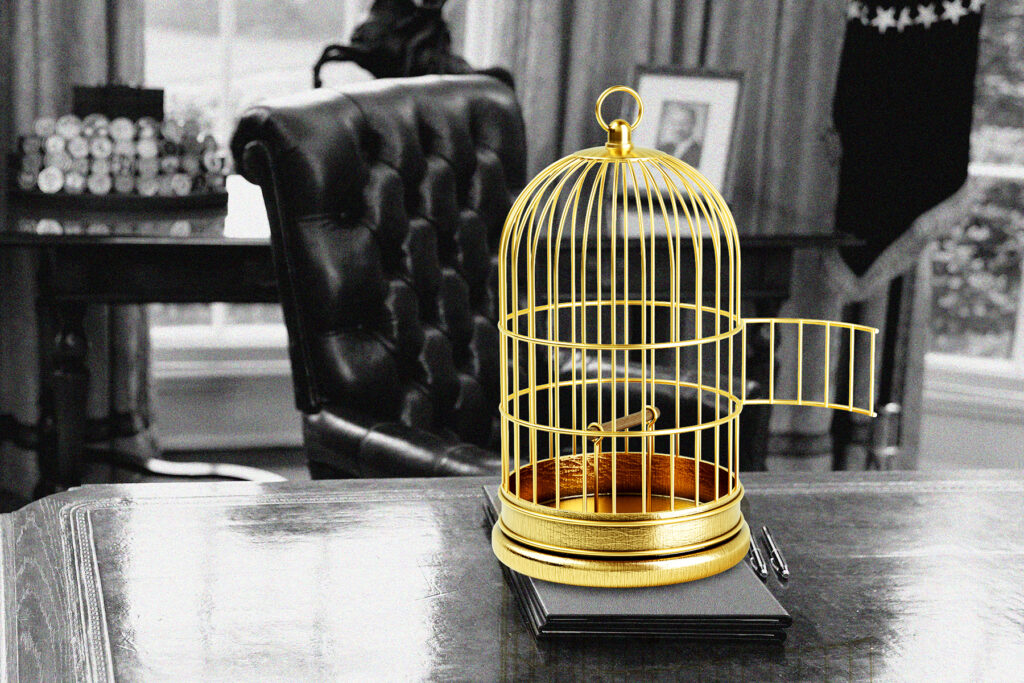
Yet another reason that Donald Trump’s and Joe Biden’s presidencies cannot be examined without wincing concerns a constitutional provision that is obscure until it is abused, which it now often is. The presidential “power to grant reprieves and pardons” has become yet another source of political brutishness fueling voters’ cynicism.
George Washington, conscious that he was constantly setting powerful precedents, meticulously wielded the awesome and unreviewable pardon power by consulting pertinent officials and listing reasons relating to the public interest. His amnesty — a mass pardon — for participants in the Whiskey Rebellion in western Pennsylvania promoted reconciliation.
The second and third presidents were less scrupulous. John Adams’s pardons of some Pennsylvania tax evaders might have been related to that state’s electoral votes in 1800. Thomas Jefferson pardoned several supporters who had been imprisoned under the Sedition Act, which he considered unconstitutional. Critics, however, saw him aiding rabid allies.
These instances of awkward political appearances were models of decorousness compared with what transpires today. Presidents, writes Saikrishna Bangalore Prakash, are embracing the “astounding potential of the pardon pen.” In his new book “The Presidential Pardon: The Short Clause with a Long, Troubled History,” Prakash, a University of Virginia law professor, says we have entered “pardon dystopia.”
Bill Clinton greased the downward slide. He pardoned his half brother (Secret Service code name: “Headache”), who then made a fortune lobbying his sibling, the president, to pardon, among others, a Gambino mob associate. As Hillary Clinton began seeking a U.S. Senate seat, her husband commuted the sentences of 16 members of a Puerto Rican group that had detonated more than a hundred bombs in the United States. He pardoned Marc Rich, a fugitive who owed $48 million in taxes. Rich’s ex-wife made a $450,000 contribution to Clinton’s presidential library, gave $100,000 to Hillary’s Senate campaign, and $1 million to the Democratic Party.
This was unseemly enough, but Prakash says, “Something has qualitatively changed over the past two presidencies.” Leaving office, Biden gave preemptive pardons to a slew of family members. Prakash: “For many years, Joseph Biden had been involved in a sordid business, where he was the product.” Family members charged for access to him. He gave preemptive pardons to two brothers, his sister and her husband, and a sister-in-law. Before the 2024 election, he said, regarding his egregiously corrupt son Hunter, “I will not pardon him.” After the election, he did.
In Trump’s first term, he pardoned his daughter’s father-in-law, who, for vengeance against his brother-in-law who had testified against him, hired a prostitute, filmed her encounter with the brother-in-law, and mailed the tape to his sister. Having, consecutively, the two seediest families in presidential history has besmirched the practice of pardoning.
Lobbying for pardons is now a more-than-cottage industry in Washington. One Trump pardon, Prakash says, might have saved the recipient, a fraudster, nearly half a billion dollars.
Campaigning in 1976, Jimmy Carter indicated that he might pardon Vietnam-era draft evaders. He did. In 2020, Prakash says, candidate Biden was “the first to promise a pardon explicitly,” courting young voters by vowing to “expunge” marijuana convictions. He did, on the eve of the 2022 midterm elections. Prakash believes this was the first pardon based on a president’s disapproval of a federal law. Another was Biden’s 2024 commutation of 37 death sentences.
In 2024, Trump pandered to his base by saying his first acts if reelected would include pardoning the Jan. 6 defendants he called “hostages.” This, like Biden’s actions regarding marijuana and capital punishment, was discordant with the presidential duty to “take care that the laws be faithfully executed.”
Welcome to what Prakash calls the “brave (and frightening) new world of policy pardons.” Prakash believes that such pardons amount to suspensions of laws — announcements of the chief executive’s refusal to honor, by enforcing, some statutes.
What can be done about grotesque use of the pardon power that, in Prakash’s understatement, “seems inconsistent with the general structure of checks and balances”? Not much. Submit potential pardon grants to the president’s Cabinet? You probably have seen — speaking of grotesque things — the toadyism of the current one. Presidents hoard power, so any president probably would oppose constitutional reforms, such as establishing an independent Clemency Commission, or empowering the Senate or House to disapprove of presidential clemencies.
So, the remedy for tawdry pardoning is not this or that institutional gambit. The only feasible solution is the election of presidents who are not louts. This, however, becomes less likely as voters are made ever more cynical by loutish pardons.
The post This abuse of presidential power is grotesque, loutish, unpardonable appeared first on Washington Post.