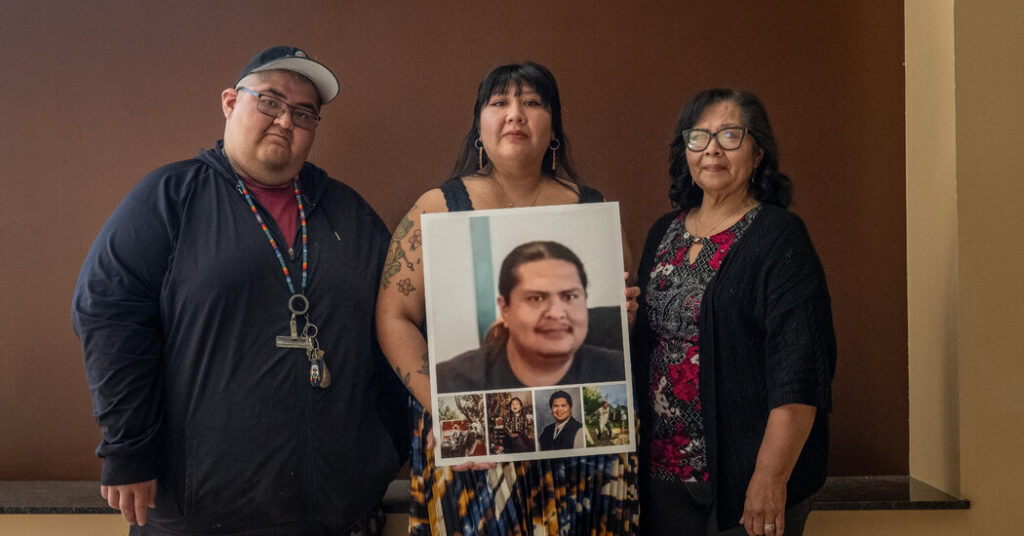
The last time Lorenzo Pahvitse-Rodriguez saw his therapist, in mid-December, unsettling changes were around the corner. The state of Idaho had embarked on a risky cost-cutting experiment, eliminating a set of Medicaid-funded services that were designed to deliver medical care to people with the most disabling mental illnesses.
Mr. Pahvitse-Rodriguez, a member of the Shoshone-Bannock Tribes, had stabilized in the program. At 45, he had begun taking long-acting medication for his schizophrenia, and talked about going back to school. He even felt strong enough to tackle a challenge that had daunted him for years: getting his teeth fixed.
Two weeks later, the therapist returned to Mr. Pahvitse-Rodriguez’s house and was shocked to find a funeral going on. Mr. Pahvitse-Rodriguez had gotten an infection after dental surgery. It turned into sepsis, but he ignored his family’s pleas to see a doctor, they said. The coroner’s report gave the cause of death as acute respiratory failure.
His was the first death, but not the last, among the Idahoans who lost access to the home visits and medical care the program provides.
In January, a 49-year-old man was found in his trailer in the city of Nampa. The same month, a 36-year-old man was found in the closet where he slept in the desert town of Arco. In February, a man in his 40s died at his home in Boise; providers said he was too paranoid to take medication to treat a chronic health condition.
The deaths so alarmed Idaho legislators that last week they took the unusual step of voting to restore funding for the program, known as assertive community treatment, or ACT.
In Idaho, unlike other parts of the country where battles are playing out over health care, it was Republican legislators who led the charge. They cited the four deaths, but also laid out a financial argument — that stripping services for severely mentally ill people will simply reroute them toward jails or emergency hospitalizations, which cost the state far more.
“They realized, well, that was a mistake,” said Sheriff Sam Hulse of Bonneville County, a Republican. “You started seeing deaths occurring in the community. We started seeing the numbers in the crisis system rise. The very thing we told them would happen was beginning to happen.”
Idaho’s experience may serve as a harbinger for other states poised to make deep cuts in Medicaid. The major domestic policy bill President Trump signed last summer enacted the largest Medicaid cuts in history, reducing federal funding by 15 percent, or $1 trillion, over a decade.
Idaho has found itself in a particular bind. A series of income tax cuts have reduced state revenue by $1.3 billion annually, but the state’s Constitution prohibits deficit spending. In August, Gov. Brad Little, a Republican, issued an executive order requiring each state agency to reduce spending by 3 percent, in part to “make way” for the president’s tax cuts.
With few options and little time, Magellan, the state’s Medicaid contractor, announced that it would eliminate ACT, which pays teams of providers to deliver intensive care to people with the most severe mental illnesses, often ensuring that they take antipsychotic medications.
ACT was developed in the 1970s, as half a million patients dispersed from state psychiatric hospitals into private homes in American neighborhoods. This set off a vast churning: Patients stopped taking medication and deteriorated; were arrested or institutionalized; stabilized; and then were released to begin the cycle again.
ACT, sometimes referred to as a “hospital without walls,” interrupted that cycle. It provided each client with a team of clinicians who were paid to make home visits and build relationships, sometimes delivering medications on a daily basis. Researchers have found this approach can reduce emergency hospitalizations by anywhere from 40 to 80 percent.
As the cutoff date approached, providers warned that the 226 people receiving the services in Idaho would deteriorate quickly, and some might die.
Laura Scuri, who headed the ACT program in Boise, recalled trying, for the first week or so, to keep tabs on the 57 clients her team was serving. But they were already vanishing into the populace, she said.
“As the days went by, we had less contact with them, and only formal contact,” said Ms. Scuri, co-owner of Access Behavioral Health Services. Their long-acting antipsychotic medications would wear off in late December, she warned, and the sickest of them would begin to unravel in January.
“I haven’t slept,” she said. “You worry. Every time the news comes on, you just sit there with your E.H.R. software open, hoping it’s not one of yours,” she added, referring to electronic health records. “When someone has a severe psychotic episode, they don’t always come all the way back.”
Cutting Them Loose
The fallout came faster than Ms. Scuri expected. On Dec. 18, Mr. Pahvitse-Rodriguez’s brother, who shared a house with him, began to worry. He was immobilized with a broken hip, so another brother ventured down to the basement — and found Mr. Pahvitse-Rodriguez on the floor, unresponsive.
He had been suffering an infection after a tooth extraction, but refused to see a doctor, said his mother, Lori Pahvitse. She said she believed his death could have been prevented if the ACT team had continued to send a nurse to visit him at home. “If somebody had been out there to check on him, they would have seen that he was really sick, and that he needed to see a doctor,” she said.
The family erected a tepee and tended a campfire for the four-day period that, in the Lemhi Shoshone tradition, allows the spirit to find its way to the next world.
Then, on Jan. 8, another grim discovery. Police knocked on the door of a trailer in Nampa, outside Boise, to check on Carl Adair. They found him curled on the floor, a cellphone in his hand, said his mother, Sue Johnson. A coroner reported his cause of death as bronchial pneumonia and sepsis, she said.
Mr. Adair, who was 49, had struggled to find a place for himself after serving prison time for a sex offense, but he had been on an upswing in the last year. The ACT team had transitioned him onto a long-acting injectable antipsychotic, delivered in a shot every three months, which had evened out his symptoms, Ms. Johnson said.
“Things just kept getting better,” said James Thorpe, a pastor who befriended him after spotting him at a restaurant, reading a Bible. “He could see his life was being restored. He had a home, he had a car, he had friends.”
Ms. Johnson, a retired medical assistant, said she was still baffled by her son’s death, which could have been prevented with intravenous antibiotics. Most likely, she has concluded, he dismissed it as a chest cold. “Why didn’t he know he was sick?” she said. “That’s what I don’t understand.”
A third death was discovered on Jan. 29, in a cold, squalid apartment in the desert town of Arco. Jesse Turnipseed, 36, was found that morning by his brother, John, wedged in a trash-choked closet where he liked to sleep. John, who slept next door, said that when he drifted off, his brother had been watching “Inuyasha,” one of his favorite anime series.
The Arco apartment, which they had found on Craigslist for $570 a month, was all they could afford, he said, and was so overrun with roaches and bedbugs that they saturated it with insecticide, which made it difficult to breathe. “What we needed was another place to live,” John said.
Tara Parsons, the Butte County coroner, said the cause of death was positional asphyxiation.
Thomas Tueller, whose counseling practice delivered services to Mr. Turnipseed, described Mr. Turnipseed’s death as “totally preventable.” The team had found a new apartment for the two brothers when the program was terminated, he said. The paperwork was done.
“If we would have had one more week, we probably could have gotten him moved, stabilized and on his way,” Mr. Tueller said. “We were so close.”
In February, word came of a fourth death, in a family home in Boise. The man’s family has not released a cause of death, but Ms. Scuri, whose team provided services to him, said he was in his 40s and managing chronic health conditions that required him to take medication.
When his delusions were not treated, though, he believed the government was trying to poison him, she said. “That was the belief,” she said. “The government made the yellow pill, so he wasn’t going to take the yellow pill.”
A Backlash in Boise
Legislators from eastern Idaho began protesting the termination of mental health services in January, as soon as the session reconvened. The cuts, they warned, would simply shift costs to jails and emergency rooms — and could endanger members of the public.
“These are people who if they’re not on their medications are very unstable,” Representative Ben Fuhriman, a Republican whose district includes Arco, told a state politics podcast.
“They might go to the park and hear voices and all of a sudden take a child because the voices told them to,” he added. “These are not far-fetched situations. Most of the time these people in the past would have been in institutions.”
At hearings, Mr. Fuhriman and several colleagues argued that the program, which cost the state around $4 million annually, prevented much larger costs down the road.
“We have had four deaths that you can pinpoint directly back to these programs that were done away with,” said Senator Kevin Cook, a Republican from Idaho Falls. “Our sheriffs, our E.R.s and our courts are dealing with the same individuals over and over again.”
Sheriff Hulce said that after the services ended in December, his patrol teams were carrying out 14 involuntary psychiatric commitments per month, more than double the rate from a year ago, and crisis centers had seen a 28 percent increase in demand.
Last week, Idaho’s Legislature voted to restore the programs, allocating $10.4 million from state opioid and tobacco settlement funds. The amount will bring back peer support services, as well as the ACT program, for a year.
But ACT providers said it could take months to revive their operations, since so many staff members changed jobs or moved when the program was defunded.
It may also prove difficult for the teams to rebuild relationships with their former clients, said Meredith Sievers, a nurse practitioner whose team served Mr. Adair. “There is a trust broken with the system,” she said. “Why would they believe you?”
Of the 54 patients her team was serving before the cuts, she said, all but 20 have fallen out of contact. “A few of them are now incarcerated,” she said. “I have got a couple in the hospital. Some of them have straight up disappeared.”
Ellen Barry is a reporter covering mental health for The Times.
The post Idaho Cut Services for People With Schizophrenia. Then the Deaths Began. appeared first on New York Times.