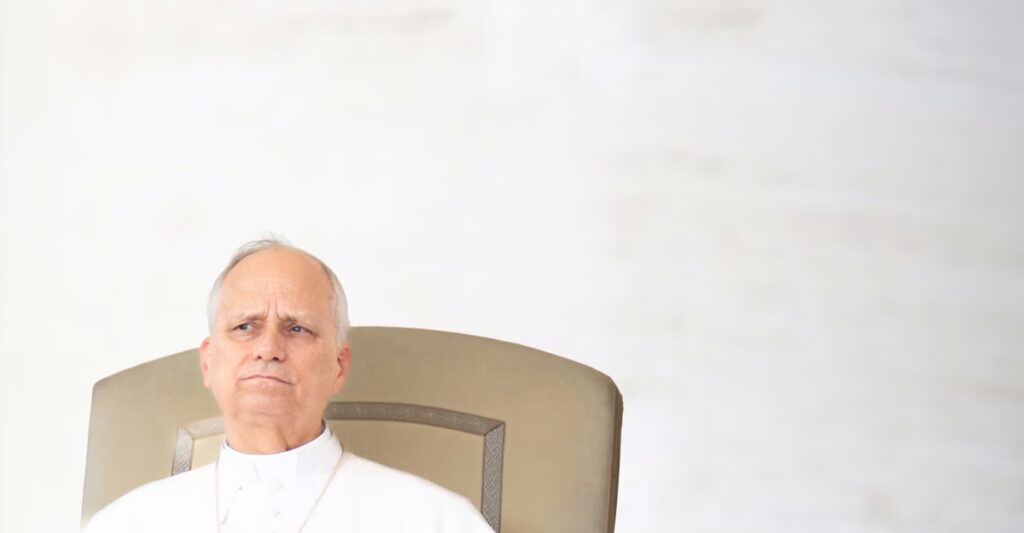
The Vatican, as one aphorism puts it, tends to “think in centuries.” But Pope Leo XIV seems intent on changing that, moving with remarkable speed to publish his first encyclical today, Magnifica Humanitas, “on safeguarding the human person in the time of artificial intelligence.” Leo has managed to produce a major teaching document on AI while college students are still booing commencement speeches about how the technology will change the world. Compare that with his 19th-century namesake, Pope Leo XIII, who didn’t publish an encyclical about the Industrial Revolution until more than a century after it started.
In Magnifica Humanitas (“Magnificent Humanity”), Leo seeks to counterbalance alarm with hope. He composes a long and vivid list of dangers posed by AI, but insists that the technology is a “gift that can alleviate suffering and open up new possibilities”—as long as it’s ordered by humane values rather than monopolistic interests. As for the specific advantages that AI might yield, however, Leo is largely silent. His expressions of alarm are detailed and expansive; his expressions of hope, perfunctory and brief.
Leo decries AI-driven unemployment, especially among young people, as well as the environmental degradation caused by energy-intensive, carbon-emitting AI infrastructure. He condemns the exploitation of workers such as those who label data, moderate disturbing content, or extract “the resources required for the production of the devices and microprocessors on which AI depends.”
[Read: Why Silicon Valley is turning to the Catholic Church]
The encyclical also takes a hard line against autonomous-weapons systems. “Moral judgment cannot be reduced to calculation, for it involves conscience, personal responsibility and the recognition of the other as a person,” Leo writes. “Therefore, it is not permissible to entrust lethal or otherwise irreversible decisions to artificial systems.”
On many of these issues, Leo offers prescriptions for reform that rely heavily on governments and institutions to mitigate AI’s risks. As is typical for papal documents, the encyclical does not offer detailed recommendations or specify which bodies should carry them out. “Robust legal frameworks, independent oversight, informed users and a political system that does not abdicate its responsibility are required,” he writes. With regard to work, the pope argues that “every introduction of automation and AI should be accompanied by verifiable measures to protect the employment, retraining and participation of workers.”
Beyond concerns of public policy, Leo expresses a range of humanistic reservations about AI. He warns against “equating this type of ‘intelligence’ with that of human beings,” who, unlike machines, can grow in wisdom through relationships and experiences of joy and suffering, including bodily pain. The technology can “weaken personal creativity and judgment,” he says, and promote the “illusion of a relationship with a real personal subject” that can lead users to “lose the very desire to form genuine human connections.”
The encyclical rejects two philosophies espoused by some in Silicon Valley—transhumanism and posthumanism—that see technology as a means to augment or perfect people. Such conceptions of perfectibility pose a threat to the vulnerable, the pope writes, by making it “easier to accept that some lives are less useful, less desirable or less worthy.”
Reflecting on this danger, Leo laments that modern culture tends to view every limitation “primarily as a defect to be corrected, rather than a reality through which our humanity matures and opens itself to relationship. And yet we must remember that humanity flourishes not despite limitations, but often through them.”
Although his main focus is technology, Leo touches on other subjects. The document includes a section condemning the rise of what he calls a “culture of power” and the resulting “normalization of war.” In one notable aside, Leo apologizes for how long the Church took to offer a “formal, absolute and universal condemnation of slavery,” which didn’t happen until 1888. That delay “constitutes a wound in Christian memory,” the pope writes. “For this, in the name of the Church, I sincerely ask for pardon.”
The encyclical follows in the line of Leo XIII, who initiated the modern tradition of Catholic social teaching, most famously with his 1891 encyclical Rerum Novarum, which defended the rights of workers during the Industrial Revolution. The current pontiff suggested, at the very start of his reign last May, that his namesake’s work would inspire his own teaching “in response to another industrial revolution and the developments of artificial intelligence.”
The new encyclical is also informed by more than 10 years of dialogue between the Vatican and representatives of the tech industry that began under Pope Francis. In an unusual move, Christopher Olah, a co-founder of the AI company Anthropic, took part in a panel that presented the document alongside Leo.
“Every frontier AI lab—including Anthropic—operates inside a set of incentives and constraints that can sometimes conflict with doing the right thing,” Olah said at the presentation. “That is why, if we want this technology to go well, it is enormously important that there be people outside those incentives—people who care about things going well, who are paying close attention, who are willing to say hard things and insist on safety, who are willing to be our earnest, thoughtful critics.”
[Read: Anthropic is at war with itself]
Magnifica Humanitas repeatedly advises against giving tech leaders unbridled power to develop AI and determine its use. When control over platforms, data, and computing power is “concentrated in the hands of a few,” Leo writes, “it tends to become opaque and evade public oversight, increasing the risk of distorted forms of development.” Elsewhere, he warns that “small but highly influential groups can shape information and consumption patterns, influence democratic processes and steer economic dynamics to their own advantage, undermining social justice and solidarity among peoples.”
To fend against the concentration of corporate power, the pope calls for more transparency and accountability regarding the use of AI in business. “When data and algorithms influence credit distribution, personnel selection or access to services and opportunities,” Leo writes, “it is necessary that decisions be understandable, contestable and subject to oversight, so that individuals are not reduced to mere profiles.”
Leo also denounces what he calls novel forms of colonialism, including the “extraction” of health data and demographic information. “These have become the new ‘rare earths’ of power: vital data which, once aggregated and analyzed, can be used to train predictive models, guide investment strategies, anticipate crises and, above all, determine who and what is deemed to matter.” Individuals must be able to decide how their own health data are used, Leo says, if this information is to be “a true common good rather than an instrument of dominance.”
Ultimately, the pope lays out the choice that humanity faces in stark terms: “If technology becomes the ultimate criterion, the human person risks being reduced to data, a cog in a machine or a commodity. If, however, technology is integrated with a wise perspective, it can become an instrument of growth, justice and fraternity.” More than anything, Magnifica Humanitas is an exhaustive account of what could happen if the world makes the wrong choice. As for the benefits of making the right one, Leo mostly leaves them to the reader’s imagination.
The post Pope Leo’s Unsettling Vision of the AI Future appeared first on The Atlantic.