Ken Moriyasu, a former correspondent for the Japanese newspaper Nikkei, is a senior fellow for greater Asia at the Hudson Institute.
The closure of the Strait of Hormuz — cutting off roughly one-fifth of the world’s seaborne oil — has exposed the fragility of maritime choke points and dramatically boosted the strategic value of overland energy routes across Eurasia.
The United States should recognize this shift and craft policies that prevent any single power from dominating the Eurasian landmass. The first step is identifying which countries matter most to that objective.
Just as U.S. presidential elections hinge on a handful of swing states, a new set of Eurasian middle powers is emerging as decisive terrain in the great power competition between the U.S., China and Russia. These states are Armenia, Azerbaijan, Hungary, Kazakhstan, Mongolia, Pakistan, Turkey and Uzbekistan.
These eight countries sit astride the major corridors linking Asia and Europe. Many are rich in oil, gas or critical minerals — resources that carry great weight in today’s era of geo-economic rivalry.
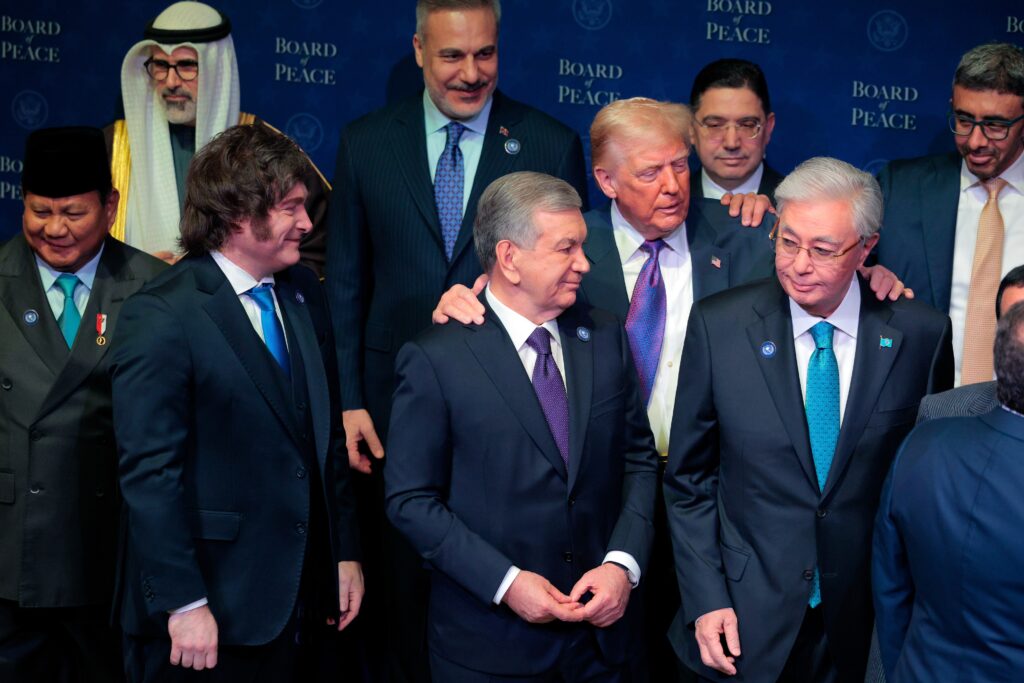
These states in effect identified themselves. Only 10 countries sent leaders to both Chinese President Xi Jinping’s military parade in Beijing in September and President Donald Trump’s Board of Peace launch in Davos in January. Indonesia and Bulgaria have since distanced themselves from the board, leaving the eight on this list as the swing states of Eurasia.
What is striking is how many of them sit in or near what British geographer Halford Mackinder called the Eurasian “Heartland” — the vast interior between the Volga and Yangtze rivers. Mackinder argued that whoever controls the Heartland commands the “World‑Island” of Africa, Asia and Europe, and ultimately global power itself. If great‑power competition is shifting, this is where it is shifting to.
As in the Cold War, America’s central objective is not to dominate Eurasia but to prevent any hostile power from doing so. NSC-68, a National Security Council policy document written in 1950, noted that U.S. strategy should be to establish friendly regimes in Eurasia so as to “engage the Kremlin’s attention, keep it off balance and force an increased expenditure of Soviet resources in counteraction.”
Many of the eight swing states already pursue a strategic hedging policy. American strategy should reinforce this instinct by expanding the partnership options available to them.
The Heartland is in motion for a reason. Russia’s war in Ukraine has weakened Moscow’s grip, opening space for China to expand its influence through the Belt and Road Initiative. Beijing has knit Central Asia more tightly to itself with pipelines and railroads.
Yet few countries in the region want to swap dependence on Russia for dependence on China. This reluctance creates a clear opening for the U.S. — especially under Trump, who prioritizes energy security, critical minerals and strategic geography over democracy scorekeeping.
At a March 3 seminar hosted by the Caspian Policy Center, Kazakhstan’s ambassador to the U.S., Magzhan Ilyassov, said that Central Asia is watching developments in Iran with keen interest, noting that the corridor linking the Caspian Sea to the Persian Gulf — via railways, pipelines and oil‑swap routes — offers the shortest path for landlocked Central Asia to reach global markets.
Some swing states are natural partners for Washington; others are not. Pakistan, for example, has an “all-weather strategic partnership” with China — the second-highest status of bilateral relations Beijing offers, only after the “comprehensive strategic coordinated partnership” with Russia. Yet Prime Minister Shehbaz Sharif has positioned himself as a potential mediator between Washington and Tehran.
Hungary was the first European country to join China’s Belt and Road Initiative in 2015 and has been a focal point of Chinese investment. But U.S. Vice President JD Vance is scheduled to visit Hungaryin early April, just days before elections there, to in effect campaign for Prime Minister Viktor Orban, a Trump ally.
The Trump administration’s Eurasian policies, whether by design or by consequence, align well with the swing-state concept. The Trump Route for International Peace and Prosperity (TRIPP) corridor is built on it. By brokering connectivity between Armenia and Azerbaijan, the TRIPP project establishes a U.S.-managed link that connects Central Asia to Turkey and Europe while bypassing Russia.
But Trump can do more.
First, he can establish a regular “Eurasia 8+1” dialogue, convening these countries with the U.S. on an annual basis. As host of the G-20 summit in Miami this year, he also has an excellent opportunity to invite several of them — a simple but powerful gesture that would elevate their status and signal that Washington views Eurasia as central to global strategy.
Trump can also enlist partners. Japan already understands the swing-state dynamic and is acting on it. It is uniquely positioned to help the U.S. open doors across Central Asia and the Turkic world.
In January, Japan’s Senior Deputy Foreign Minister Hiroyuki Namazu visited the Organization of Turkic States, whose members include Turkey, Azerbaijan, Kazakhstan and Uzbekistan (with Hungary as an observer), in Istanbul. The organization’s Secretary General Kubanychbek Omuraliev told Namazu that Japan and Turkey share an Altaic linguistic heritage — referring to the theory that the two share a common ancestral language that was spoken around the Altai Mountains of East-Central Asia — and that Japan is thus eligible to apply for permanent observer status. The same logic could apply to South Korea.
As Trump prepares for his May visit to Beijing, these Eurasian swing states will be watching closely — not only for signals on U.S.-China relations, but for how Washington approaches the broader map. If the U.S. fails to engage these states systematically, other powers will fill the vacuum. And once Eurasia’s infrastructure, energy routes and trade networks lock into a Sino-centric order, the U.S. will lose leverage for decades.
Mackinder mapped the pivot of history; Trump is about to test it.
The post As the Iran war continues, these ‘swing states’ will be pivotal appeared first on Washington Post.