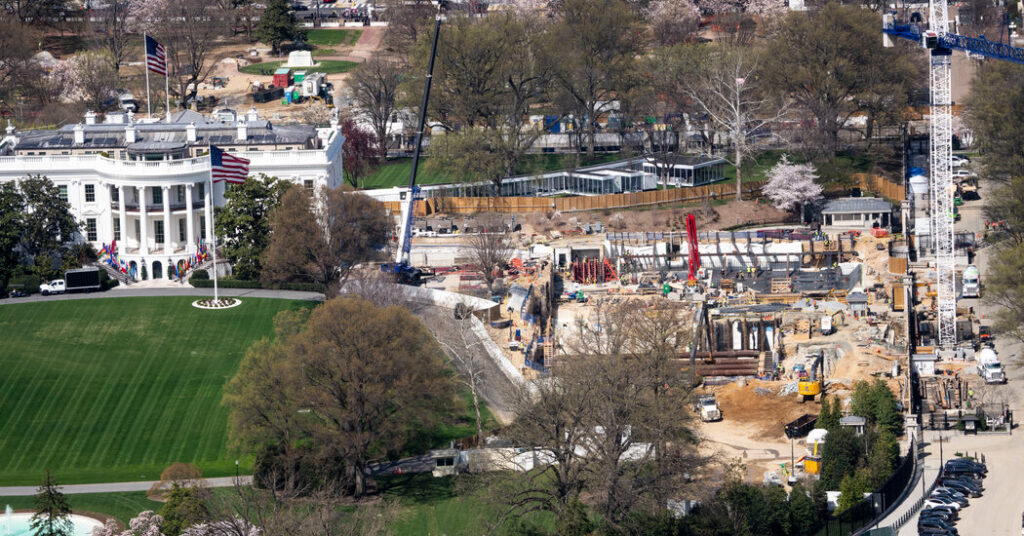
While most public attention has focused on the aboveground portion of President Trump’s planned $400 million ballroom, what is underneath could prove to be the more complex and expensive portion of the project.
Work crews have been digging in the earth for weeks, ripping out the Presidential Emergency Operations Center, or PEOC, to build something bigger, better and deeper underground.
The PEOC, which was built during World War II to protect the president and other top officials in the event of an emergency, was where Vice President Dick Cheney was hustled after the Sept. 11 terrorist attacks, later to be joined by President George W. Bush and his national security teams. Mr. Trump was rushed there, too, during protests over the death of George Floyd in 2020.
The bunker is beneath what was once the East Wing, which Mr. Trump tore down last year to make way for his ballroom.
Details of the underground facility are usually shrouded in secrecy. But as Mr. Trump’s ballroom faces legal challenges, he has been talking more openly about the bunker. He argues that the two are linked, which makes building the ballroom a matter of security.
Here is what we know about the PEOC.
‘A Massive Military Complex’
Speaking on Sunday to reporters on Air Force One, Mr. Trump said that he envisioned his 90,000-square-foot ballroom as a “shed” for the underground project.
“The military is building a massive complex under the ballroom, and that’s under construction, and we’re doing very well,” Mr. Trump said.
In Mr. Trump’s telling, the bunker will have bomb shelters and “very major medical facilities,” including a hospital. It will have the latest secure communication methods and defenses against bioweapons.
He said the ballroom would protect the underground facility from drones, bullets and other attacks. “It’s high-grade bulletproof glass. So all of the windows are bulletproof,” Mr. Trump said.
Last week, speaking about the ballroom project during a cabinet meeting, the president said that “the military wanted it more than anybody.”
Mr. Trump has said the security features make his project even more important — a point he made again this week after a judge halted the project, saying it required congressional approval.
“Unless and until Congress blesses this project through statutory authorization, construction has to stop!” wrote Judge Richard J. Leon of Federal District Court in Washington, a George W. Bush appointee.
Mr. Trump ordered an appeal, but he pointed to a section of Judge Leon’s order that allowed “construction necessary to ensure the safety and security of the White House” to continue.
“We have biodefense all over,” Mr. Trump told reporters in the Oval Office this week. “We have secure telecommunications and communications all over. We have bomb shelters that we’re building. We have a hospital and very major medical facilities that we’re building. We have all of these things. So that’s called: I’m allowed to continue building.”
The Secret Service
The Secret Service has twice filed documents in court attesting to the necessity of finishing the ballroom project.
Matthew C. Quinn, deputy director of the Secret Service, wrote in December and again in January that any halt in the project could put lives in danger.
Mr. Quinn said that the agency was working with a contractor on security upgrades but that the underground work was not finished.
“Accordingly, any pause in construction, even temporarily, would leave the contractor’s obligation unfulfilled in this regard and consequently hamper the Secret Service’s ability to meet its statutory obligations and protective mission,” Mr. Quinn wrote.
He offered to brief the judge privately about the security upgrades underway. The Trump administration also filed some documents about the project under seal in federal court.
Judge Leon appeared to mostly reject those arguments.
“While I take seriously the government’s concerns regarding the safety and security of the White House grounds and the president himself, the existence of a ‘large hole’ beside the White House is, of course, a problem of the president’s own making!” he wrote.
Joshua Fisher, director for management and administration in the White House, told the National Capital Planning Commission in January that he could not share all the administration’s plans for the project.
“There are some things regarding this project that are, frankly, of top-secret nature that we are currently working on,” he said.
There are still many unanswered questions about the project, including which branch or branches of the military are involved, the costs of construction and maintenance, and many other details.
Asked about the underground portion of the project on Monday, Karoline Leavitt, the White House spokeswoman, was equally closemouthed.
“The military is making some upgrades to their facilities here at the White House, and I’m not privy to provide any more details on that,” she said.
Luke Broadwater covers the White House for The Times.
The post What to Know About the ‘Massive’ Military Bunker Beneath Trump’s Ballroom appeared first on New York Times.