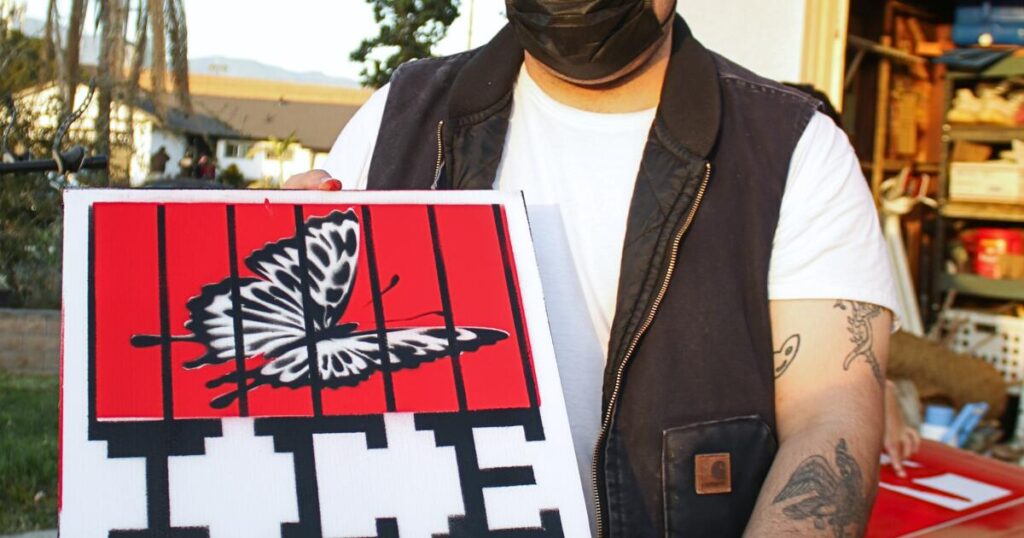
Outside Andrea Galván’s Ontario home, two young boys stop on their scooters to watch their neighbor create signs. Galván, an art consultant and activist, is accompanied in her driveway by a group of volunteers passing stencils and aerosol paints around to one another.
“Can we join?” the boys ask.
Soon, they’re wearing face masks and spraying away, stacking the growing pile of posters in the back of a red pickup truck.
The next day, the signs appear in front of a car wash, a Home Depot and in various neighborhoods throughout the Inland Empire, catching the eyes of passersby with four words: “ICE stole someone here.”
Since November, the signs have popped up around the Inland Empire, bringing awareness to the Immigration and Customs Enforcement raids in the area, which activists say might otherwise go unnoticed because they often happen in the early morning. According to Galván, the signs keep the stories of local immigrants taken by ICE visible and tangible.
“Some people say, it wouldn’t happen in my neighborhood. It is, it has,” said Javier Hernandez, executive director of the Inland Coalition for Immigrant Justice, the organization behind the signs.
IC4IJ has organized a network of volunteers who post them throughout Ontario and as far as the Salton Sea. Designed by Pomona artist Jaime Muñoz, the butterfly-adorned signs tell a story of deported community members and the places where they worked, gathered and lived.
Founded in 2008, the organization provides the IE immigrant community with legal support and resources, as well as documenting after someone or their family member is deported. The signs project builds upon their existing records of local deportations.
According to the Deportation Data Project, ICE arrested 14,376 people in the L.A. metropolitan area, which includes Riverside and San Bernardino counties, from September to mid-October.
The continued ICE operations in the IE and controversy around allegedly inhumane conditions in local detainment centers like the Adelanto ICE Processing Center raised concerns for local activists such as Michael Rios, director of Citizens for Ontario.
“There’s so many arrests happening here and you don’t see it in the news as much,” Rios said. “We wanted a way to tell people because we’re unfortunately in a news desert.”
In 2025, MuckRack and Rebuild Local News released a report on the decline of local journalism across the United States. By documenting the ratio of journalists to county populations, the report found that Los Angeles, San Bernardino and Riverside counties all fell in the bottom tier, with some of the lowest numbers of local journalists in the country.
In both Inland Empire counties, report research showed that there were about two local journalists per 100,000 people. A small number of regional publications exist, including the Press-Enterprise and the Riverside Record.
According to Hernandez, IC4IJ’s rapid response networks have documented that aggressive and undercover ICE operations in the IE have only continued into 2026.
In October, a man in Ontario was shot from behind by ICE agents as he warned officers of nearby children gathered at a bus stop. Federal agents claimed they opened fire because the man was interfering with ICE operations. In August, a San Bernardino man driving with his teenage son was surrounded and shot at by ICE agents as he drove away.
“Once we started putting up signs and pulling the data, then we started seeing trends,” Hernandez said. “We could tell that certain parts of the IE were being hit harder and that ICE agents were following certain routes.”
As a historically Republican region, activists say some local government officials and law enforcement in the Inland Empire have ignored calls to monitor ICE activity. Late last year, Chad Bianco, sheriff of Riverside County, joined Huntington Beach in a failed attempt to sue California over its sanctuary state law, SB 54.
“We realized we had to do something, because so many people don’t know what’s happening,” Galván said.
In the IE, voter turnout fell below state averages in the 2024 general election, according to USC Sol Price School of Public Policy’s voter turnout tool. Galvan says that the disconnect between citizens critical of ICE and local officials like Bianco was part of the call to action to make the signs.
“Some people don’t want to get involved. Part of [the signs project] was telling people there are ways for you to push back, even in a small way,” Galván said.
“These things aren’t happening in vacuums, and you don’t have to feel helpless.”
In October, Galván saw a story that set the project in motion. The Washington Post reported that in Washington, D.C., neighbors had independently begun creating signs to mark streets where someone had been taken by ICE. They were inspired by Europe’s “stolpersteine,” brass-topped cobblestones in front of houses with names and dates of birth and death that mark the homes of victims taken by the Holocaust. The nonprofit foundation Stolperstein, created to honor their legacy, writes that the stones were designed to “provide a lasting and continuous remembrance.”
“A person is only forgotten when their name is forgotten,” their website quotes, citing Jewish text the Talmud.
Galván was moved and thought that the legacy of the stolpersteine and Washington’s signs could fit into the IE, especially in the wake of the Ontario shooting.
The initial signs Galván and Michael Rios, a fellow activist and colleague, mocked up were straightforward: bold text on a plain background.
Rios remembers wondering if there was a way to reflect the artistic side of their Mexican American community in the project. As they considered who could capture the IE’s immigrant population through art, Jaime Muñoz came to mind.
Muñoz’s art studio in downtown Pomona is a cactus-flanked alcove of massive paintings, tiny sketches and two hyperactive dogs. He pets them with a smile as he recalls his grandmother, an immigrant who bought her first house in the IE. As he moved around growing up, Pomona felt like an anchor to home.
When Galván and Rios approached him about the project, he said the opportunity to contribute to his hometown was one he had been waiting for. In his studio, he began to sketch out the design that’s now scattered across Pomona and beyond.
“I wanted to create a visual message for loss,” Muñoz said. “I feel like the way I view the world, my experience, has been shaped by being raised by immigrants. This is how I pay tribute.”
With inspiration from Mexican woodblock artist Jose Guadalupe Posada, the stenciled style took form — a butterfly emerging from behind bars.
A former construction worker turned full-time artist, Muñoz says his interest in class struggles began from watching immigrant workers being treated like a commodity.
Muñoz’s work is rich in working-class iconography stemming from the IE and his Chicano upbringing. Storage containers, police cars and an empty jornalero truck with the door left open characterize his bold, tattoo-like portraits.
“We weren’t just tapping a random artist to ask them to do this,” Galván said. “Jaime has been telling our stories in his art, so this is just a continuation of that.”
With Muñoz on board, the trio, along with neighbors and local activists, met in places like Galván’s driveway to hand-make the signs by the hundreds.
“When you see a sign, you see their house, their place of work, you see an individual,” Rios said. “It always chokes me up to talk about it, but someone told us, ‘You put up a sign where my mom was taken.’ And that just hit me so much. These signs are personal.”
The group began receiving calls and messages from community members, asking them to place signs where friends and family were deported, sometimes the day it happened.
Tina Silva, an Ontario retiree, joined rapid responder groups to record and pinpoint ICE operations in the area, and was one of the first people to help create the signs.
“Our work as a community is not just the people ICE takes. It’s also about who’s left behind,” Silva said. “It’s saying that it happened, that we’re watching out for them too.”
Silva joins Galván and the other volunteers as they paint signs in her driveway that cloudy afternoon. They compare the signs to altars, traditional and physical tangible mementos of grief and remembrance.
“The Inland Empire is our immigrant mecca. It’s the place people came to when they made it to the U.S., where they could find a place of peace,” Galván said. “We’re fighting for that.”
This article is part of a De Los initiative to expand coverage of the Inland Empire with funding from the Cultivating Inland Empire Latino Opportunity (CIELO) Fund at the Inland Empire Community Foundation.
The post ‘ICE stole someone here’: These signs popping up across the Inland Empire tell a story appeared first on Los Angeles Times.