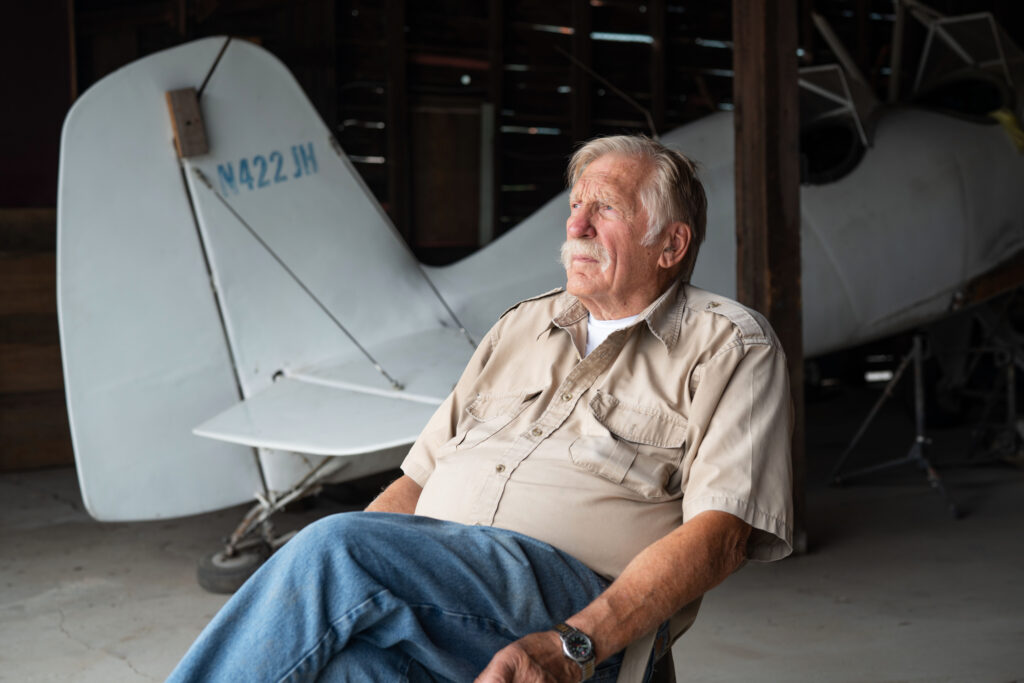
Ken Jouppi, a veteran bush pilot, swears to this day he never saw the beer on his plane — not the six-pack of Budweiser, much less the gallons of suds tucked inside the aircraft.
That beer, though, cost him his plane and sparked a dispute that made it all the way to the U.S. Supreme Court.
One morning in April 2012, Jouppi was preparing to shuttle a 59-year-old woman to Beaver, a remote Alaskan village of 48 inhabitants. The woman, who regularly flew with Jouppi, was going there to celebrate her birthday with her husband.
All her groceries were loaded into Jouppi’s 1969 Cessna Skywagon, the prop plane he had used to shuttle moose hunters into the wilderness and swoop residents to their far-flung communities.
The engine was running. But before Jouppi could take off from the airport in Fairbanks, state troopers arrived. They had a warrant to search Jouppi’s plane.
The officers first found the six-pack of Budweiser. Then, among the passenger’s groceries, they discovered a total of nine gallons of beer in other boxes and bags.
That was evidence of a crime. Beaver, like some other communities in Alaska, bans alcohol, so the beer could not be flown in.
The troopers confiscated Jouppi’s plane, instantly changing his life.
“They took it right there,” Jouppi, 83, recalled in an interview with The Washington Post. “It pretty much put me out of business.”
About a year after his plane was confiscated, a jury found Jouppi guilty of intending to import alcohol into a dry community — a misdemeanor. One trooper testified that Jouppi would have to have been “blind” not to notice the beer, which belonged to his passenger.
Jouppi was sentenced to three days in prison and ordered to pay a $1,500 fine. An appeals court later ordered Jouppi to forfeit his plane.
For the past 14 years, Jouppi has been fighting to get his Cessna back — and now he will make that case to the highest court in the nation.
The justices will hear arguments in his dispute on Dec. 1 and consider whether the forfeiture of the plane would infringe on the constitutional right to be free of “excessive fines.”
Jouppi and his lawyers argue that his punishment was a grossly disproportionate penalty for the first-time offender convicted of a low-level crime. The plane, they note, is valued at $95,000.
“No matter that the alcohol is a six-pack of Budweiser. As here. No matter that it belonged to a customer. As here,” Jouppi’s lawyers wrote in a filing to the high court. “The result: an airplane forfeited for a six-pack.”
The state of Alaska does not see it that way.
Transporting any alcohol into Beaver is a crime under state law because the village implemented a ban eight years before the troopers showed up and searched Jouppi’s plane.
State troopers had already been investigating Jouppi and his company after being tipped off that he “repeatedly” transported passengers with alcohol to communities where it was banned, state lawyers wrote in a brief before the Supreme Court.
Jouppi’s passenger, Helen Nicholia, pleaded no contest to the same misdemeanor importation charge he faced. The Post could not reach Nicholia for comment.
Small, sometimes remote communities in Alaska can elect to ban alcohol because many have no emergency medical services or law enforcement resources to deal with alcohol-related incidents. Many, like Beaver, do not have roads.
“When an alcohol-fueled event occurs, the victims often have nowhere to turn,” lawyers for the state wrote to the high court.
Plus, the state argues, the case is about more alcohol than just a six-pack.
Jouppi, Alaska lawyers say, loaded two cases of beer onto the plane, in addition to four six-packs. And penalties for willingly using a plane to transport alcohol into an alcohol-free community include forfeiting the plane, the state says.
“Jouppi fell within the class of defendants principally targeted by the law,” the state argues. “And the alcohol he would have willingly flown to Beaver had the potential to cause the exact harms feared by the legislature.”
The outcome of the case could have implications beyond Jouppi and his airplane. Supporters of Jouppi’s cause — many of them conservative, libertarian and business groups — filed amicus briefs saying that a ruling for the pilot could make it harder for the governments to impose disproportionately high fines on large and small businesses.
Legal scholars point out that the concept of penalties being proportional to an offense goes back to the era of the Founding Fathers.
“Without meaningful judicial inquiry into whether a forfeiture is excessive, state and local governments will be free to employ their forfeiture regimes to raise revenue, treating as ‘merely coincidental’ the relationship between the actual cost a crime imposes and the forfeited property the government collects,” one group of law professors wrote in an amicus brief supporting Jouppi.
But those who support the state’s seizure of Jouppi’s plane say harsh penalties act as a necessary deterrent.
In a brief supporting Alaska, William P. Barr, who was attorney general under Presidents Donald Trump and George H.W. Bush, wrote that Jouppi’s offense was “grave.”
A third of Alaska Native villages lack any law enforcement personnel, and many others do not have the resources to handle felony-level offenses, Barr noted, citing federal law enforcement estimates.
“Six beers do not mean the same thing in a remote, dry Alaska Native village without ready access to law enforcement as in a city where alcohol is sold in grocery stores and law enforcement is minutes away,” Barr wrote. “Gravity must be measured in context, not just by counting cans.”
Barr is among the handful of former law enforcement officials, as well as state and local authorities, who wrote in support of Alaska.
The state has also received support from the Trump administration, which said in an amicus brief that forfeiture for illegal acts is rooted in America’s history and tradition — an important consideration for the high court.
Jouppi said he recognizes the importance of Alaska’s laws preventing alcohol in certain communities.
“It is a problem in the villages, and nobody denies that,” he told The Post.
But the law required him to search all his passengers’ luggage — something Jouppi called a “tremendous invasion of their privacy.”
He was not willing to do that to his customers, Jouppi said. Jouppi insists that he never saw his passenger’s beer before the troopers showed up in 2012.
Jouppi’s said his life as a pilot effectively ended the day he lost his plane, which he called his “second home.”
Two years after the state took possession of his plane, he pleaded guilty to trespassing onto the grounds of the Anchorage airport to retrieve headsets and other personal items from the mothballed Cessna, according to court records and the interview with Jouppi.
“I was an aircraft owner and a licensed pilot. I had every reason to be there,” Jouppi said.
Now retired, Jouppi lives in western Idaho, just south of Coeur d’Alene. He no longer flies planes. He said he mostly spends his days working on hobby cars and rebuilding antique Winchester rifles.
For him, getting his plane back is about its value. But the fight is also about principle, he said.
“I just won’t give in,” he said. “Quitting might’ve been cheaper for me and a lot less trouble, but it’s just not in my nature to do that. I’ll stay with it until the bitter end, till there’s no other options.”
The post How a six-pack of beer landed an Alaska bush pilot before the Supreme Court appeared first on Washington Post.