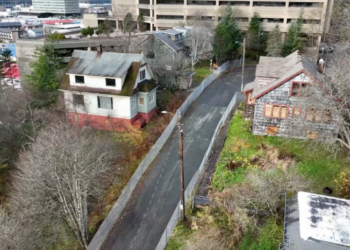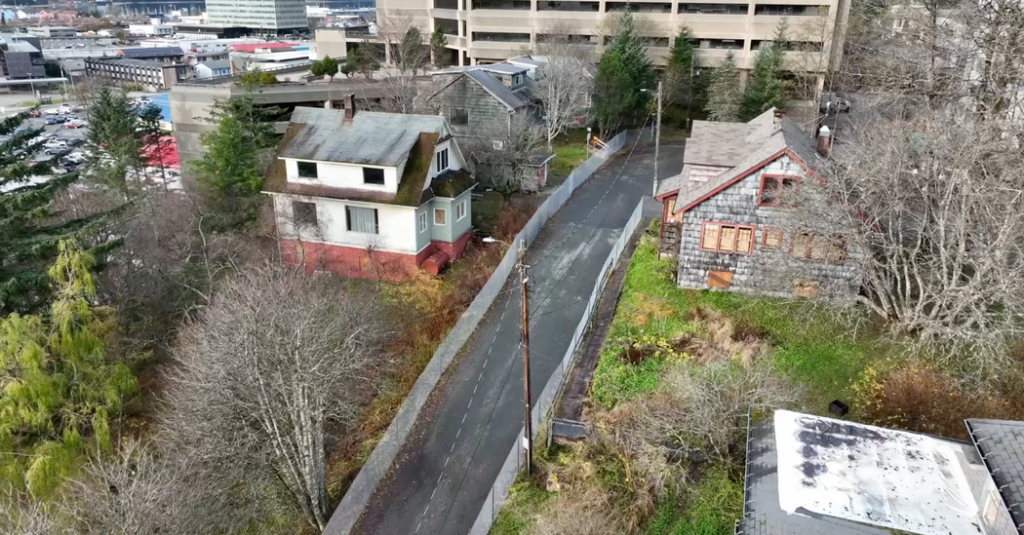
Tucked onto a windswept hillside above the Gastineau Channel, Telephone Hill, one of Juneau’s oldest neighborhoods, was once an unlikely enclave of artists, aging hippies and longtime Alaskans.
Its seven weather-beaten houses incubated the Alaska Folk Festival; sheltered visiting musicians, including the English folk singer who taught Paul Simon his version of “Scarborough Fair”; and offered a bed and a piece of old Alaska to down-on-their-luck neighbors.
“When the tourists would get off the cruise ships and wander up the hill, they’d fall in love,” said Maureen Conerton, a longtime resident. Rough around the edges and filled with characters, Telephone Hill was “what they thought Alaska would be,” she said.
But in a shrinking city that nonetheless faces a dire affordable housing shortage, Telephone Hill is also prime real estate, five minutes from the Alaska governor’s mansion. Today, the windows are boarded up, chain-link fencing keeps everyone out, and the land is in limbo as the state, city and residents battle over preservation versus construction.
“Now we have this nice, empty nothing,” Ms. Conerton said.
She spent more than 36 years in the original home of the Juneau & Douglas Telephone Company, a sprawling clapboard house with three roofs, three basements and old-growth timber framing that gave the hill its name. Edward Webster, a gold and silver miner, built the oldest portion of the home in 1882 for its clear sightlines across the channel to Douglas Island, where he ran an underwater telephone cable.
The city grew up around the Webster House, as the gold rush turned Juneau into Alaska’s most important community by the turn of the 20th century.
In the early 1970s, calls to move the state capital from Juneau to Anchorage, which was more easily accessible, prompted lawmakers to try to entrench the bureaucracy even more deeply along the Gastineau Channel. They bought Telephone Hill and its seven houses in 1982 with plans to expand the capitol complex.
Two years later, plunging oil prices gutted state budgets and mothballed those plans. The neighborhood became a liminal space: The state, not eager to play the role of landlord long-term or willing to invest in making major fixes, offered cheap rents with the understanding that the arrangement was temporary.
Tenants did most of the maintenance on the 19th-century houses, which were routinely battered by rain, snow and winds that could top 70 miles an hour. Hill residents felt a sense of ownership over a neighborhood they couldn’t own — the big lilac tree their children loved to climb, the roofs and gutters they repaired themselves, the street they shoveled because borough crews always seemed to save the blocks of nebulous ownership for last.
“There was always a sense that we were the ones holding the place together, or the only ones who cared about it,” said Rachel Beck, who first worried the neighborhood might get bulldozed when she was pregnant with a child who is now 43.
In 2022, the state declared the hill surplus property and gave it to Juneau as repayment for a long-ago loan meant to help pay for a new State Capitol. Borough leaders had no interest in owning rental property, but they wanted the land underneath and took the deal.
Like much of Alaska, Juneau suffers from a seemingly contradictory set of problems. The region is shrinking, largely because younger people are leaving. Yet an aging population entrenched in its homes, high construction costs and the rise of short-term rentals for tourists and seasonal workers have created an affordable housing shortage.
Planners estimate the borough needs as many as 2,000 new units over the next three decades in an isolated corner of Alaska where new construction is largely impractical because of steep, rocky terrain and a rising annual risk of flooding from a Mendenhall Glacier softened by climate change.
In October 2022, Juneau voters approved a funding measure that included $2 million to help prepare the hillside for four mid-rise apartment buildings with as many as 155 units, which would require razing the hill’s seven houses. Then Juneau ran straight into the math and shifting political winds.
The costs of clearing and improving the rocky hillside — solid bedrock beneath glacial till — kept rising. Private developers warned that any housing project would require tens of millions in government help at a time when the borough was facing deep budget cuts.
In the interim, residents packed Juneau Assembly meetings and rallied preservationists. Last fall, even as the borough pressed ahead with evictions in the hope of making redevelopment easier, voters ousted an incumbent in favor of a challenger who promised to slow or stop the project.
“The facts didn’t necessarily change,” Katie Koester, the city manager, said. “It just became real.”
Now, Telephone Hill sits waiting. The hill’s residents have found new homes. This month, borough leaders issued a new request for proposals from private developers. Preservationists have sued. Everyone is frustrated.
“There is no ‘right,’” said Ella Adkison, a borough Assembly member, who supports tearing down Telephone Hill homes in favor of denser affordable construction. “It just depends on what you want the future of Juneau to look like.”
Economists and planners warn of a “slowly shrinking, slowly dying city” without creative housing solutions, Ms. Adkison noted. Juneau’s population has fallen from 32,600 a decade ago to 31,600, a decline expected to continue even if a planned Coast Guard icebreaker base is completed. By 2045, one in four residents will be 65 or older, according to a borough estimate.
Ms. Adkison says she knows evicting people in the name of future construction is hard to explain but sees this as a choice between preserving a special place “that was never meant to be permanent” and ensuring the city’s survival as more than just a stop for cruise ships and state legislators.
And she worries the current limbo could lead to a worst-case scenario for people on both sides — the city eventually giving up and a private builder deciding the simplest, most profitable solution is building one or two luxury homes on the hill.
Some preservation advocates have proposed a compromise, maybe a development that keeps the old buildings while adding apartments around them. They’re pushing to have the neighborhood declared a historic district, which would complicate but not block demolition.
“It’s not too late to hit pause and do this right,” said Mary Alice McKeen, a retired lawyer who lives a short walk away.
Ms. Conerton doubts a return to the hill is plausible. She and her husband, Jeff Brown, a founder of Juneau’s community radio station, were the last to move out when they left in February during a heavy snowstorm.
Telephone Hill had “an extraordinary run,” she said, “a piece of magic that lasted way longer than anyone ever expected.”
The post History vs. Housing: Juneau Shows How Hard Tackling Affordability Can Be appeared first on New York Times.