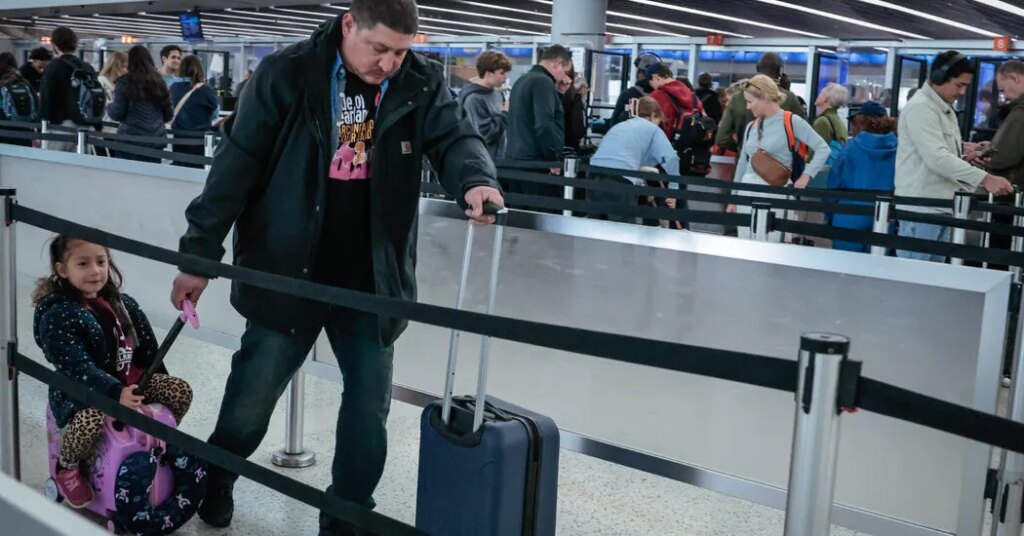
Flying on the Sunday after Thanksgiving — always one of the busiest travel days of the year — can be a bit of a grind.
But this weekend, passengers have good reason to be especially wary. They are facing gnarly weather patterns, sky-high ticket prices and lingering anxieties after a nationwide ground stop earlier this month. In recent weeks, there have been some high-profile accidents, along with a spate of technical glitches that caused delays and cancellations.
“Pack your patience,” said Jeff Guzzetti, the president of Guzzetti Aviation Risk Discovery, a safety consulting firm. “Go into it recognizing you may be delayed or inconvenienced.”
Alex Smith, of Birmingham, Ala., was extra cautious when she booked her Thanksgiving trip to Hawaii. Alarmed by the Nov. 13 ground stop, which canceled about 17,000 flights across several days and left travelers stranded at airports, Ms. Smith, 36, purchased travel insurance — including a provision to cover cyberattacks.
“Normally, I wouldn’t think twice about it,” she said in an interview from Oahu, where she celebrated the holiday with her husband and two children. Ms. Smith was preparing to fly home on Sunday, with a layover in Detroit. She hoped that the first flight, at least, would go smoothly.
“If we get stuck in Michigan,” she said, “we can drive and get home.”
Officials blamed this month’s ground stop on a communications network outage during a routine upgrade, raising concerns about the age and durability of the country’s air traffic infrastructure.
A few days after that, United Airlines flights were grounded because of a “widespread system outage” that was resolved in about an hour.
And last weekend, Delta Air Lines also encountered problems: Flights traveling to and from the company’s hub in Atlanta were delayed after a failure with the system that calculates a plane’s weight and balance, the Federal Aviation Administration said.
The Trump Administration has since announced the formation of a task force devoted to preventing further air traffic shutdowns. But critics of Transportation Secretary Sean Duffy say that his efforts to transform the F.A.A.’s slow and cautious culture — including by rapidly installing artificial intelligence systems — is a risky gambit that could continue to disrupt air travel.
And while aviation in the United States has been “able to rebound” and return to normal levels of air traffic this past week, Mr. Guzzetti said, long-term problems, like chronic understaffing of air traffic control facilities and aging traffic control infrastructure, were still straining the system.
Himanshu Sharma, a graduate student in business school, took a United Airlines flight from Los Angeles and arrived Saturday at Chicago’s O’Hare International Airport.
Mr. Sharma, 30, said he was concerned about the effects of artificial intelligence on critical infrastructure. “I read about how A.I. is affecting these outages,” he said, “and I feel scared how the future is going to pan out.”
He added that his social media feeds were flooded with “fear mongering” over uncertainties related to new technologies. “God forbid, if some of these outages do ultimately impact physical lives,” Mr. Sharma said. “It is a big concern.”
The recent disruptions have prompted some passengers to make surer — if costlier — travel choices.
“We’re more cautious,” said Maritza Garcia, 49, who flew from Albuquerque to San Francisco on Saturday. “We try to look for nonstop flights, and that way, we’re not jumping around airports.”
She and her daughter Evangeline Garcia, 25, had hoped to avoid a layover. But the Thanksgiving weekend prices were too steep, so they connected through Phoenix instead. They made it in time to attend the San Francisco 49ers football game on Sunday.
As of Saturday afternoon, air travel was flowing normally across the United States, according to data from FlightAware, a flight-tracking service. George Cuzzort, 73, was waiting at O’Hare to catch a flight home to Anchorage, Alaska.
So far, he said, his trip had gone smoothly. “I do think we will have more of these issues, of national groundings, in the future. I am sure of it,” Mr. Cuzzort said, adding that the country’s antiquated airline infrastructure was in need of updates.
Delays and cancellations are not the only problems on passengers’ minds: Some recent accidents have also raised safety concerns. In September, a cargo plane overran a runway at Miami International Airport, killing five people on the ground. And on Wednesday, a FedEx jet overran a runway at the same airport, though no one was injured.
While fatal airline accidents remain exceedingly rare, the number of “runway incursions,” in which planes on the ground come dangerously close to each other, has risen since last year, and experts say that the aviation safety system is under strain.
And if heightened anxieties over technology and safety were not enough, passengers this weekend are also grappling with an old-school encumbrance: bad weather.
Storms pummeled much of the East Coast on Thanksgiving, canceling hundreds of flights, causing hundreds of thousands of power outages and postponing the Macy’s Thanksgiving Day Parade in New York City.
And while conditions are improving there, forecasts show thunderstorms and steady rain spreading into the Midwest and the South by Sunday. The National Oceanic and Atmospheric Administration was predicting moderate to high aviation impacts across much of the country.
John Gradek, an aviation expert at McGill University, warned that airline hubs in Chicago could be badly affected. “The problem with Chicago is that, how Chicago goes, the U.S. air travel system goes,” he said.
Mr. Guzzetti said that some delays, such as ground stops caused by severe weather, were put in place to keep passengers safe. “You don’t want to stifle economic commerce and people’s ability to travel, but by the same token, you may need to implement actions that will inconvenience the passenger,” he said. “That’s always been the rub in aviation safety. It’s managing risk.”
Katie Chaumont, a spokeswoman for Dallas Fort Worth International Airport, one of the country’s biggest air transit hubs, said that Sunday was shaping up to be one of the busiest days of the Thanksgiving travel period.
She added that Monday would be busy, too, since some travelers may have extended their trips to avoid peak traffic. In fact, a forecast from the F.A.A. had predicted that the number of Monday flights across the United States might exceed the number of Sunday flights.
Ms. Chaumont said that travelers should stay up-to-date with their airlines to check for any delays. Being flexible and anticipating changes, she said, “makes a little bit smoother journey.”
But even with careful preparation, Mr. Gradek said, air passengers should be prepared for hiccups on Sunday. “There are going to be delays; there are going to be cancellations,” he said. “It’s not going to be trivial.”
Madison Malone Kircher and Heather McCabe contributed reporting.
The post Travelers Pack Caution and Patience as They Head to Airports appeared first on New York Times.