In a photograph taken around 1955, Jackson Pollock holds an abstract collage by his wife, Lee Krasner, sideways, as if it is meant to be a horizontal landscape. The unshaven Pollock chomps on a cigarette mafioso-style while glowering at the camera. Alcoholism had clearly taken its toll and by the summer of 1956 he died in a horrific car accident that also killed another passenger. He was almost certainly drunk at the time.
Krasner’s collage, “Color Totem,” was meant to be viewed vertically, so Pollock appears to be misreading the work. Is it an act of aggression? Or an indifference to his partner’s art so profound as to be indistinguishable from aggression? A new survey of Krasner and Pollock at the Metropolitan Museum of Art complicates those readings. It reaffirms Krasner as at least Pollock’s equal, foregrounds the interplay of their work and careers and documents a marriage that was messy — in both good and bad ways. Through a lens colored by the nuances of love, support, cohabitation and grief, it humanizes both artists; and as they are rendered merely terrestrial, it is Krasner who emerges as the larger, more fascinating figure.
“Color Totem,” unfortunately, isn’t included in the exhibition “Krasner and Pollock: Past Continuous,” but other large, vertical works by Krasner are on view. In the exhibition’s most engaging and exhilarating gallery, which includes several of Pollock’s giant drip paintings made around 1950, Krasner’s abstract collages feel both Promethean and organic. Seen next to Pollock’s horizontal tracings of energy and gesture, Krasner’s collages seem to stand up, literally, and the effect is touchingly bipedal and human. They are Venus or Adam or Golem in fancy dress, and they stand apart from Pollock’s assertion of gestural freedom, landscapes of the mind best described by Milton a few centuries earlier: “Illimitable Ocean without bound,/Without dimension, where length, breadth and highth,/And time and place are lost …”
Krasner’s work made in the mid-1950s arose out of disorder, the chaos Pollock sowed in his last years, when his productivity dropped almost to nil, and his drinking and extramarital affairs strained relations with family, friends and his wife, his most devoted admirer. She had been the better connected, more mature, more cerebral artist when they met, reportedly briefly and without consequence in 1936, and again in 1941, after which they began dating, were married, and moved from New York City to a ramshackle house in East Hampton in 1945.
Her support opened doors for the slightly younger artist, who was born in Wyoming and grew up in Arizona and California. He drew, at first, upon regional painters and the Mexican muralists; she flirted with surrealism, cubism, Picasso and especially Matisse. Their relationship grounded him, for a while, and he flourished artistically, making his all-absorbing drip paintings, which established him as one of the country’s controversial and lionized painters. But the relationship may have muted Krasner’s productivity in the 1940s — or perhaps it was the world war, or Germany’s destruction of the Jews that unsettled her — and it isn’t until after Pollock’s death that one feels the full power of her explosive creativity.
Early in the exhibition, there are a striking pair of self-portraits, by Krasner sometime around 1929-30, and by Pollock from the early 1930s. Pollock’s looks as if torn from another painting and mounted provisionally, like stolen property, on a rough board. It is a dark and clotted image, fixed, insistent, unyielding. Krasner’s is a pencil drawing with washes of brown to suggest the shadows and topography of the face, but the pigment and the line don’t cohere. It is unfixed, tentative, questioning. Were these young artists painting who they understood themselves to be? Or who they wanted to be? Or did they grow into these premonitions?
One of the most moving interpretive decisions by the curators, David Breslin and Brinda Kumar, is the understatement with which they register Pollock’s death. It is felt more as a preordained, inevitable absence rather than a trauma. In some ways, Pollock had already died, and in a condolence letter to Krasner, his brother Jay writes as if he had always foreseen the calamity: “When the news came I said, yes I expected it would happen this way …”
After his death, Krasner took over the prime studio space on their property, which had been Pollock’s domain. Her art suggests an enormous burden has been lifted, but that is probably not a reliable guide to her emotional life. Painters don’t necessarily paint what they feel anymore than composers or authors use their media as confessional; and grief isn’t a feeling, but an existential state, often a suspension of feeling altogether.
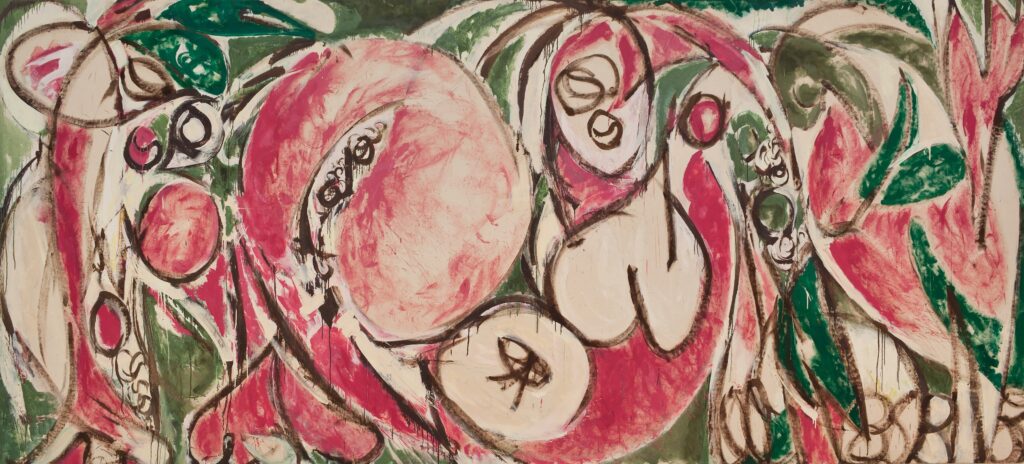
If Krasner did process her emotions through art, it wasn’t until the early 1960s when she made a series of paintings dubbed by the poet Richard Howard “Night Journeys.” She pulls back from the vibrant, exuberant colors of the late 1950s, the pink and green canvases, and works with an earthier, more monochromatic palette, with a new focus on motion animating the entire canvas without a center or focus.
You can lose yourself as thoroughly in Krasner’s 1960 “Polar Stampede” as fully as any of Pollock’s drip paintings, and the feeling is more three dimensional. With Pollock you are always keenly aware of surface, with streaks of paint laid over and under one another without suggesting foreground or background, or depth. In “Polar Stampede” the energy is just as vibrant but the turbulence goes deeper, rummaging beyond the skin and deep into the fur of the world.
Some of these works were made at night during a period after the 1959 death of Krasner’s mother, when the artist was suffering from insomnia. Working at night meant less light and thus less control over color, which may explain the more muted hues. The loss of her mother may have pressed upon the still raw wound of Pollock’s death. Krasner seemed to acknowledge that possibility: “I didn’t know how to deal with Pollock. It was a rough life.”
It was a rough life, but a life that extended 30 years longer than that of Pollock, to whom she was married just over a decade. She had more life, more time, more opportunity for reversals and reexamination. Pollock’s reputation eclipsed hers for the rest of her life, and some critics have argued that even now she deserved an exhibition at the Met devoted entirely to her, not to her relationship to Pollock.
But it is thrilling to see her work beside, beyond and at last transcendently untethered to Pollock. The exhibition opens and closes with work in which Krasner recycles in collage earlier paintings, drawings and materials including, as in the “Color Totem,” works of Pollock. Often, in her collages, she cuts and pastes shard-like shapes, sharp-edged, knifelike forms. They have a strange menace and beauty, like icicles dangling from trees in the spring or the blades of ice that shatter and gather along the banks of a frozen river. If you look past their danger, and imagine they might be something altogether different, they cohere into something prismatic, like stained glass, luminous and otherworldly.
The exhibition subtitle, “Past Continuous,” is happily borrowed from a late, large collage, made in 1976, in which Krasner included some her early drawings in a grid of vignettes. One square is entirely abstract, a burst of fiery ocher reminiscent of the momentary appearance of color in Barnett Newman’s “Stations of the Cross.” We often process our own lives with the same raw documentary materials that a scholar or historian or police detective might use: documents, photographs, scraps of text and faded letters. In an earlier work, Pollock’s 1953 “Portrait and a Dream,” her husband juxtaposed a black-and-white eruption of abstract motion with a surreal face, as if trying to weave together two unresolved threads of his past.
In “Past Continuous,” Krasner lines up relics of her own artistic journey, gives them order, and then inserts that single block of volatile color, like the last maple tree burning in the fading light of autumn. It’s autumnal, but not morbid, an assertion of energy and heat among spent coals.
She didn’t just have a longer life than Pollock, she knew how to use it. One suspects that she knew that all along, from the moment she first met Pollock, when she fell in love, when she married him and on through and beyond his self-destruction. He appears in this show not as its subject or hero, but because for a while their lives were intertwined too deeply ever fully to be disentangled.
The post It was one of art’s messiest marriages. At the Met, her genius eclipses his. appeared first on Washington Post.