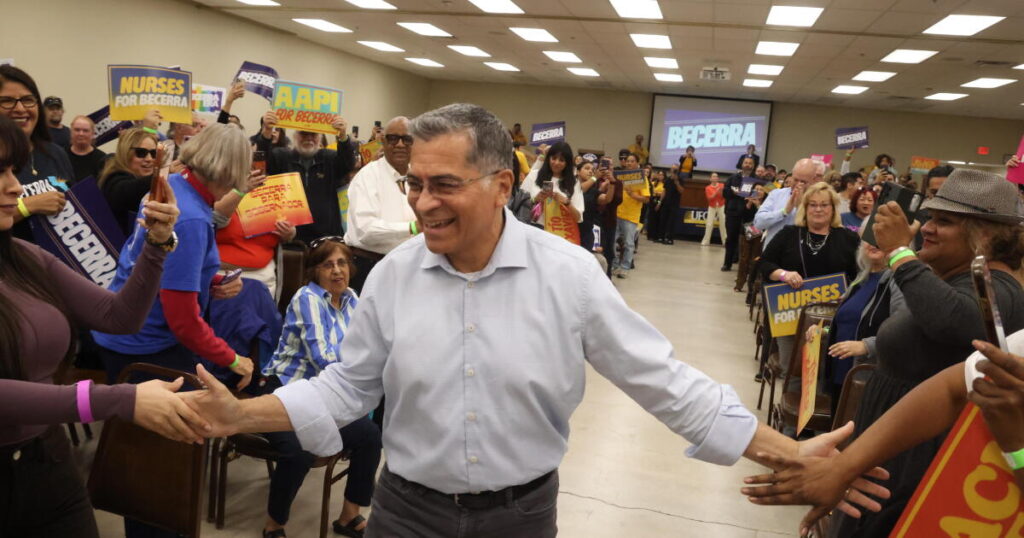
SACRAMENTO — During his election night victory speech in Sacramento, Gov.-elect Xavier Becerra held up an orange campaign shirt made by the laborers union.
“LiUNA in the house,” he said to cheers from members of the Laborers’ International Union of North America in California. “I told you they were in the house.”
California’s 41st governor didn’t mention that the laborers were in fact the only union in his house from the start of his campaign.
In a turbulent 2026 gubernatorial race, organized labor had two chances to endorse Becerra when he needed support before the June primary. Most unions blew both opportunities.
Now for the first time in at least a generation, a Democratic governor will take office with significant independence from the most powerful unions — and most other major interest groups — in California.
“He has an opportunity that no other Democratic governor has had in decades,” said Dan Schnur, who teaches political communication at USC and UC Berkeley. “If Becerra wanted to, he would have the freedom to chart a much more independent course than Democratic governors normally have.”
California’s Democratic governors and unions are typically coupled in a powerful political marriage that starts long before election day.
Unions exercise their power by sending legions of workers to knock on doors and canvas for the candidates they endorse and whose values align with their priorities. Endorsements from the biggest unions, such as SEIU California State Council, the California Teachers Assn. and the top unions within the California Federation of Labor, can come with six, or seven-figure political contributions.
Once in office, governors often remember the support and open their doors when union leaders come knocking.
Teachers announced their support for then-candidate Gavin Newsom more than seven months before the 2018 gubernatorial primary. One of his first moves in office was to champion new charter school transparency rules that they had failed to pass for years. Charter school advocates had also spent millions supporting his opponent Antonio Villaraigosa, the former L.A. mayor, which irked Newsom.
For unions, a governor’s help is often critical to push politically thorny policies through the state Legislature and pressure waffling lawmakers to support a bill. For public-sector unions who negotiate union contracts with the governor’s administration, a close relationship can be particularly beneficial to their members.
To the crowded field of Democratic candidates competing in June, public support from powerful unions was seen as a way to lift them out of the pack in the primary and build momentum for their campaigns.
But picking a candidate from among nearly a dozen Democrats with few policy distinctions between them proved unusually challenging for even the most seasoned political operations. The last time there was no clear front-runner in a California gubernatorial primary was in 1998, when former Gov. Gray Davis came from behind in polls.
The California Federation of Labor endorsed four candidates in March. None were Becerra.
After picking Rep. Eric Swalwell before he was accused of sexual assault and dropped out, the California Teachers Assn. settled on billionaire Tom Steyer for its do-over choice because of his promise to raise revenue, including for schools, by increasing taxes on commercial properties, colloquially known as split-roll.
SEIU California backed Swalwell first and then made a safe dual endorsement of Steyer and Becerra. The split support, though it benefited him more than the others, still limited Becerra’s ability to take full advantage of the union’s backing at a time when he was grossly overmatched in fundraising against Steyer, who spent more than $200 million of his own wealth on his campaign.
“Most of labor tried to be for what they thought was going to happen, and they were wrong,” said Rob Stutzman, a Republican political consultant. “None of it panned out.”
The missed opportunity leaves most of labor in an unfamiliar place at the start of the Becerra era: with their hat in hand.
It’s unclear if Becerra will hold a grudge.
Davis still recalls who had his back early and who did not.
“No one is going to fault you for remembering people who helped you in your time of need,” Davis said. “The question is, can you do it in a way that’s fair, that’s transparent, and that doesn’t block more compelling ideas coming from groups that may not have been for you, but came up with a better public policy solution.”
Every gubernatorial transition creates anxiety in Sacramento as interest groups try figure out a new governor, their leadership style and who is in and out of their inner circle.
Stutzman and others doubt that Becerra will turn his back on workers. The incoming governor has a track record of supporting unions and has close relationships with individual local union leaders.
In his election night speech, he described himself as a new sheriff in town with a “law degree and a union card.” He worked as a laborer in college with the same union his father was a member of for 40 years.
That kinship inspired the California State Council of Laborers to endorse Becerra in November 2025 when he was polling in the low single digits. Most other labor organizations jumped on board after he won the primary and he didn’t need their help to trounce his Republican challenger Steve Hilton in the November election
“Xavier was raised on a labor’s pension, a laborer salary,” said Joseph Cruz, the executive director of the laborers. “He understands what our membership’s lives look like every single day. He was family to us, and that was one of the big reasons why we endorsed him. But also because he lived that life, he knew how to connect to my leadership.”
That support proved prescient. When Swalwell dropped out of the race in April, Becerra almost immediately began climbing in public opinion polls.
“I got my guys together and said, “Hey, we’re never going to see this opportunity again in our lifetime where we endorse the candidate at 1 or 2%, who’s a laborer, who now has enough to have a chance,’” Cruz said. “Did he have a clear path to victory? Of course not. But he was in the race at that point.”
The laborers formed an independent expenditure committee in late April with the California Primary Care Assn., another early Becerra backer. The union put in $2 million to start, with another $450,000 before the primary, according to campaign finance filings.
Newsom’s political consultants, Bearstar Strategies, dropped a pro-Swalwell independent expenditure committee and started working with the group supporting Becerra. Several people who worked on Swalwell’s campaign also took jobs with Becerra.
Before the primary, the committee supporting Becerra received big donations from the California Assn. of Realtors, the Pechanga Band of Indians, California Medical Assn., electrical workers, Airbnb and Meta.
California campaign finance law limits the amount of money candidates can directly receive from donors. Supporters can provide unlimited funding to outside independent expenditure committees, also known as political action committees or PACs, that cannot coordinate their spending with the candidates.
Meanwhile, the California Chamber of Commerce, PG&E, Realtors, developers and other business interests continued to funnel a total of $37 million to a never-Steyer committee run by Jim Deboo, a Democratic political consultant and former chief of staff to Newsom. Though the committee was formed to oppose Steyer, hitting his billionaire opponent helped Becerra. In early May, they ran their first ad contrasting the two candidates in support of Becerra.
In comparison, before the primary SEIU-affiliated local unions individually gave Becerra $137,200.
Jennifer Barerra, the chief executive of the California Chamber of Commerce, said her organization opposed Steyer because he campaigned against the business community and made promises that would place more costs and burdens on companies, such as increasing commercial property taxes and enacting single-payer healthcare.
Shortly after the primary, the Chamber made a historic step and endorsed Becerra, the first Democratic governor to win the support of the powerful business group, which often declines to weigh into the race at all.
Becerra expressed a desire to work with the business community, she said, instead of viewing them as an enemy.
“Feeling like a partner and extending a hand versus pointing a finger and blaming them for all the faults of California definitely resonated with the members,” Barerra said.
The incoming governor’s support, and lack thereof, is fueling hope that more advocacy groups will be included at the start of his administration compared with the early days of Newsom’s governorship.
Newsom received strong support from the labor movement and walked into office with a series of progressive policy commitments to make good on that unions helped him push. Over time, Newsom’s positions shifted more moderate and his relationship with the business community improved even as he remained close to labor unions, such as SEIU and CTA.
“It’s very different to start in this place, where I feel like we have a better seat at the table now with Newsom, so to speak, but I think we’re starting in that position with Becerra,” Barerra said.
The unusual dynamics in the race allowed Becerra to cruise to victory in November without making the same kinds of liberal promises to interest groups. But the proposals he has endorsed suggest the governor-elect’s agenda could naturally align with some labor priorities.
In a CNN debate in May, Becerra indicated that he would restore Newsom’s cuts to healthcare coverage for undocumented immigrants, which has included adding premiums for care and freezing enrollment to rein in soaring costs. He has since said he needs to see the state’s balance sheet first.
The Democratic governor-elect also endorsed a concept SEIU has been pushing to penalize large corporations that do not offer affordable healthcare for full-time workers. Though the details of the plan are yet-to-be seen, the idea is to target corporations whose low-income workers continue to receive care through Medi-Cal, forcing taxpayers to pick up the tab.
Becerra also offered what appeared to be an olive branch to the teachers this month.
He named Teri Holloman, the associate executive director of governmental relations for the California Teachers Assn., as his appointments director for his transition into office. The post gives the teachers’ political strategist, a veteran Sacramento operator, an influential role in filling positions on state boards, commissions, departments and agencies in the new governor’s administration.
Christian Grose, a professor of political science and public policy at USC, described Becerra as a leader who will want to work with groups across the political spectrum.
Politicians, he said, also have long memories and there could be some lasting damage for unions that didn’t back him, creating opportunities for others.
“He’s going to also be working with more corporate aligned political advocacy groups, and I actually think some of the more center-left and center-right lobbyists in Sacramento are excited about somebody who wasn’t endorsed extensively by unions,” Grose said.
The post Early endorsements leave labor in unusual position at start of Becerra era appeared first on Los Angeles Times.