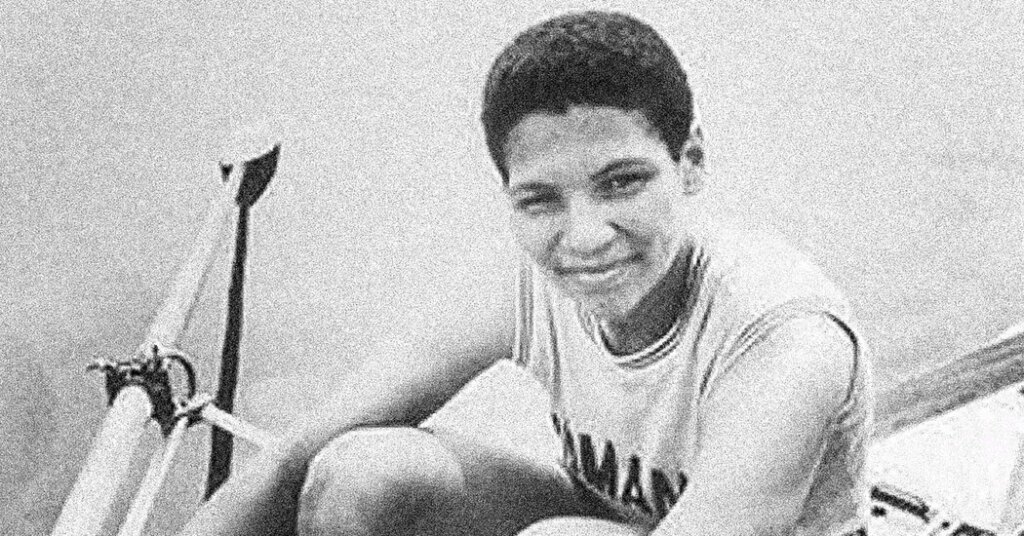
Anita DeFrantz, who was the first Black woman to win an Olympic medal in rowing, a relentless advocate for athletes’ rights when the United States boycotted the 1980 Moscow Games and the first American woman elected to the International Olympic Committee, died on Wednesday in Santa Monica, Calif. She was 74.
Her death, in a hospital after a years of treatment for gastric cancer, was confirmed by her brother David DeFrantz.
Ms. DeFrantz saw the Olympics as a rare opportunity for athletes from different countries and cultures to meet and compete, even as doping scandals, geopolitics and corruption controversies have tarnished the Games over the years. She also fought to expand the participation of women — both as athletes and as sports executives.
During the Olympic torch relay ahead of the 2026 Milan-Cortina Winter Olympics in Italy, Ms. DeFrantz handed the torch to Kirsty Coventry of Zimbabwe, the first woman elected president of the I.O.C.
“She really led the way for female leaders in sport globally,” Ms. Coventry told Olympics.com, the organization’s official news site, after Ms. DeFrantz died.
Ms. DeFrantz won a bronze medal as captain of the women’s eight-person rowing crew at the 1976 Olympics in Montreal and continued training with aspirations of a gold medal at the 1980 Moscow Games. But in March 1980, President Jimmy Carter announced an American boycott of the Moscow Games after the Soviet Union invaded Afghanistan.
As a lawyer and a spokeswoman for the U.S. Olympic Committee’s athletes’ advisory council, she led a group of 25 athletes that sued the committee, which supported the boycott.
The lawsuit failed, which was crushing, Ms. DeFrantz often said through the years, noting that, in an era of amateurism, American athletes received no local, state or federal money to help them train.
In a 2020 video interview with Edwin Moses, a top hurdler who was also named to the thwarted 1980 Olympic team, Ms. DeFrantz recalled receiving death threats from people who called her selfish for wanting to compete in those Games.
“I knew some athletes wouldn’t want to go,” she said. “That was fine, but those who did should have that right.”
Years later, Mr. Carter was said to have told Jeff Blatnick, a wrestler who was named to the 1980 Olympic team, that the boycott was a “bad decision.”
The most irritating aspect of the boycott, Ms. DeFrantz told Mr. Moses, was the erasure experienced by the athletes: “We are the team with no result. They don’t know our names. They don’t care about us. Nobody knows what sports we’re in. Our glory days do not exist.”
Anita Lucette DeFrantz, who went by Lucy, was born on Oct. 4, 1952, in Philadelphia and grew up in Indianapolis. Her father, Robert DeFrantz, was a community activist and social worker. Her mother, Anita (Page) DeFrantz, taught audiology and speech pathology at Indiana University and later education at the University of San Francisco.
Lucy joined a swim team in Indianapolis. She liked basketball, but the sport was not offered for girls at her high school, her brother said. Still, she made the basketball team at Connecticut College, where she studied music and received a bachelor’s degree in political philosophy in 1974. In her sophomore year there, she discovered rowing, which she once described as “the most noble of all sports.”
She returned to Philadelphia, a popular training site for elite rowers, and entered law school at the University of Pennsylvania as she trained for the 1976 Olympics. She graduated in 1977.
After becoming more dedicated to rowing in 1974, she “lit on fire,” Bart Gullong, her rowing coach at Connecticut College, told The Hartford Courant in 1997. “She lost 45 to 50 pounds and really trained hard. She made the national team the following year. And the following year she made the Olympic team.”
The 1980 Olympic boycott left Ms. DeFrantz determined to make sure that athletes’ voices were not ignored. She served as vice president of the organizing committee of the 1984 Summer Olympics in Los Angeles. During those Games, the first Olympic women’s marathon was held.
While Ms. DeFrantz did not play a pivotal role in getting the 26.2-mile race approved, she “was incredibly supportive of that decision,” Kathrine Switzer, an early competitor in the Boston Marathon whose activism was at the forefront of the marathon’s Olympic inclusion, said in an interview.
From 1987 to 2015, Ms. DeFrantz was president of what is now called the LA84 Foundation, and managed $93 million of the $232 million surplus from the 1984 Games. The foundation funds grants to expand youth sports participation in Southern California and supports a library and research center. By the time she retired, the foundation had awarded $192 million in grants and had grown its assets to nearly $160 million, according to The Sports Examiner, an outlet that covers Olympic sports.
In 1986, Ms. DeFrantz became only the fifth woman to join the I.O.C. — historically a European-dominated men’s club — and the first American woman to do so. She was also its first African American member. In 1997, she became the first woman named vice president of the I.O.C.; she served two four-year terms in the role.
“She was a warrior her whole life against all odds,” Donna de Varona, a U.S. Olympic official and a 1964 Olympic swimming champion, said in an interview. “She fought for what she believed in. Her whole life was dedicated to the Olympics and athletes and young people. She lived her dream and because she did, so many benefited.”
In addition to her brother David, Ms. DeFrantz is survived by two more brothers, Thomas and James DeFrantz.
In 2001, she became the first woman candidate for president of the I.O.C. From 1995 to 2014, she was chairwoman of what was then called the I.O.C.’s Women and Sport Commission and helped expand participation in the Olympics. At the 2012 London Olympics, every participating nation included female athletes for the first time. At the 2024 Paris Olympics, women for the first time made up half of the 10,500 athletes. Today, 46 of the I.O.C.’s 106 members are women.
Ms. Coventry, the current I.O.C. president, recalled to Olympics.com the early advice that Ms. DeFrantz gave to her and other women athletes who had joined the Olympic committee: “Even though you sit at the back of the room, you should be the loudest.”
Ms. Coventry added, “Anita opened doors for the rest of us, but her real legacy is that she expected us to keep those doors open for those who come next.”
The post Anita DeFrantz, Who Rowed Her Way Into Olympic History, Dies at 74 appeared first on New York Times.