Manhattan is on track to have its strongest year in office leasing since 2000, and artificial intelligence companies are playing a major role in that turnaround.
Their arrival has made New York the A.I. industry’s largest office market outside San Francisco. In the first half of this year, A.I. companies made up more than 8 percent of all new leasing in Manhattan, up from less than 1 percent in 2020, according to a report from Savills, a real estate company, and CompStak, a data provider.
The industry’s expansion in New York to be near companies that buy their products and supply their funding is happening as the office market has grown ever tighter in the city, with many buildings being converted to housing and little new office construction taking place.
The surge has benefited landlords, who can get leases with longer terms and higher rates — and created challenges for A.I. companies seeking more space as they grow.
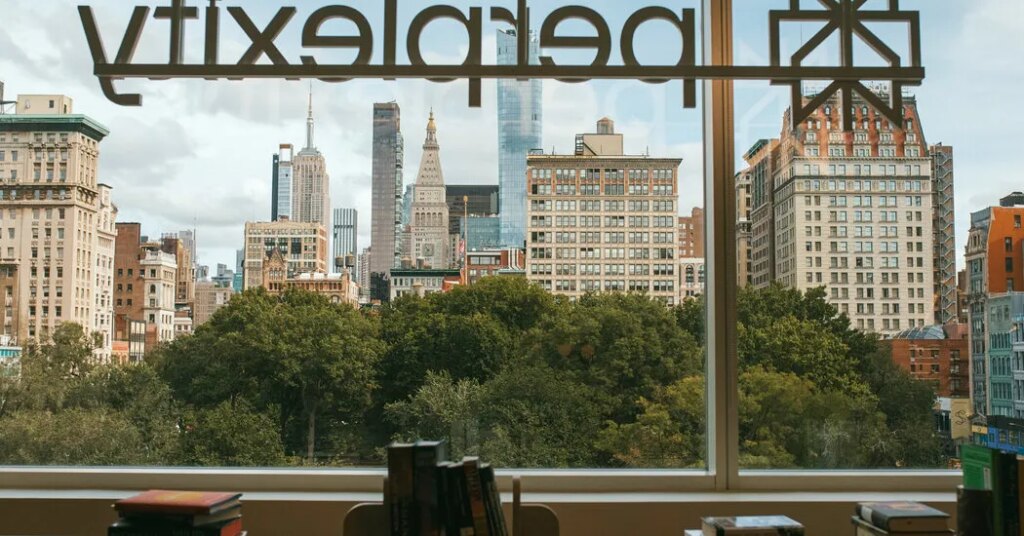
One such company is Perplexity, the maker of an A.I.-powered search engine that arrived in Manhattan in 2024 and has taken a somewhat unorthodox approach to expanding its footprint in the city.
In 2025, Perplexity signed a lease for an 8,000-square-foot space on the fourth floor of a building in the Union Square neighborhood, then signed a second lease early this year for a 12,000-square-foot space in the building next door, also on the fourth floor. The buildings happen to be owned by the same landlord, the Feil Organization, which proceeded to slice through their exterior walls to unite the floors, creating a sprawling, if quirky, space for the company to spread out.
One side of the office has high ceilings and massive arched windows, while the other has standard ceilings and windows. A ramp in the opening between the buildings was installed to align the floors. ALA Studio, an architecture and design firm, turned the gaping hole into a clean-lined arched passage tiled with penny mosaics — a reference to subway station walls and the lobby floors of historic Manhattan buildings.
Nathan Barksdale, Perplexity’s general counsel and chief operating officer, expressed satisfaction with the design maneuverings on a recent tour of the now 22,000-square-foot space, but he said the company was already searching for more room. (The company lists 92 jobs on its website that could be filled in New York.)
“We’re already looking to expand,” he said.
Perplexity will have to compete with all the other A.I. companies looking for space in New York. The city’s Economic Development Corporation counted more than 2,000 A.I. start-ups in New York last year. Those companies have leased more than six million square feet, said Jonathan Mazur, who leads research at the Newmark Group, a real estate firm.
“The biggest takeaway is the pace of growth,” said Matthew Schreck, a research director at Savills. “A.I., on its own, is already one of the top five industries leasing space in Manhattan.”
Aside from Perplexity, there’s Anthropic, which recently had a record-setting initial public offering and occupies an entire 16-story building in the Hudson Square neighborhood. Harvey AI, which specializes in A.I. tools for legal companies, and Clay, a sales and marketing start-up, have planted flags in Flatiron. OpenAI leased about 90,000 square feet in the Puck Building in SoHo.
(The New York Times is suing OpenAI and Perplexity over alleged copyright violations. The companies deny the claims.)
In Brooklyn, there are companies like Rilla, a homegrown operation that uses A.I. to coach sales teams. The company, which in August moved into 57,000 square feet in Williamsburg, offers an $18,000 stipend annually to employees who rent apartments near the office as an alternative to what its chief executive, Sebastian Jimenez, called an “annoying” commute from Manhattan. Eighty percent of the company’s 130 employees take the stipend, he said.
At Perplexity, Mr. Barksdale is searching for more space in a significantly tighter market than when he began exploring Manhattan real estate.
Both of the company’s buildings, which were 25 percent vacant two years ago, are fully leased today, said Andrew Weiner, head of commercial office leasing for Feil. Mr. Barksdale has toured the top floor of one of the buildings, which will become available in 2028. He has also considered other buildings in Union Square, with the idea of developing what he called a “Perplexity campus” in the neighborhood.
Even as A.I. companies continue to add office space in New York City, there is some concern that the momentum will someday come to a crashing halt as the technology eventually displaces workers, shrinking demand for offices. Some see worrying similarities with the boom-and-bust cycle of the dot-com era.
That kind of outcome is always possible, Mr. Schreck of Savills said, but most A.I. companies are well capitalized, he added, so that even if a business fails, it should be able to fulfill its lease obligations. “I don’t think it would tank the market,” he said, noting that finance and law, in addition to the broader tech sector, are also buttressing the office market today.
The post A.I. Companies Race for Space in New York, a City That Doesn’t Have Much of It appeared first on New York Times.