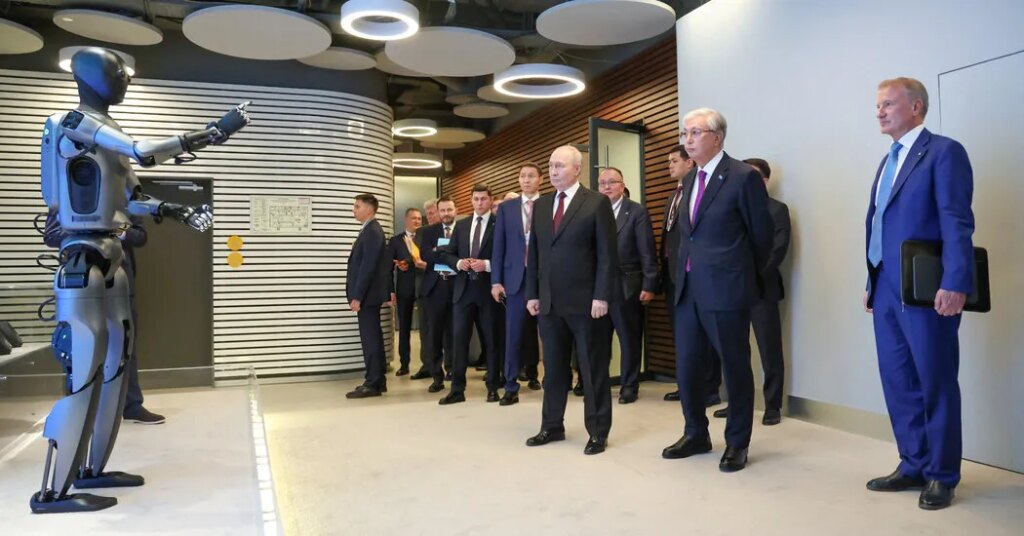
The humanoid robots shimmied and leaped in perfect synchronicity with the flesh-and-blood dancers behind them. President Vladimir V. Putin, eyes wide at times, took in the spectacle from the audience at Russia’s flagship technology conference.
In this display and many others at the event, called A.I. Journey, the country’s future was presented as being shaped not by the war in Ukraine, but by the development of artificial intelligence. Russia, Mr. Putin said in his keynote speech on Thursday, wants the adoption of A.I. to encompass “all spheres of the economy and people’s lives.”
Yet even as Russian officials look to the technology to offset a range of problems like labor shortages, the country’s technological development has been constrained.
Russian A.I. models depend on American and Chinese hardware that has become harder to obtain and more expensive because of sanctions. Immense spending on the military has diverted resources. Technology talent has left Russia because of the war. Security officials monitor domestic A.I. models to ensure that they comply with censorship rules.
And this year, a new challenge emerged after Ukrainian drones attacked some of the country’s most powerful data centers.
Still, Mr. Putin and senior technocrats remain determined to push Russia forward in A.I.
During the conference, German O. Gref, the head of Russia’s largest bank, Sberbank, unveiled the latest model of its flagship GigaChat bot, claiming that it approaches the capabilities of leading Chinese models such as DeepSeek.
The bank has woven the model into daily life in Russia. Some Moscow restaurants offer A.I.-assisted menus, and museum exhibitions use A.I.-powered guides to explain the works on display.
The model remains censored. For instance, GigaChat declines to give concrete examples of what Mr. Putin’s opponents criticize him for, saying it is a “sensitive” topic.
A Russian data scientist involved in the bot’s development said that the security services watched closely to make sure that the model complied with a loosely defined set of “traditional values.” The developer spoke on the condition of anonymity because he was not authorized to speak publicly.
Mr. Gref has pitched the bank’s model as the only genuinely domestic option, arguing that it can therefore be used in sensitive fields such as defense, according to a Russian official involved in developing digital infrastructure. The official spoke on the condition of anonymity to discuss internal deliberations.
Even as Russia and China have drawn closer in recent years, there is unease in Moscow over growing too dependent on Chinese technology. In his speech, Mr. Putin said Russia was “betting on sovereign foundational models.”
“We must not end up in a situation we have already experienced, when someone presses a button for us and everything stops working altogether,” he said.
At the conference, Russian officials and business leaders struck an effusive tone about A.I., suggesting in speeches that the technology could help solve many pressing problems at once. Endless screens showcased how A.I. could improve Russia’s court system, health care and even pothole repair.
Officials argued that the technology could make up for labor shortages caused by Russia’s demographic challenges. The country is projected to lose roughly 820,000 people to population decline this year, according to a leading demographer. That includes some of the hundreds of thousands of soldiers who have been killed over nearly five years of war in Ukraine, according to recent estimates.
“For Russia — as we are developing amid serious demographic challenges and a shortage of labor resources — such technologies are a real opportunity to overcome limitations and strengthen our potential,” Mr. Putin said in his speech.
Although Western sanctions are a hurdle to Russia’s A.I. development, technical specifications released with the GigaChat model underscored how Russian companies had managed to procure advanced chips. Aleksandr A. Vedyakhin, the first deputy chairman of Sberbank, declined to comment on how the company obtained the chips, saying only, “We are doing it somehow.”
Still, while Russian companies may be able to get some of the hardware they need, many of them, including those owned by the state, use American and Chinese models in their work, instead of developing their own.
According to Stepan Gershuni, a Russian technology investor and entrepreneur, “it isn’t just about computing capacity — it’s also about access to capital, access to talent and companies’ willingness to do it.”
“A serious effort to build a competitor today would require investments in the single-digit or tens of billions of dollars,” Mr. Gershuni said in response to written questions. “In the current economic climate, Russian businesses simply don’t have that kind of money. I can’t speak for the government, though it seems they are spending their money elsewhere.”
Since invading Ukraine, Russia has poured hundreds of billions of dollars into its military.
In addition to the financing shortfalls, the war has left Moscow scrambling to protect the domestic technology infrastructure. This fall, Ukrainian drones struck several data centers, including a facility being developed by Sberbank. The company’s main rival, Yandex, had three data centers hit and damaged.
But Kremlin officials have argued that Russia has advantages in the A.I. age, including its vast energy reserves and remote territory.
On Tuesday, Mr. Putin approved a program to build data centers in Russia’s coal-mining regions of Kuzbass and Yakutia, areas far from the front line in Ukraine. Depleted coal pits and shafts there could be used to shield the facilities from attack.
Kirill A. Dmitriev, the Kremlin’s senior envoy on talks with the United States, said at the conference that cheap domestic energy gave Russia “an exclusive global advantage as the lowest-cost power supplier for data centers worldwide.” He added that Moscow could build data centers for both the United States and China.
“In the current geopolitical climate, that may sound like a fantasy,” Mr. Dmitriev said. But in a few years, he added, “countries will realize that managing complex A.I. systems requires capabilities Russia can provide that others simply cannot.”
Oleg Matsnev contributed reporting.
The post With Dancing Robots, Russia Projects a Future Shaped by A.I., Not War appeared first on New York Times.