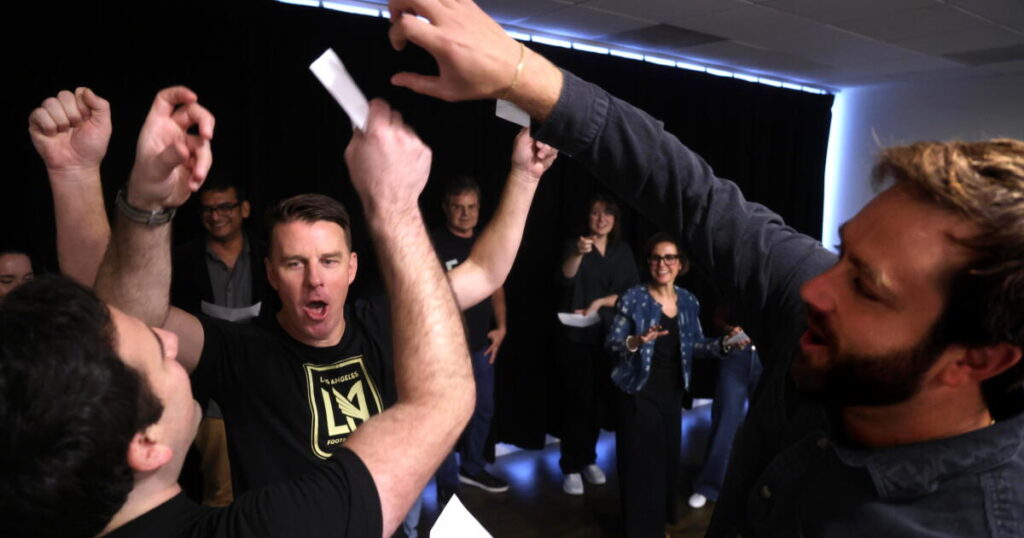
High on adrenaline and king-sized bars of Payday and 100 Grand, a punchline’s worth of plaintiff’s lawyers clowned around a Mid-Wilshire office tower one recent afternoon, learning how to talk nonsense and influence jurors.
“Who hasn’t been made uncomfortable yet?” asked actor and attorney Brian Breiter, who leads this popular workshop for litigators.
Eugenia Bagdassarian, a personal injury lawyer with towering curls, tentatively raised her hand.
By this point, she and her classmates had already crawled around on all fours, held a cocktail party in gibberish and exchanged invisible gifts, among other ego-piercing exercises.
Such games are stock-in-trade for beginner improv classes, dozens of which can be found in Los Angeles on any given day. Once the sole province of aspiring actors and up-and-coming comics, improv has long since spread to corporate team-building, pediatric play therapy and even dating.
Still, Improv for Trial stands apart. In this elite workshop, buttoned-up attorneys learn how to let go and “just do” in service of winning civil cases and the occasional criminal conviction.
(Though he has taught thousands of law students, prosecutors, public defenders and plaintiff’s attorneys, Breiter generally bars civil defense lawyers from his improv courtroom, in part because he considers most too risk averse, and in part to disadvantage the competition.)
To nonlawyers who deal daily with the vagaries of our judicial system, the utility of such a course is obvious: a trial requires sustained close attention from jurors who don’t want to be there, something even a law professor may struggle to command.
“This is my favorite thing to do,” said Joseph Limbaugh, Breiter’s longtime acting partner and co-teacher. “Some of this stuff I’ve never tried with lawyers before.”
After each game, Breiter would debrief. Imaginary gifts became an object lesson for voir dire, the nonsense-party, nonverbal communication. Talking around the letter “r” or “s” or “t” was meant to help navigate motions about what evidence can be presented at a trial.
“The most important thing is hyper-listening, being super observant and understanding how you are perceived,” Breiter explained. “I would do a trial 10 different ways depending on the audience I have.”
For most of the last 15 years, Breiter and Limbaugh have taught this class in a purpose-built theater, complete with plush velvet curtains, a movable witness stand, and half a dozen Muppet-style hand-and-rod puppets slumped on a hat rack in the corner.
“Puppets allow you to say and do things that you as a human can’t,” Breiter said.
“I feel like puppets and masks are the only magic left in the world,” Limbaugh agreed.
Around the room hung framed posters of Hollywood court movies, including “A Few Good Men,” “My Cousin Vinny” and “Legally Blonde.”
Breiter’s most infamous wins are nearly as dramatic: closing arguments performed as a game show, Oscar the Grouch interrupting to ventriloquize arguments for the defense, a baking competition enacted through mime.
To those outside the law, all this might appear like a Tinseltown affectation. In a city where accident attorneys are their own brand of roadside celebrity, even lawyers struggle to grasp the utility at first.
“I have no idea what to expect, except the email said ‘wear comfortable clothes,’” said Jacob Seropian, a last-minute addition to the class.
To understand why this class is so popular, it helps to understand just how different courtroom dramas are from courts in real life.
There’s a reason Hollywood can’t quit the legal procedural.
The American judicial system is “adversarial,” meaning tension is built into the process. So too are stakes. Trials are a war of narrative. Lives hang in the balance.
This is true not only in criminal court, where liberty and justice spar out of necessity (see: “To Kill a Mockingbird”), but increasingly in the civil division (See: “Philadelphia”), where everything from domestic military deployments to the limits of social media have been fought — often, though not always — before juries.
Yet many of this country’s busiest halls of justice are not ready for prime time.
In courtrooms smelling of burnt dust and WPA-era plumbing, most of what happens is stultifying.
Journalists distill hours of crushing boredom into a highlight reel with context and observation that sets the most significant moments apart from the tedious accretion of detail necessary to fit a messy set of facts inside a tidy set of laws.
But jurors don’t have that luxury. They must sit attentively through days, weeks and sometimes months of testimony without the benefit of snappy experts, clever editors or a union paycheck to guide them.
“When you watch these TV lawyers, they’re actors so they know how to perform their role,” Breiter said. “Most lawyers don’t know how to tell a story. They don’t even know what a story is.”
There are several good reasons for this. First, even in Los Angeles, most lawyers are not actors. Second, the law is bound by a library’s worth of complex rules. Third, attorneys are trained to be ruthlessly analytical.
Breiter’s goal is to loosen those binds so that lawyers can connect with lay people, and move them.
“The audience can’t walk out. You have them captive there,” he said of the jury. “You have to be appreciative of their time and make it enjoyable when it can be.”
To that end, he frequently casts his student-audience as jurors — a role lawyers adopt almost unconsciously, and with total fluency.
“Who here speaks another language?” Breiter asked while debriefing the gibberish exercise.
Constantinos “Dean” Pavlakos raised his hand, showing off a muscled arm inked with Greek iconography. At Breiter’s instruction, he answered questions in fractured English for a mock voir dire, reacting gamely as the teacher recruited other attorney-jurors to his cause in a pedagogical version of crowd work.
These exercises build toward the marquee concept in Breiter and Limbaugh’s workshops: Status.
Black’s Law Dictionary defines status as “a person’s legal condition” including their rights, duties and liabilities. In Limbaugh and Breiter’s stage court, it’s a term of art invented by the late acting teacher Keith Johnstone, of whom the pair are disciples.
Johnstone’s school of theater is less “yes, and” and more relationship building.
For Breiter and Limbaugh, status is a framework for radical empathy — that is, inhabiting another person’s perspective in the pursuit of justice — albeit justice in the form of money damages.
In the lesson’s status exercises, students practiced observing and projecting power dynamics. Participants loomed and shied, minced and strutted, advanced and retreated, first in opposition, then in concert, until at last each was charged with addressing their peer-jury with an improvised speech about an unfamiliar topic while attempting to maintain eye contact with everyone simultaneously.
It was torture that induced rib-aching laughter.
Attorneys have a common, cringey habit of reminding jurors just how essential they are to the legal system.
Improv for Trial puts that platitude into practice.
In reality, justice requires millions of ordinary people to open that letter no one wants and show up to that leaky, roach-infested courthouse where no one wants to be, on the off chance they might be selected to decide the fate of a stranger.
When court is a bore, justice suffers along with the jury.
“Jurors dread going to court,” Breiter said. “If they’re going to take 8 to 25 days out of their life and sit there, you better make it entertaining.”
The post Improv for lawyers: L.A. acting class offers tips on influencing jurors, courtroom banter appeared first on Los Angeles Times.