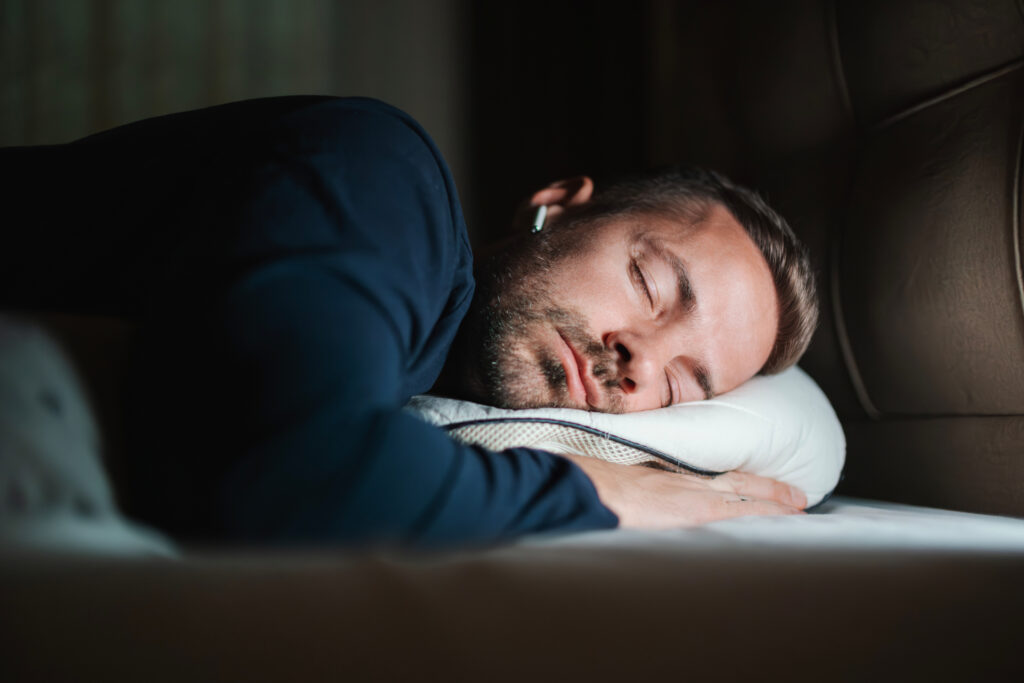
If you ever fell asleep as a kid with someone reading to you, you might remember the feeling: You’re following the story, your eyelids get heavy and the next thing you know, it’s morning. With an audiobook, you may be able to experience that same lulling effect as an adult.
Experts often recommend reading as a healthier alternative to phones and TV for winding down before bed — no bright screen in your face, no temptation for endless scrolling. But sometimes your eyes are too tired, or you don’t feel like picking up a book. (Or maybe you did pick one up, and it keeps slipping out of your hands and knocking off your glasses. I’ve, er, heard this can happen.)
That’s where audiobooks come in. All you have to do is press play, turn out the light, close your eyes and see how far you get.
Why listening can help you drift off
Bedtime may be the first quiet moment you’ve had all day, which can make it easier for anxiety to creep in, said Aric Prather, a professor in the department of psychiatry and behavioral sciences at the University of California at San Francisco.
“Our minds are really active, and we don’t have the opportunity to process or deal with the things that are stressing us out until we get into bed, and all of a sudden we have that space,” Prather said. “For some of us, that space is filled with worries, thoughts about the day, thoughts about tomorrow, things you wish you had gone differently. And so that cluttered, active mind is certainly at odds with being able to fall asleep.”
An audiobook gives your brain something external to focus on, said Amita Sehgal, PhD, director of the Chronobiology and Sleep Institute at the University of Pennsylvania. Because it’s not about you, it may be less emotionally charged than replaying your own day — better to wonder how the detective is going to get out of this one than why you sounded so weird in that email.
Distraction is part of the appeal. In a recent non-randomized survey of more than 1,100 bedtime audiobook listeners in Sweden, quieting worries or racing thoughts was a common reason for listening.
How to fall asleep with an audiobook
Keep the volume low
The volume should be just high enough that you can follow the plot. Louder audio could disrupt your sleep, Sehgal said, whereas lower, more even tones may be easier to tune out as you drift off.
To create an ideal listening setup, it’s also important to use comfortable earbuds or headphones, Prather said. There are even Bluetooth sleep masks made for bedtime listening, such as Manta Sound, with thin, soft, adjustable speakers designed to feel good in any sleeping position.
Prefer to keep your ears free? If you sleep alone (or have a hard-to-disturb roommate), you can also listen through your phone’s speaker or a nearby smart device — as long as it doesn’t make a noise or announce that it’s disconnecting when the audio stops.
Set a timer
The sleep timer feature stops an audiobook automatically, so you don’t have to reach for your phone as you’re dozing or let the track play all night. Some audiobook apps, including Audible and Spotify, fade the sound as the timer ends, making the transition to silence less noticeable.
Start with a 30-minute timer, Prather suggests. It’s normal to take 15 to 20 minutes to fall asleep, he said, so that gives you a little breathing room without leaving the book playing all night. If you find yourself waiting for the timer to cut off, you may need more time.
There’s no perfect setting: How long you need will depend on how quickly you typically fall asleep and what you’re listening to, Sehgal said. Adjust until you find what works for you.
Choose a calming narrator and an easy-to-follow story
Your nighttime listening should probably diverge from your daytime selection. “Something that is a bit slower and even-paced is more likely to be effective,” Sehgal said. “The book has to take your mind off your own thoughts and life.”
Prather suggests choosing a narrator with a smooth, calming voice, a genre that “isn’t going to be activating for you” and a storyline that “isn’t too cognitively taxing.”
Richard Osman’s cozy mysteries are one place to start, with reviewers often highlighting their warmth, humor and endearing characters. The first two Thursday Murder Club books may fit the bill particularly well, thanks to British actor Lesley Manville’s soothing, unhurried narration.
Regardless of the genre, choose your audiobook before you’re ready to turn in, and listen to a preview to see whether the narrator’s voice appeals to you, Prather advised. “I think the important thing to remember is that the goal of listening to an audiobook is not supposed to count as ‘making good use of your time’ but a process for trying to facilitate sleep.”
Save anything that leaves you on the edge of your seat for daytime: “If it’s too exciting a book, you may stay up [listening to] it,” Sehgal said.
Nonfiction may be worth trying, too. “My intuition is that nonfiction may be drier, less suspenseful and less affective, all of which probably work to help people wind down,” Prather said.
Consider revisiting an old favorite
You could also try the audiobook equivalent of a comfort show you’ve seen a dozen times. Familiarity has a practical perk: there’s less temptation to stay awake for the next chapter.
Torrie Rathjen, an audiobookphile who founded a book club in her New Jersey town, returns to longtime standbys like “Little Women” and “The Time Traveler’s Wife.” “I know what’s happening, so when I fall asleep, I don’t miss what’s going on,” she said.
She also listens to the “Sleepy Bookshelf” podcast, which features classics read gently by a British voice-over artist. She plays it at a slower speed than her daytime audiobooks. Right now, she’s drifting off to E.M. Forster’s “A Room With a View.”
Experiment to find what works for you
“Sleep is universal, but it’s also kind of personal,” Prather said. One person’s page-turner may be another person’s lullaby.
For my neighbor Jaimee Gordesky, who spends hours commuting from central New Jersey to her job in Philadelphia, celebrity memoirs help her unwind. “I think it feels like listening to a friend. There have been times that I get super into [an audiobook], but most times it helps my brain shut off the day’s noise,” she said. Her go-tos are Stanley Tucci’s “What I Ate in One Year,” Alex Trebek’s “The Answer Is …” and “Spare” by Prince Harry.
It’s worth having other ways to wind down, too, so you’re not relying on an audiobook every night, Prather said. If insomnia is chronic, he recommends reaching out to a sleep medicine specialist, such as someone trained in cognitive behavioral therapy for insomnia.
As for this writer with insomniac tendencies, I like well-known stories at bedtime over my daytime penchant for high-drama World War II historical fiction. After years of reading Harry Potter aloud to my daughter — and it reliably putting us both to sleep — I let someone else narrate now.
The post Audiobooks may help you fall asleep — here’s how to choose the right one appeared first on Washington Post.