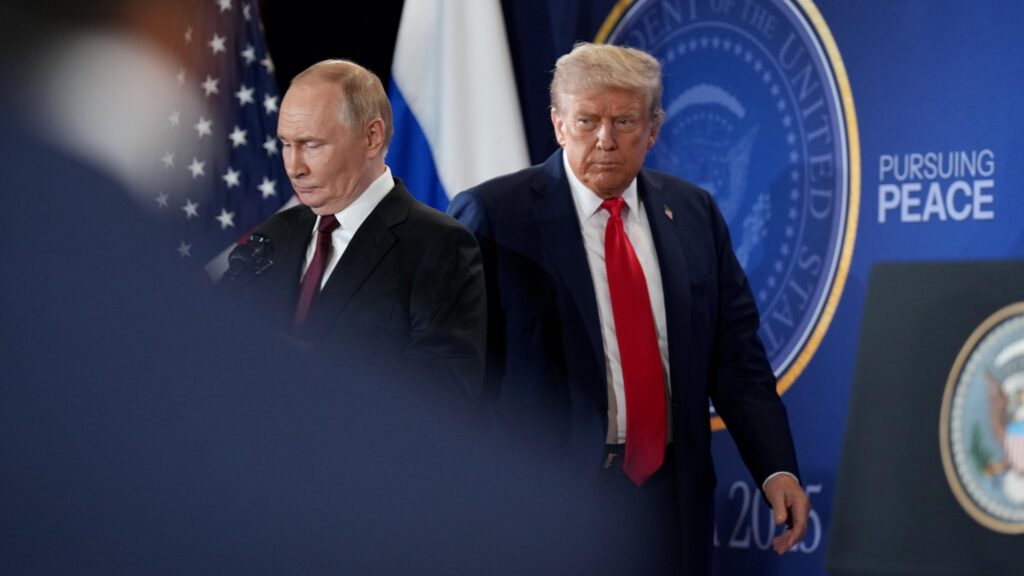
President Donald Trump on Thursday said he would like to see Russian President Vladimir Putin “pull back all military aggression against territories throughout Europe” in the hope that a deal can be made to end the Russia-Ukraine war.
“During my conversations in China with President Vladimir Putin, of Russia, I spent a lot of time talking about the fact that I would like to see President Putin pull back all military aggression against territories throughout Europe,” said Trump, referencing the meetings he had with Putin at the Asia-Pacific Economic Cooperation (APEC) summit last week.
Expressing his belief that a deal can be made “quickly,” Trump continued: “I really believe this is a strong possibility. Thousands of people are being killed each and every month. A complete bloodbath.”
The U.S. President didn’t specify what he meant by “territories throughout Europe,” but his remarks come amid concerns over the possible expansion of the Russia-Ukraine war.
A number of recent incidents involving NATO members have sparked fears. Last week, Poland accused Russia of violating its airspace after two missiles and a drone crashed in its territory. Russia denied violating Poland’s airspace. Estonia also recently accused Russian security services of ordering an attempted arson attack on an Estonian defense company. Russia’s Ministry of Foreign Affairs called the accusation “unfounded,” denying Moscow’s involvement. Tensions escalated further this week when Russia alleged that Estonia was quietly allowing Ukrainian drones to use its airspace to strike northwestern Russia and accused Tallinn of trying to obstruct Russian cargo ships in the Baltic Sea. Estonia vehemently denied both accusations calling them “baseless,” with Foreign Minister Margus Tsahkna stressing that the country “has not allowed and will not allow its territory or airspace to be used for drone attacks against Russia from Ukraine.”
Trump’s update came a day after he met with NATO chief Mark Rutte at his Mar-a-Lago estate. Trump said he informed Rutte of his conversations with Putin during the meeting, which primarily focused on Ukraine and Iran.
In a joint statement issued Wednesday night, Trump and Rutte said the “impactful” sit-down had seen them discuss the “importance of Russia avoiding any actions that intentionally, or unintentionally, expand the war, and the importance of obtaining a peaceful resolution to the war as rapidly as possible.”
Offering his own reflections of the meeting, Rutte—who has previously been dubbed the “Trump whisperer”—said: “It’s clearer than ever that American leadership remains essential as we build a stronger Europe in a stronger NATO.”
U.S.-mediated talks between Russian and Ukrainian delegations resumed earlier this month after a nine-month hiatus, but there is still no clear pathway to ending the current conflict which started in February 2022 when Russia invaded Ukraine.
Trump, as of late, has raised eyebrows over his interactions with Putin. On the sidelines of the APEC summit last week, he warmly greeted the Russian leader by referring to him as a “friend.” The remark led to stern criticism from the likes of Polish Prime Minister Donald Tusk.
Last month, Trump waived sanctions on Russia to progress the controversial diesel deal he made with Putin in an attempt to lower fuel prices, which have soared in the wake of his war with Iran. The move drew condemnation from European leaders and Republican lawmakers.
Russia-Ukraine war intensifies with no clear end in sight
Russia on Thursday accused Ukraine of attempting to expand the geographical scope of the conflict into the Mediterranean and Baltic seas, after Kyiv claimed responsibility for an attack on a Russian warship stationed at a port in Libya and another strike on a Russian ship in the Gulf of Finland.
Kremlin spokesperson Dmitry Peskov told reporters that the attacks could “cause concern among coastal states and, most likely, within the North Atlantic alliance as a whole,” according to Russian state media.
As tensions escalate, Russia launched fresh strikes on Kyiv overnight into Thursday morning, injuring at least seven people, according to the Ukrainian capital’s mayor, Vitali Klitschko. Russia’s Defense Ministry confirmed carrying out strikes, claiming via a Telegram post that it had targeted Ukrainian military equipment with precision weapons.
Ukrainian Prime Minister Sergii Koretskyi added that as part of the overnight attacks two foreign ships carrying more than 100,000 tons of grain had been attacked near Ukraine’s Black Sea port of Odessa. Russia’s Defense Ministry claimed its forces had struck a dry cargo ship with military equipment.
In two separate strikes, Ukrainian forces hit an oil terminal refinery deep into Russian territory, and an airfield base in southern Russia.
Zelensky on Thursday also said that Russia was planning a major attack on Ukraine’s power grid.
“According to intelligence, energy facilities and logistics infrastructure, as well as essential services facilities in cities and communities, will once again be the targets. I expect a report from Ukraine’s Foreign Ministry on the results of its communication with our partners regarding the supply of air defenses—interceptors for Patriots and NASAMS [Norwegian Advanced Surface-to-Air Missile System] are the key priority,” he said via a social media update.
Europe ramps up pressure on Russia
Europe this week unveiled a sweeping new sanctions proposal aimed at further isolating Russia economically and increasing pressure on Moscow to end the war.
Leaders of the E.U.’s 27 member states met Thursday in Brussels to discuss the bloc’s long-term budget for 2028-2034 and to address Ukraine’s financial needs for 2027.
Ahead of the meeting, Estonian Prime Minister Kristen Michal told reporters that Europe “cannot afford cuts to defense funding” and instead needs to invest more in its security. “If you look at what Russia is doing on the eastern border, the eastern border needs protecting, it needs investments and money,” he said.
Ukraine “probably will face a winter like hell” and so “they must know that Europe has their back, with money and everything we have,” he urged.
German Chancellor Friedrich Merz also insisted that support for Ukraine should continue to be at the forefront of discussions. “We must ensure that Ukraine receives sufficient support in the coming years. That applies both militarily and in humanitarian terms,” he said.
Ukraine and its allies have pushed to secure a European seat at the next round of negotiations between Russian and Ukrainian delegations.
“Europe will be represented by five countries plus the European Union and NATO, and America fully understands why strong and coordinated European participation in the negotiations is necessary,” Zelensky said last week after attending a Coalition of the Willing meeting in Berlin.
Zelensky has since said that Kyiv is “waiting for the American side to set a date for the next meeting.” TIME has reached out to the White House for comment.
The post Trump Urges Putin to ‘Pull Back’ Military Aggression in Europe appeared first on TIME.