At Huawei Technologies’ headquarters in Shenzhen, China, a palatial corridor gleams with gold ceilings and elaborate frescoes of Russian aristocrats on galloping horses. It bears the name of the American president who tried to bring the Chinese technology giant to its knees.
Huawei executives call it the “Trump Corridor,” a pointed reference to President Trump’s campaign during his first term to drive the company out of global wireless networks and cut off its access to advanced chips.
The name is a gesture of defiance. Having survived punishing American sanctions, Huawei is determined to prove that Washington cannot dictate its future. That resolve faces a new test after the company was convicted this week in an American court of stealing trade secrets.
In 2019, Mr. Trump’s crackdown threatened Huawei’s survival, just as it had become a world leader in telecommunications and consumer devices. Seven years later, Huawei is central to Beijing’s ambitions to challenge the United States in artificial intelligence. Its chips are the closest thing China has to an answer to Nvidia’s advanced semiconductors.
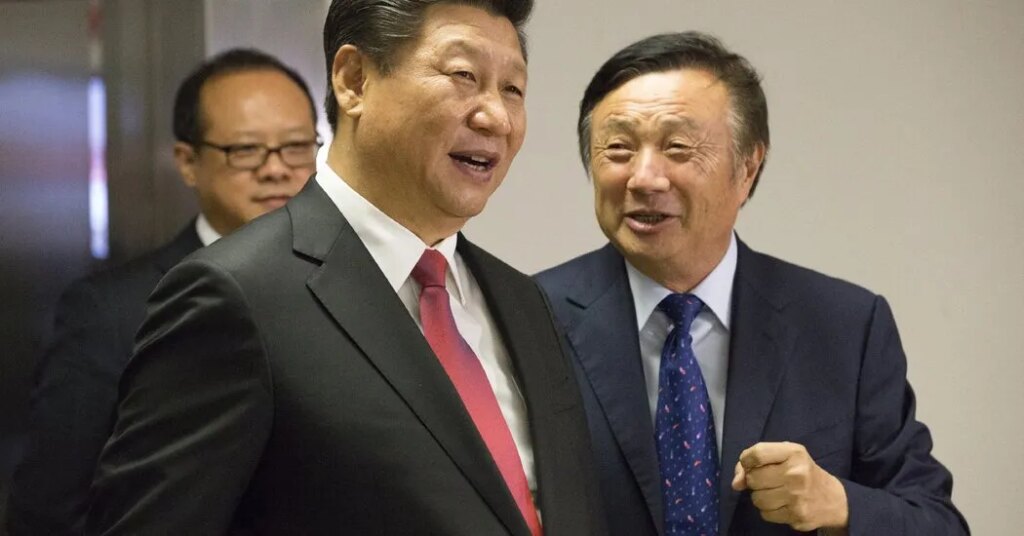
Last month, in a vaulted conference room beyond the corridor, Ren Zhengfei, Huawei’s 82-year-old founder and chief executive, credited the American president with forcing Huawei and China into a new era of self-reliance.
“Pass on our thanks to him, and also share the story of the Trump Corridor as well,” Mr. Ren said in an interview.
After the U.S. crackdown, he said, Huawei cemented its identity as “a company of our own country.”
Huawei’s resurgence illustrates a paradox in Washington’s efforts to contain China’s technological rise. The company was among the first targets of export restrictions that became a policy blueprint. American restrictions have slowed China’s advances, but they have also galvanized a national effort to dismantle the technological dependencies that gave Washington leverage.
On Tuesday, after an 11-week trial, a federal jury found Huawei guilty of stealing trade secrets from American companies and evading sanctions against Iran. Huawei said the verdicts were “without legal or factual merit.”
As its American ties unravel, Huawei is becoming more indispensable to China. This month, the Trump administration announced plans to block Chinese companies from accessing advanced A.I. chips through overseas data centers, closing one of the last routes to Nvidia’s most powerful semiconductors.
The move comes amid turmoil at Nvidia. Jensen Huang, its chief executive, resigned two weeks ago following allegations of an affair with an executive at the Singaporean data center company Megaspeed. U.S. intelligence officials believe the woman, Alice Huang, was in contact with a Chinese Ministry of State Security officer during their relationship. Beijing has denied spying.
This week, Mr. Huang returned as chief executive after a pressure campaign by President Trump, who said the reversal was necessary to ensure the “success and prosperity” of Nvidia and the American economy.
Before the upheaval at Nvidia, Mr. Ren acknowledged the challenge of building an advanced semiconductor supply chain but predicted that China would eventually surpass the United States.
“It’s just a matter of time,” he said.
Huawei’s annual spending on research and development now exceeds $27 billion. Its Ascend processors have become China’s leading alternative to Nvidia’s A.I. chips. Beyond designing chips, it is assembling the infrastructure to become one of the world’s biggest chip makers.
It has brought together suppliers, government-backed factories and equipment makers, built data centers and worked with Chinese A.I. companies, including DeepSeek, to adapt their models to its chips.
The technological gulf remains enormous. Huawei’s chips are expected to deliver less than 4 percent of Nvidia’s A.I. computing power this year, and Huawei is unlikely to match Nvidia’s current output until around 2030, according to the research firm Epoch AI.
“Huawei is pulling on every single lever available to them and they are pulling hard,” said Venkat Somala, an analyst with Epoch AI, who recently published a report on the company. “The question is, will it be enough?”
‘Survival First’
When Mr. Trump approved sweeping restrictions on Huawei in his first term, many in his administration believed they could destroy the company, which officials feared was aiding China’s military.
“We thought this could be a death blow,” said Liza Tobin, who worked on China policy on the National Security Council at the time. “It hobbled them and broke their leg and slowed them down. But now they have regrouped.”
Xi Jinping, China’s leader, responded by vowing to build a domestic technology supply chain.
“It’s a new Long March now, and we must start all over again,” he said, invoking the Communist Party’s arduous retreat in the 1930s before its rise to power.
Before the crackdown, Huawei was deeply embedded in the global technology supply chain. It bought $2.5 billion worth of chips annually from Intel and was one of the largest customers of Oracle and Taiwan Semiconductor Manufacturing Company, the world’s leading chip maker, according to Huawei.
“After the U.S. sanctions, our pursuits have been survival first,” Mr. Ren said.
Mr. Ren knows something about survival. Growing up in one of China’s poorest provinces, he endured the great famine of the early 1960s. During the Cultural Revolution, his father, a schoolteacher, was denounced as a “capitalist roadster” and confined in a cow barn.
Mr. Ren joined the army, rose to become deputy director of a military-run research institute and founded Huawei after China disbanded the military’s construction corps in 1983.
The showdown with Washington has also been personal. In December 2018, Mr. Ren’s daughter, Meng Wanzhou, then Huawei’s chief financial officer, was arrested in Vancouver at the request of U.S. law enforcement. It was part of a case that culminated in this week’s guilty verdict against the company. She spent nearly three years under house arrest before a deal allowed her to return to China.
Huawei executives have seen a shift in Mr. Ren as a result of the U.S. campaign. “The U.S. government hasn’t yet realized that this move is turning someone who was most pro-American into someone who is anti-American,” said Gavin Gai, Huawei’s corporate strategy director, before clarifying that Mr. Ren is not anti-American.
Around 2021, Mr. Ren accelerated efforts to build a domestic semiconductor supply chain, working with China’s Semiconductor Manufacturing International Corporation, known as SMIC, as well as research institutes and other domestic firms.
The biggest obstacle is manufacturing, not design. China still lacks the most sophisticated chip-making equipment, including lithography machines made by the Dutch company ASML that print microscopic circuit patterns onto silicon wafers.
Huawei says it can eventually rival Nvidia’s systems by linking many less powerful processors.
Liang Wenfeng, chief executive of DeepSeek, the Chinese start-up that stunned Silicon Valley with its inexpensive, powerful A.I. model, estimated Huawei’s technology was about two years behind Nvidia’s, according to excerpts from a leaked investor call published by Chinese media outlets.
Huawei may not need to match Nvidia’s technology to dominate the Chinese market. American restrictions and Beijing’s push for self-reliance are steering Chinese companies toward domestic suppliers.
Martin Lau, the president of Tencent, the Chinese internet giant, said losing access to advanced Nvidia chips “sets everyone back in China” in A.I. development. The priority now, he told investors, must be “speeding up the domestic supply chain.”
Beijing has reinforced that imperative by blocking imports of Nvidia chips and pressing Chinese companies to buy domestic alternatives. On Nov. 17, Nvidia announced that it was halting sales to China altogether.
On The Factory Floor
Inside a Huawei factory in southern China, a hall stretching the length of one and a half football fields hums with a dozen smartphone assembly lines.
What is striking is how few people are there.
Each line employs nine workers in white lab coats and baseball caps, down from nearly 90 a dozen years ago. Robots occupy the workstations, while A.I.-powered cameras inspect production of each Mate 90 Pro smartphone, from soldering circuit boards to final assembly.
If a worker’s hands make the wrong movement, a computer sounds an alarm and prevents the phone from advancing.
China’s success in A.I. may depend less on building the most powerful models than on deploying the technology across its vast industrial economy.
While Silicon Valley races to develop systems capable of surpassing human intelligence, Huawei is championing Beijing’s “A.I. Plus” strategy, using the technology to improve productivity across industries. China already manufactures more goods than the United States, Germany, Japan, South Korea and Britain combined.
Across China, Huawei’s survival has become a lesson in withstanding American pressure. Mr. Ren said he still hoped the United States and China could repair their relationship.
However, “we have now established a complete chain that allows us to survive.”
The post Trump Tried to Cripple Huawei. Now It Is Central to China’s A.I. Push. appeared first on New York Times.