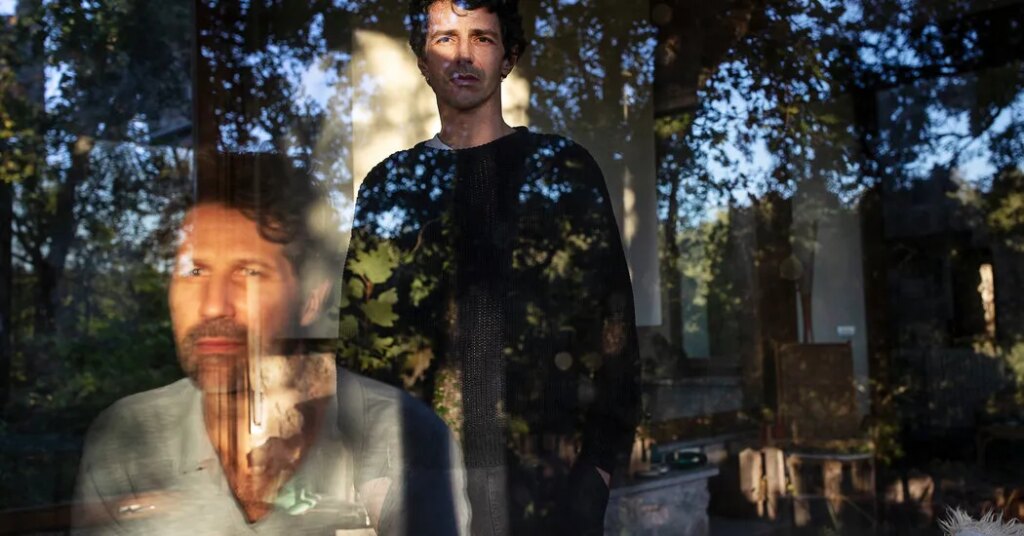
From the moment Gabriele Gallinari and Michele Mazzoni saw the glass-walled house built into the ruins of a medieval castle, they were enchanted. They had decided to leave the urban clamor of Rome for the countryside, and here, some 60 miles north of the capital, they found three acres flanked by the walls of an Etruscan fortress, a 137-foot tower and views of a verdant valley.
The house also came with a serious dose of cultural heritage: It was built by Pier Paolo Pasolini, one of Italy’s most famous poets and filmmakers, and completed just two years before he was brutally killed in 1975.
“It’s the kind of site where somehow you enter another dimension when you get there,” Mr. Mazzoni, 45, said.
Mr. Gallinari, a 47-year-old actor, sold his apartment in Rome to raise roughly $900,000 to buy the house from a cousin of the film director in 2021.
The couple’s dream house quickly turned into a nightmare. Within days of closing the deal, a local community group questioned whether the new homeowners had any right to be there.
In a lawsuit filed a year after the couple took over the Pasolini house, the group — Università Agraria of Chia — said that laws from the Middle Ages or earlier dictated that the property could not be privately owned because it belonged to the community. The group wants to absorb the site into an adjacent Pasolini-themed park.
Now, a judge has ordered the couple to leave the house, but they remain living there while they appeal the decision. Mr. Gallinari said his experience was a cautionary tale for prospective buyers of Italian property.
“Don’t buy a house in the Italian countryside because you don’t know where your money will end up,” Mr. Gallinari said, sitting on a kilim rug in the house’s living room, surrounded by wall-to-wall glass windows. Under the judge’s ruling, Mr. Gallinari, the property’s sole legal owner, is not entitled to any compensation for either the purchase price or the tens of thousands of dollars he has spent on renovations.
“It’s not just the house, it’s not only the money,” Mr. Gallinari said. “It’s that this is an injustice.”
Gianluca Inverni, the Università Agraria’s president, said Mr. Gallinari was “a victim of the system.”
“He should be angry at whoever sold him the thing and didn’t even double-check” the land’s legal status, Mr. Inverni added. “Unfortunately for him, in this case, the land has always been ours.”
Medieval Rules in the Modern World
Under Italian law, thousands of acres of countryside are subject to “usi civici,” or civic use — a designation that some scholars say dates at least to the Middle Ages, long before Italy unified as a nation. Feudal lords could grant the use of lands to vassals for agriculture, forestry and livestock grazing. That land could not be transferred to private ownership.
But as private property laws were introduced in the 19th century and industrialization drove agricultural workers to the cities, much of the land subject to these community ownership codes was abandoned and its ownership status fell into a gray zone. A 1927 law sought to formally convert this land into private property, but a 2017 law prevented the privatization of what remained communal. According to Federico Roggero, a law professor at Rome’s Sapienza University, more than 12 million acres of Italian countryside are subject to these civic use laws.
Since much of that land has already passed into private ownership, the community rights are “rarely exercised,” Mr. Roggero said. Still, he said, “there is a margin of risk.” If “an ancient document were to emerge attesting to the existence of this right,” he said, a community could reclaim privately owned land.
Pasolini bought the property in 1970 from another private owner, after filming some of his movies nearby, including a scene depicting Jesus’ baptism in “The Gospel According to Matthew,” and a scene with the opera singer Maria Callas that he ultimately cut from his film of the Greek tragedy “Medea.”
Approaching 50, he was a prolific, openly gay poet and novelist whose boundary-pushing work had sparked protests. It divided critics between those who regarded him as a genius and those who accused him of obscenity.
There were no legal objections to his purchase of the property, with its ruined castle and imposing tower. He soon commissioned an architect to design a midcentury-modern-style house built into the side of the castle ruins. He also installed a separate studio to paint and write his final novel, which he never finished.
After Pasolini’s murder, one of his cousins, Graziella Chiarcossi, now 83, moved in with her husband. But as they started a family, they outgrew the house’s narrow kitchen and single bedroom, and moved out — keeping the house as a space for cultural events.
Decades later, as its maintenance grew costly, Ms. Chiarcossi decided to sell it. When Mr. Gallinari and Mr. Mazzoni came along, she said, “It was a blessing.”
Before signing the contract, Mr. Gallinari hired a notary, Clara Capasso, to check municipal records for any legal encumbrances.
Ms. Capasso said she found no evidence of any civic-use laws binding the property. But she said she warned the purchasers that her search was not definitive because there is no comprehensive public register of civic use lands. A claim, she said in an email, “can emerge, and be recognized, after decades or centuries of peaceful possession, of regularly recorded property transfers, and of private use of the asset, sweeping away all previous transfers.”
Still, Mr. Gallinari said he was satisfied by Ms. Capasso’s search, given that Pasolini and his cousin had owned the property for half a century without incident.
An Indecipherable Will
Things started to go awry almost immediately.
The community group, which represents 120 households in a nearby village, wanted to absorb the property into an adjacent plot that it has turned into a Pasolini-themed nature park.
The group had recently hired a new land registry expert, Marta Spigarelli. She said she had found documents that determined the property was subject to civic use laws.
Less than a month after the sale, the group threatened to “take all necessary measures” to claim the land.
Within a year, it sued Mr. Gallinari.
Two experts, one hired by Mr. Gallinari and the other appointed by the court, supported Mr. Gallinari’s ownership. They cited documents from the 19th century that suggested that an Italian prince, who owned the property at that time, had reserved it for his private use.
Despite that, the judge ruled in favor of the community group.
During an interview, several members of the community group said that an appendix added to the prince’s will by his heirs showed they had stolen the community’s rights to the property. But none of the group could fully decipher its script.
Mr. Gallinari said he found the timing of the group’s case suspicious. The group had never tried to take back the property while either Pasolini or his cousin occupied the house. The group said nothing when Ms. Chiarcossi listed it for sale, or when the national Culture Ministry — offered the chance to buy it — publicly declined to do so. “They had plenty of opportunities to speak up, but they didn’t,” said Mr. Gallinari.
Mr. Inverni, the group’s president, said he only learned about the sale after it closed.
As news of the case spread in local media, friends of Mr. Gallinari and Mr. Mazzoni started petitions that call for the government to intervene in their favor. The petitions have been signed by more than 42,000 people, including well-known artists and filmmakers.
Mr. Inverni said the group wanted to turn the Pasolini house into a museum about the filmmaker. Mr. Gallinari said he didn’t think the group was capable of honoring Pasolini’s legacy. Mr. Inverni “works in a laundry, he doesn’t have any skills to do it,” said Mr. Gallinari.
Mr. Inverni suggested that Mr. Gallinari accept the court’s decision and “eat humble pie.” He added: “If you keep throwing mud at me every day, it’s obvious you’re not looking for a middle way.”
For now, as they await a ruling in December on whether they can stay in the house until the appeal hearing in 2028, both Mr. Gallinari and Mr. Mazzoni say they have trouble sleeping.
“I’m so tired, and I don’t want to live here as a squatter,” said Mr. Gallinari. “I own this house legally.”
The post They Bought Their Dream Home. Their Neighbors Want to Evict Them. appeared first on New York Times.