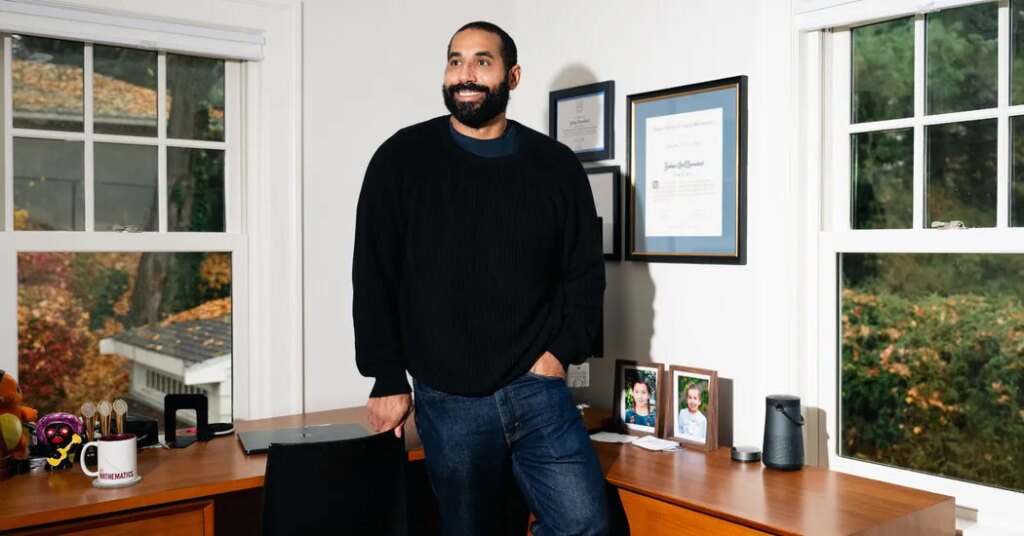
John Urschel, a former N.F.L. offensive lineman, doesn’t have much time for football these days. Now a professor of mathematics at M.I.T., he generally follows college games but not the pros: “Watching football Saturday and Sunday is asking far too much of my wife,” he said in an interview this week. Mostly he pays attention to Virginia Tech (his best friend is their offensive coordinator) and Penn State (his alma mater). On Thanksgiving Day he expects to be “kid wrangling,” not parked in front of the television.
After playing three seasons for the Baltimore Ravens, from 2014 to 2016, Dr. Urschel retired at age 26 to finish a Ph.D. in mathematics. He published a memoir in 2019, “Mind and Matter: A Life in Math and Football,” which he wrote with his wife, the writer Louisa Thomas. It appeared on the New York Times best-seller list for sports and fitness books.
In recent months, as new research has seemed to confirm football’s long-term occupational health risks, the profession of mathematics is experiencing a different sort of crisis. Artificial intelligence systems have generated solutions — collaborating, to various degrees, with human mathematicians — to some of math’s most illustrious and elusive problems.
Dr. Urschel is one of those mathematicians. In August, he and Rikhav Shah, a graduate student, posted a significant result to arXiv, an online prepublication platform. As the authors described in their “A.I. usage statement” at the end of the paper, this research “blends purely human-based mathematics with some mathematics that involved the use of ChatGPT Sol 5.6 and Claude Fable 5.” Then, early last month, Dr. Urschel posted an even more significant paper — this time around, he used OpenAI’s ChatGPT Sol 5.6 and Astra 6 when he was stumped. The research resolved a well-known conjecture posed in the mid-1990s by the mathematician Nick Trefethen.
One of Dr. Urschel’s mentors, Peter Sarnak of the Institute for Advanced Study and Princeton University, called the October paper “a great result.” He suggested that Dr. Urschel’s targeted use of A.I. — to get across the finish line on specific points rather than to put out an amorphous, unintelligible proof — might serve as a new paradigm for math research.
Dr. Urschel isn’t sure: “What does this mean for early-career researchers? What does this mean for postdocs, for grad students, for undergrads?” he asked.
But he’s game to explore the terrain. He does not have tenure — the promotion process will play out over the next two years. When addressing a panel question about advice for young mathematicians, he said, “For my students, I stress that human understanding and the joy of doing mathematics are the two things that should be front and center.” The following conversation, conducted by videoconference and email, has been condensed and edited for clarity.
In your book, you write: “I know no other feeling like the satisfaction of discovery. I still feel the same sense of wonder and curiosity when I try to prove a theorem that I felt when I did logic and math puzzles as a kid.” So, now that you’re doing math using A.I. as a tool, does that change the game?
I find in general it’s just less fun — absolutely less fun.
How so?
People get into this business for different reasons. There is a good characterization, although it’s an oversimplification, that sorts mathematicians into artists and scientists. With A.I., I think scientists can be quite optimistic and encouraged by the fact that they now have new tools that allow them to get answers to the questions they care about faster than ever, and this is exciting.
But then you have the artist, who was not so concerned about the answers. I view myself much more as an artist than a scientist. I get the most joy when I’m confused. I enjoy not knowing what’s going on, trying things and stumbling and fumbling my way through. You hit dead ends, you get stuck, but you learn something, and then you try a different direction. Over time, you start to build some sort of vague understanding of the landscape.
It was the sort of thing where I’m working on it, I’m working on it. And prior to these two latest papers, I was an A.I. vegan — all my papers and work before that was done not touching the machine. And I really wanted to think it through to the end myself.
My wife tells me I should be happy about the results. But I sometimes say that I wish I were born a decade earlier for math — it would have been nice to make it into my 40s without the machine — and a decade later for football.
A decade later for football in terms of mitigating and navigating the risks?
No, a decade later because top college players now are making large sums of money.
Do you follow the latest C.T.E. research?
No, I don’t really follow it. I don’t find much benefit in digging into those things. For my own personal health, I try to exercise regularly and take care of my body. My wife and I, we like to go on runs a lot. We lift weights together, we get good sleep. And I use my brain a lot.
That’s a bit of an understatement. Is it accurate to say that the C.T.E. risk was one of the factors in your decision to retire from football?
Yeah, one of the factors, not the factor. Other factors were my overall health, the birth of my daughter, and math.
Your wife is Louisa Thomas, a book author and New Yorker journalist — someone trying to make a living in another profession under threat from A.I. Do you two talk much about these strange A.I. times?
We do. She has a very positive view of the importance of human writing, and that human writing is perhaps now more important than ever. We don’t use A.I. at all for things at home. In fact, my wife and I were just texting about no A.I. toys coming into the home. We had never talked about this, but my wife wanted to mention it just so we’re both on the same page. My only experience with the machine has been for some of my mathematics, not all of it.
Both of your new papers involve Gaussian elimination, an old and popular algorithm for solving systems of linear equations, with many applications in computing. How did you start using A.I. in this research?
Leading up to the first breakthrough that resulted in the August paper, I showed my collaborator some ideas. I figured we needed maybe a couple months. About two days later, he caught wind of a group that was putting in a lot of hours, prompting autonomous solutions for things related to what we were working on. He said, “I don’t think we have even a week.”
So then I start talking with the machine. I said, essentially, “Hey, here is something I published, here are all my unpublished files. Here is the research program of every single step for how this construction should go. Please build this thing.” Initially the machine didn’t believe me. Because the thing that we ended up proving, the thing that I thought was true for quite a while, was contrary to what everyone in the community thought.
Eventually the machine started believing me, and it built this thing. It’s ugly, and it’s all wrong. But just having the wrong thing is enough for us to build the correct thing, and that gave us the first paper. The final thing in the paper is purely human.
And with the second result, your breakthrough on Nick Trefethen’s conjecture, how was A.I. useful?
Problems like these are listed on A.I. test-bed websites for autonomous solutions. I was encouraged that this problem seemed resilient to autonomous solutions; at least, the current models could not solve it. Which made me feel kind of good, like, “Oh, I’m useful! I’m an expert in numerical analysis; I have some ideas.” But I was struggling with proving a key piece, a probabilistic estimate. I could prove a weak version, but I didn’t have a strong enough version to get a proof of the entire result. The machine produced a stronger argument — which, after some back and forth and polishing on my part, resulted in one of the propositions in the paper.
Do you think your recent experience offers a good model for hybrid human-plus-machine mathematics?
I wouldn’t say anything that strong. It’s some balance between understanding certain important things — possibly with a machine, possibly not, but also having this joy of doing mathematics the old-fashioned way.
How is mathematics going to change with A.I. in the picture?
No one has the answers. The undergrads are asking the grad students. The grad students are asking the professors. I’m an assistant professor — I’m asking the senior professors. The senior professors are asking the department head. The department head meets with a bunch of other department heads from other universities.
We’re still some distance away from consensus on a number of fronts. One, what are the norms in the mathematics community around A.I.? And two, what does A.I. capability for solving mathematics problems look like asymptotically, as it starts to reach some sort of limit? And is there still a good role for human ideas in mathematics to play to complement that?
I’m going to keep working, and keep thinking, and keep trying to solve things under the assumption that the answer is yes — that there is a role to play. But I can’t know the future.
Football has been under siege, and now math is under siege. Could you ever imagine leaving mathematics?
No. I’m in it for the long haul.
The post The N.F.L. Player Who Left Football for Math appeared first on New York Times.