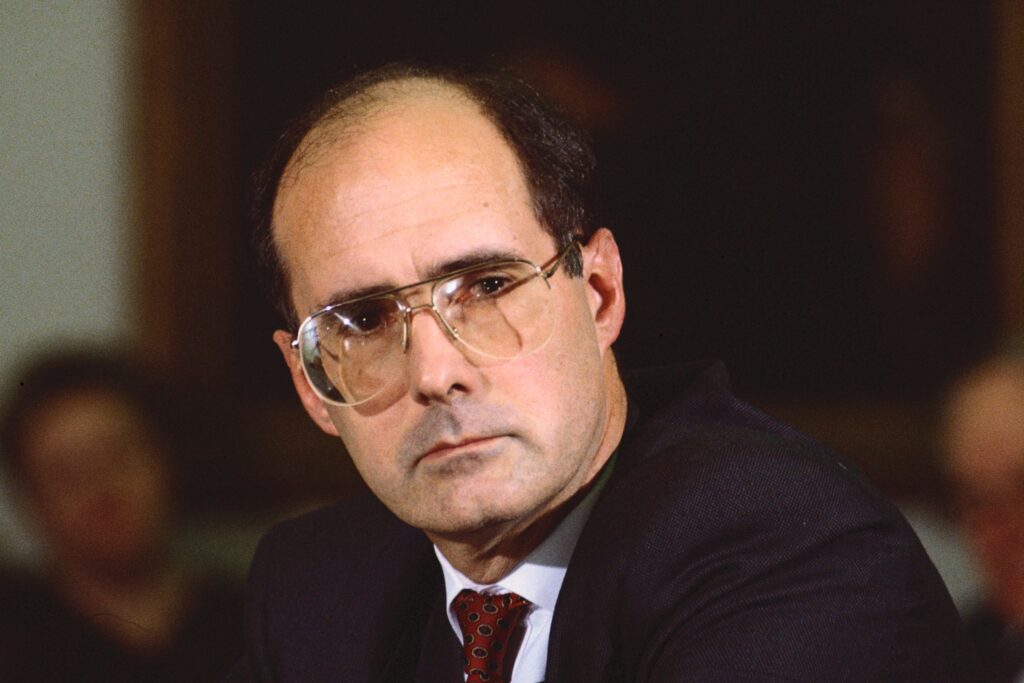
In 1970, Strobe Talbott was writing his dissertation on Russian literature at the University of Oxford in England when Time magazine, for which he had interned in Moscow, hired him to translate former Soviet premier Nikita S. Khrushchev’s then-secret memoir, which had been smuggled out of the Eastern Bloc.
The crash project required working nights, and Mr. Talbott’s housemate, fellow Rhodes scholar Bill Clinton, sometimes knocked on the door with scrambled eggs and pots of tea, so the two 24-year-olds could chew over the Kremlin’s endless intrigues.
Those predawn chats did more than cement a lifelong friendship. After taking office in 1993, then-President Clinton tapped Mr. Talbott — who by then had spent 21 years at Time as a Washington correspondent, bureau chief and columnist — to shape U.S. policy toward post-Communist Russia and the former Soviet republics as they struggled to adopt democratic reforms and free market policies in the wake of the Cold War.
Over the next eight years, first as special adviser and then as second-in-command at the State Department, Mr. Talbott helped lead the administration’s efforts to quell conflicts in the Balkans, expand the NATO military alliance eastward, remove nuclear weapons from three former Soviet republics and manage Clinton’s fraught relations with Russia’s erratic leader, Boris Yeltsin.
Mr. Talbott, who led the nonpartisan Brookings Institution’s public policy research center for 15 years after he left the Clinton Administration, died Thursday. He was 80.
The death was confirmed by his son, Devin Talbott.
Known for his intellectual heft, workaholic hours and grasp of the nuances of foreign policy, Mr. Talbott rode a famously gilded academic résumé — the Hotchkiss School, Yale and Oxford — into the top tiers of government, journalism and think tanks. Tall, trim and balding, he was a highly visible presence in the nation’s capital thanks to his authoritative books on arms control, U.S.-Soviet relations, the new Russia and India’s nuclear policy.
Perhaps most importantly, he carried the ultimate Washington credential: the confidence of a two-term president who sometimes phoned him daily, often after midnight, to schmooze and discuss global strategy.
Their rapport was such that Clinton first introduced him to Yeltsin with a teasing remark. “This is my friend Strobe. His socks didn’t match until he was 40 years old,” Clinton said, according to Mr. Talbott’s recollection in a 2010 oral history with the University of Virginia’s Miller Center, which specializes in presidential scholarship. (He added that Clinton, as governor of Arkansas, often stayed at the Talbott home when visiting Washington. “My kids,” he said, “used to call him the guy who eats all the ice cream.”)
Mr. Talbott’s 1984 book, “Deadly Gambits: the Reagan Administration and the Stalemate in Nuclear Arms Control,” was arguably his most consequential. It revealed how Pentagon aides had deliberately undermined arms talks with Moscow while a “somewhat befuddled” president and his top national security aides were mostly ill-informed.
The book, which embarrassed the White House, helped set the stage for Reagan to take a less hawkish stance in his second term. He signed the 1987 Intermediate-Range Nuclear Forces Treaty, the first to eliminate an entire class of nuclear weapons, and his administration entered into talks with the Soviets that led to the 1991 Strategic Arms Reduction Treaty, the largest and most comprehensive arms control agreement in history.
Sales of Mr. Talbott’s book jumped after former vice president Walter F. Mondale, the 1984 Democratic presidential nominee, read aloud from it during a campaign debate with Reagan. It didn’t help Mondale, who lost in a landslide.
As deputy secretary of state from 1994 to 2001, under two secretaries of state, Warren Christopher and then Madeleine Albright, Mr. Talbott played an outsize role as the Clinton administration struggled to find its balance as the sole superpower in the post-Cold War world.
Convinced that Russia could be transformed into a European-style democracy, Mr. Talbott pushed U.S. political and financial support for Moscow — a policy some called “Russia First” — as a strategic priority above nearly all others, and the White House agreed.
His critics, at home and in Moscow, called him naive or deluded. They contended that he held a romanticized view of Russia based on his love of its language, literature and culture, and that he failed to grasp its brutal politics and oligarchic economy.
“Fundamentally, [Mr. Talbott] is an apologist for all things Russian, even in the Soviet era,” David Pryce-Jones wrote in the conservative National Review in 2002 after reading Mr. Talbott’s first-person book “The Russia Hand: A Memoir of Presidential Diplomacy.”
Mr. Talbott insisted that America had no choice but to deal with Moscow. He decried isolationists who wanted to “turn the American eagle into an ostrich,” with its head in the sand, as he wrote in a State Department cable in 1995.
“I think it is self-evident that you have to do business” with Russia, he told The Washington Post soon after. He added, “The business that we have to do with them is to make sure they do not blow us up.”
He defended Yeltsin as the leader most likely to stop Russia from backsliding into despotism. During his 1994 Senate confirmation hearing, Mr. Talbott praised the Russian president as the “personification of reform” even though he had ordered tanks to shell the parliament several months earlier to stop hard-liners seeking to remove him from office.
Mr. Talbott found a sympathetic ear in Clinton, who felt an affinity for the embattled leader he called “Ol’ Boris.” “We can’t ever forget that Yeltsin drunk is better than most of the alternatives sober,” he told aides, Mr. Talbott wrote in “The Russia Hand.”
Yeltsin was “both a very big man and a very bad boy, a natural leader and an incurable screw-up,” Mr. Talbott wrote. “All this Clinton recognized, found easy to forgive and wanted others to join him in forgiving.”
Clinton’s 18 meetings with Yeltsin, usually choreographed by Mr. Talbott, produced notable achievements, including persuading Ukraine, Belarus and Kazakhstan to transfer their nuclear weapons to Russia; persuading Russia to withdraw troops from the Baltic states (Lithuania, Latvia and Estonia); and halting the sale of Russian rocket parts to India, easing an arms race with Pakistan in the subcontinent.
Mr. Talbott also took part in marathon negotiations outside Moscow that produced an accord to effectively end the civil war then raging in parts of the former Yugoslavia. During the fighting there, NATO warplanes had attacked Serb forces in Bosnia and Kosovo.
But those efforts only delayed Russia’s backsliding to autocracy and runaway corruption. When Yeltsin resigned in 1999, he handed the presidency to his chosen successor, then-Prime Minister Vladimir Putin. The fledgling partnership between Washington and Moscow gradually withered, and Putin rules Russia today with an iron fist and an ultranationalist ideology.
Despite his platinum “Friend of Bill” status, Mr. Talbott’s influence had limits in the Oval Office.
He backed a United Nations convention to ban the production, use and export of antipersonnel land mines, for example, because they so often killed civilians. But Clinton would not sign the 1997 agreement, which had nearly 100 signatories, citing U.S. military needs on the Korean Peninsula.
More importantly, Mr. Talbott warned in a memoto Christopher in 1994 that granting NATO membership to the Czech Republic, Poland and Hungary — all lying within what had been the Soviet Bloc — would antagonize Moscow and provoke future clashes. He later dropped his opposition, but his initial caution proved prescient.
After the three countries joined the military alliance in 1999, followed by seven other former Warsaw Pact member states in 2004, Putin increasingly condemned NATO’s expansion toward Russia’s borders. He later sent troops into Georgia and Ukraine, both former Soviet republics, partly to create a buffer zone against what he called a threat to Russian security.
Successful diplomacy takes two sides, and Mr. Talbott’s Russian counterpart, the deputy minister of foreign affairs, proved an able partner and friend. Georgiy Mamedov, Moscow’s top expert on America and a future ambassador to Canada, worked closely with him on NATO expansion, getting nuclear weapons out of Ukraine, and ending a war in Kosovo that grew out of the breakup of Yugoslavia.
The former journalist took a dim view of the highly classified reports he got from U.S. intelligence agencies, saying they rarely went beyond what he read in the newspapers. “The intelligence is ‘sexed up’ because they go to such trouble to collect it,” he told World Policy Review in 2003. “It is only useful at the margins of a particular problem. The policymaker’s view of the world is of a piece with what the intelligent public knows.”
The road to influence
Nelson Strobridge Talbott III was born in Dayton, Ohio, on April 25, 1946, and grew up in Shaker Heights, a wealthy Cleveland suburb. His father was an investment banker, and his mother raised their four children.
Like his father and grandfather, he attended the Hotchkiss School, an elite boarding school — then just for boys — in Lakeville, Connecticut. He was a sophomore during the Cuban missile crisis in 1962, the closest the world has come to nuclear war. “I remember the headmaster summoned us all into the school chapel,” Mr. Talbott told the New York Times in 1999. “We got down on our knees and prayed that the world wouldn’t blow up.”
Partly as a result of that crisis, he began to study Russian poetry at Hotchkiss, and he made Russian language and literature his major when — following his father and grandfather again — he attended Yale.
The campus was roiling with protests against the Vietnam War, and while Mr. Talbott opposed the U.S. involvement, he called for civility, not for storming the barricades. As chairman of the Yale Daily News, he urged his fellow students in an editorial to be “the coat-and-tie standard-bearers” of the anti-war movement.
New York Times columnist James Reston took note during a visit in 1967. “If the Strobe Talbotts at Yale, serious, idealistic, patriotic, progressive … did not support the war effort, the generals had better start worrying,” he wrote.
Mr. Talbott graduated summa cum laude in 1968 and spent three years as a Rhodes scholar at Magdalen College at Oxford, where he received his master’s degree. Years later, writing in Time, he admitted to a “moral discomfort bordering on guilt” that a draft deferment for a bum knee kept him “out of the Mekong delta [in Vietnam] but not off the squash courts and playing fields” at Oxford.
His growing Russian fluency helped him land a summer internship in Time’s Moscow bureau in 1969, and he impressed the editors. They hired him to translate and edit a 1,500-page transcript of hundreds of hours of tapes that Khrushchev, who led the Soviet Union for 11 years, had recorded after he was deposed in 1964. (Khrushchev died in 1971, at 77.)
Soviet officials condemned the 1970 release of “Khrushchev Remembers,” saying the tapes were fake. After a second volume appeared in 1974, they denounced Mr. Talbott as a CIA “sapling.”
More importantly, they rejected his request for accreditation to work as Time’s Moscow correspondent and barred him from Russia for five years.
While Mr. Talbott was still at Yale, his roommate, Derek Shearer, introduced him to Shearer’s younger sister, Brooke, a student at Stanford. They married in 1971 and moved to Belgrade when Time sent him to report on Soviet-dominated Eastern Europe.
But soon he was transferred to Washington, where he covered the State Department — as the Watergate scandal brought down the Nixon administration — and then the Ford White House. He spent seven years as a diplomatic correspondent and became Washington bureau chief in 1984. Ultimately he became the magazine’s editor at large and foreign affairs columnist, a position from which he called for détente with Moscow over confrontation.
After Reagan vilified the Soviet Union as an “evil empire” in 1983 and said communism was headed for the “ash heap of history,” Mr. Talbott expressed dismay, dismissing the harsh rhetoric as “bear-baiting” in Time.
But he later conceded his error. Days after the Soviet Union dissolved in December 1991, he confessed in a column that in none of his 30-plus visits “did I ever think I would outlive the Soviet state.”
Among his books were “Endgame: The Inside Story of SALT II” (1979); “The Russians and Reagan” (1984); “Reagan and Gorbachev,” with Michael Mandelbaum, (1987); “Master of the Game: Paul Nitze and the Nuclear Peace” (1988); “At the Highest Levels: The Inside Story of the End of the Cold War,” with Michael R. Beschloss, (1993); “The Great Experiment: The Story of Ancient Empires, Modern States, and the Quest for a Global Nation” (2008); and “Our Founders’ Warning: The Age of Reason Meets the Age of Trump” (2020).
After leaving government, Mr. Talbott moved to New Haven, Connecticut, to launch the Yale Center for the Study of Globalization. He quit abruptly a year later — leaving bruised feelings at Yale — to lead the far larger Brookings Institution in Washington. He retired in 2017 after overseeing a campaign that raised more than $650 million for Brookings.
Shearer died of cancer in 2009. Six years later, Mr. Talbott married Barbara Lazear Ascher, a poet, author and lawyer.
In his Miller Center oral history interview, Mr. Talbott said he turned down President Clinton’s first job offer — ambassador to Moscow — for unspecified family reasons. They remained close, however, and after Mr. Talbott spent Thanksgiving weekend bowling with the president at Camp David in 1993 — Christopher was not invited — the secretary of state picked Mr. Talbott as his top deputy to help compensate for his “own lack of access,” Mr. Talbott recalled.
Mr. Talbott added that his influence on Clinton “was very much exaggerated” in Washington. “That said,” he continued, “I did not waste time trying to correct people, for obvious reasons. The more people assumed I had the ear of the president, the more power I had. So fine.”
The post Strobe Talbott, who helped shape Clinton-era foreign policy, dies at 80 appeared first on Washington Post.