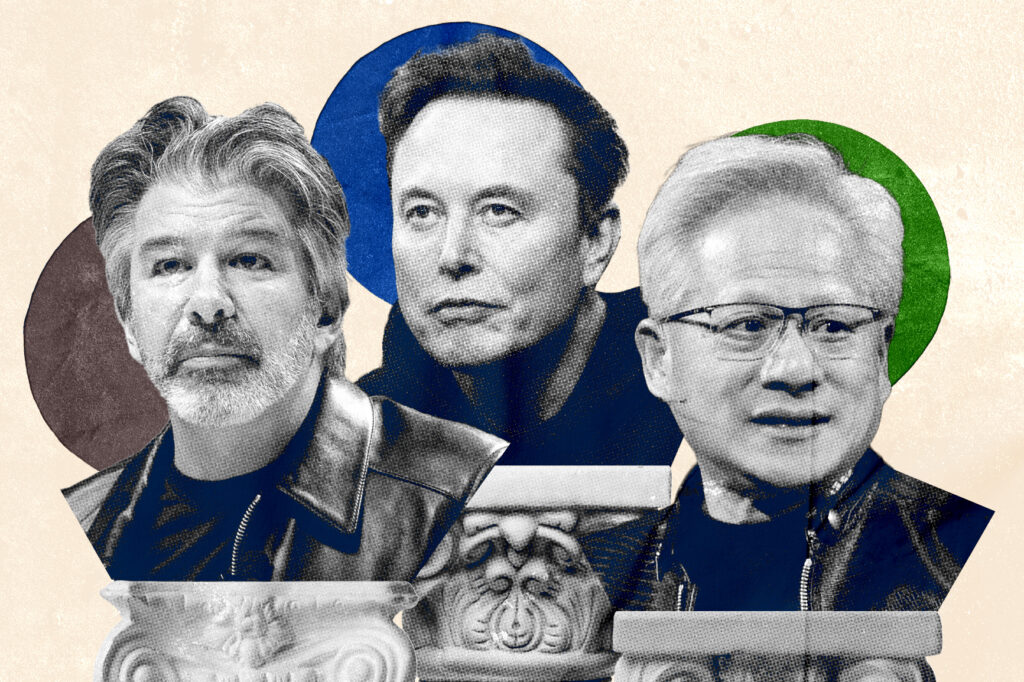
Years before Jensen Huang plunged Nvidia into crisis and faced doubts he could ever return, Elon Musk was at the center of a potential reckoning in his business empire.
Musk faced pressure in 2018 to step aside as Tesla’s chief executive, and one analyst predicted he only had a 25 percent chance of surviving.
That year, Musk was forced to resign as Tesla board chairman after he allegedly mislead investors by stating on social media he had “funding secured” to take Tesla private, leading to separate $20 million fines for him and Tesla in settlements with the Securities and Exchange Commission.
Meanwhile, he faced a defamation lawsuit for referring to a Thai-cave rescue volunteer as a “pedo guy” after the explorer dismissed Musk’s plan for a mini submarine to help children who were trapped.
On “The Joe Rogan Experience” podcast, Musk took a hit of marijuana in an episode that later prompted a federal safety review into SpaceX. In response to NASA’s concerns, Musk emailed SpaceX employees telling them “SpaceX maintains a drug free workplace.”
At Tesla, meanwhile, investors held their breath and braced for years of potential government scrutiny, lawsuits, stock losses and uncertainty at the top. Musk, subjected to a “Twitter sitter” to review market-moving posts, became more circumspect before the covid pandemic unleashed a new era of posting. He found a friendly partner in President Donald Trump, who advocated on Musk’s behalf for his company’s factory to be allowed to reopen amid county-level shutdown orders in 2020.
Tesla’s share price grew exponentially. Even after a rough ride overseeing the U.S. DOGE Service, which stands for Department of Government Efficiency, though it is not a Cabinet-level agency, Musk consolidated his power at Tesla. Shareholders last year approved a $1 trillion compensation package if he meets targets such as increasing the company’s valuation to $8.5 trillion over roughly the next decade.
“Build a big enough company with a big enough market cap, a big enough presence in the stock market, and convince the world that without you that company collapses, then you can be like the Roman emperor Nero: You can do what you want,” said Erik Gordon, a professor at the University of Michigan Ross School of Business.
That is the lesson, Gordon said, that apparently applies to Jensen Huang, who was reappointed as CEO of Nvidia this week after resigning earlier this month amid allegations he had multiple affairs, including with a woman suspected to be working with Chinese intelligence. After the reports of his involvement with the alleged Chinese spy, Huang apologized to his family and Nvidia colleagues.
Now, he finds himself back in charge.
“A lot of people who think about corporate governance and decent conduct are scratching their heads,” Gordon said.
Musk and Nvidia did not respond to requests for comment.
Corporate governance experts said the technology industry appears to have dispensed with the ethos that once led to clearer ramifications in Silicon Valley.
In the wake of scrutiny surrounding Facebook’s role in the 2016 election, Mark Zuckerberg once apologized for the effects of his work, though he said little specific other than to cite the ways it “was used to divide people.”
Uber co-founder Travis Kalanick left his role as CEO in 2017 amid a string of corporate and personal misbehavior. The company faced allegations of a toxic workplace culture and actions taken to evade law enforcement and regulatory authorities. Kalanick once said he must “fundamentally change and grow up,” after a string of scandals and embarrassing revelations.
He ultimately resigned in the heat of a shareholder revolt.
Huang’s reinstatement follows an episode where another key firm in the artificial intelligence space almost lost a co-founder, before changing course. OpenAI CEO Sam Altman was ousted from that company in 2023 over a dispute with its board before returning to his role with a wave of support. The Altman episode was an early signal that the era of founders being ousted may have come, for now, to a close. (The Washington Post has a content partnership with OpenAI.)
Over the past several weeks, Musk and other tech leaders rose to Huang’s defense. After Huang’s reinstatement, Musk reposted a photo of himself with the chipmaker’s CEO at Nvidia’s headquarters. He also said he had factored into the push to bring Huang back to Nvidia.
Numerous factors played into the new landscape, but the biggest, in Gordon’s view, had been the neutering of venture capital, once a scarce resource. As it became more abundant, the venture capitalists increasingly pitched themselves as “founder friendly,” he said, “which has morphed into ‘you can do whatever you want as long as you build the company,’ with just a few exceptions.”
That has bred a broader culture, he said, where “adult supervision” has given way to obsequiousness to founders.
“We’re certainly living in an era of billionaires gone wild,” said Nell Minow, a corporate governance expert who is chair of ValueEdge Advisors. With Huang’s reinstatement, she said, the cycle has reached its peak.
Minow said that founder-led companies have also closed ranks, paying closer attention to the makeup of their boards. The boards of the companies Musk leads consist of close allies and friends; his brother, Kimbal, serves on the Tesla board, and a longtime business associate, Antonio Gracias, is a member of the SpaceX board, for example.
“Nobody’s untouchable, particularly in a public company, but we certainly are living in an era of the … ‘imperial CEO,’” Minow said. “Musk has been a cautionary tale for lots of CEOs, and they’re all building moats around themselves.”
Numerous scandals would unfold in the years to follow as Musk’s profile grew and he took over the social media site then known as Twitter: an allegation that he sexually harassed a flight attendant on a corporate jet and offered to gift her a horse if she would “do more”; fathering multiple children with a subordinate.
Musk called the flight attendant story untrue and a “politically-motivated hit piece.” He has acknowledged his relationship and children with Shivon Zilis, though she recently said they have split. But Musk’s once-tenuous position at the head of his massive business empire was not called into similar doubt.
Throughout it all, Tesla’s share price exploded — making it the world’s most valuable automaker — and SpaceX generated massive investor interest with its plans to go public, culminating in a record-setting market debut and in Musk becoming the world’s first trillionaire. Investors and analysts who had once seen the writing on the wall were delighted.
Nothing could fell him — not a bet on a social media venture that adversely affected his cash cow in Tesla, not a pivot into politics that tore its customer base apart and cratered Tesla’s share price, not his inflammatory posting or trafficking in misinformation or his public feud with the president and administration on which he’d staked his reputation.
Now Huang has emerged similarly from a cloud of scandal.
The new dynamics are perhaps best highlighted by the reflections on X of former Goldman Sachs CEO Lloyd Blankfein, who mused amid the firestorm surrounding Huang: “Sad about Jensen. Shakespearean. But as de Gaulle said, ‘The graveyards are filled with indispensable men.’”
Huang’s reinstatement led Blankfein to reevaluate a week and a half later.
“Guess you can come back from the graveyard if you’re really, really, really indispensable,” he wrote.
The post How Elon Musk paved the way for Jensen Huang’s return appeared first on Washington Post.