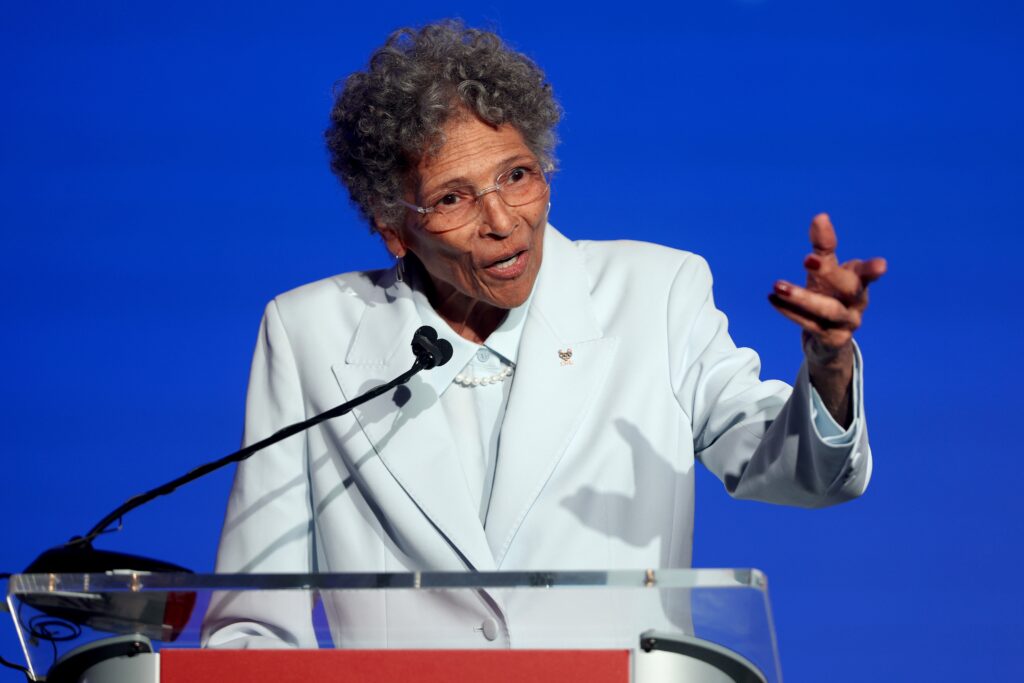
Anita DeFrantz, a bronze medal Olympic rower who broke barriers for women and African Americans, has died after a long battle with cancer, Olympic officials announced Thursday. She was 74.
Ms. DeFrantz was captain of the first-ever U.S. Olympic women’s rowing team in Montreal in 1976. She protested President Jimmy Carter’s decision to boycott the Moscow Olympics four years later, then became the first Black woman to hold a top position on the International Olympic Committee.
She used her power to advocate for equality and against doping, among other issues. In 1989 she proposed a lifetime ban for any Olympic athlete found to have used a forbidden substance. The proposal was not adopted.
“Deeply saddened by the passing of Anita DeFrantz. A remarkable Olympian, a true pioneer and a tireless advocate for athletes and equality in sport,” five-time Olympian Abhinav A. Bindra wrote on X. “Her courage and conviction helped shape a more inclusive Olympic Movement.”
International Olympic Committee Honorary President Thomas Bach called Ms. DeFrantz “a great trailblazer and an outstanding advocate for Olympic values.”
The Olympic flag will be flown at half-staff for three days at Olympic House, officials said in a statement.
Information on survivors and the date and location of her death was not immediately available. She had been suffering from gastric cancer.
Anita DeFrantz was born Oct. 4, 1952, in Philadelphia. Two years later, her family moved to Indianapolis, a city her father described as “the northernmost Southern city.” (“That was a polite way of saying it was racist,” Ms. DeFrantz, who spent her childhood in Indiana, wrote in her memoir, “My Olympic Life.”)
None of her schools had girls sports teams. In high school, she joined the choir and a birdwatching club, and she “attempted to play” the bassoon, but she longed to compete in athletics, like her brothers.
“The closest I got to a sport was taking the football field at halftime as part of the marching band,” she wrote in her memoir. “That did not make any sense to me. Girls were being denied the right to compete solely because they were girls.”
She found rowing while studying music at Connecticut College. Congress had not yet passed Title IX, the landmark civil rights law that banned sex-based discrimination, but a growing number of colleges had begun fielding women’s teams, and Ms. DeFrantz tried out for basketball as soon as she could.
At the beginning of her sophomore year, the school’s crew coach noticed her walking across campus. Ms. DeFrantz was 5-foot-11 “with legs a little too long,” she wrote in her memoir. The coach told her she’d be perfect for rowing.
“I thought that was quite a line because I had never been perfect for anything,” she wrote.
In a boat, Ms. DeFrantz possessed the fluidity that often eluded her on the basketball court. Rowing was meditative, she wrote, an exercise that allowed her to work out her problems.
Men’s rowing has been a part of the Olympics since the very first Games. But when Ms. DeFrantz took up the sport, the Games still did not have a women’s competition. Her senior year, the Olympic board decided to add women’s rowing to the 1976 Montreal Games.
Initially, Ms. DeFrantz didn’t consider trying out. There were no paid training programs for women rowers at the time, and she didn’t have the money to cover the costs herself. The sport was “inhabited by white people,” she wrote.
Still, her coach urged her to try, so after she graduated, she enrolled in law school at the University of Pennsylvania, and she joined a new rowing club — one that had produced a long list of male gold medalists.
She rowed before dawn and in temperatures so cold her hair froze. She worked multiple jobs to pay for law school and her club dues. Most mornings, she went from a night job at the police station to the boat house.
At Olympic trials, DeFrantz outlasted her competitors and was named captain of the inaugural U.S. women’s eight — an event raced in a long, narrow boat with eight rowers and one coxswain, who steers.
“I remember calling my parents and telling them that I was an Olympian,” Ms. DeFrantz wrote. “My feelings were somewhere between ecstasy and exhaustion.”
The women’s team had never rowed together before the Olympics began, Ms. DeFrantz wrote in her memoir. They lost an oar during the first heat of the competition, but did well in their second. As they positioned themselves at the starting line for their third and final race, Ms. DeFrantz looked out.
“The water was so rough that we looked like a cement mixer coming down the course,” she wrote. “But we were rowing like there was no tomorrow — and as I would learn, when it comes to the Olympic Games, there may not be.”
Someone’s blade hit the water wrong, and they lost their rhythm long enough to fall back to third place. Ms. DeFrantz was disappointed. Still, at age 23, she had made history: She was the first Black women’s Olympic rower, and she had earned a bronze medal.
She graduated from law school and worked on behalf of children at the Juvenile Law Center of Philadelphia. She decided she would dedicate her free time to rowing and try one more time to earn the gold medal the errant blade had cost her team.
As the 1980 Moscow Games approached, Ms. DeFrantz took a leave of absence from her work as an attorney to train. She again earned a spot on the team.
Four months before the Opening Ceremonies, Carter announced that the United States would boycott the Games in protest of the Soviet Union’s invasion of Afghanistan.
The United States had never skipped an Olympics before, and Ms. DeFrantz tried unsuccessfully to change the president’s mind.
“I knew it was wrong,” she told The Washington Post last year. “I knew it wasn’t appropriate for the federal government to be intervening in private citizens’ goals.”
Ms. DeFrantz’s lawsuit was dismissed, but fighting for athletes changed the trajectory of her life. She stopped competing and joined the organizing committee for the 1984 Los Angeles Olympics as a vice president. In 1986, she became the first woman and first African American elected to the International Olympic Committee.
By the 1990s, Ms. DeFrantz was one of the committee’s most respected members and the highest-ranking Olympic official in the United States.
In 1999, some accused her of knowing about improper payments and gifts that Salt Lake Organizing Committee members paid as the Utah city made its fifth bid to host the Winter Olympics.
The scandal led to the expulsion of 10 International Olympic Committee members. Ms. DeFrantz denied any wrongdoing.
“I would never and will never mortgage the Olympic movement for a bid city,” Ms. DeFrantz told The Post in 1999. “Check my record. It’s not me.”
She later became the first female IOC vice president and was the first woman to run for the IOC presidency.
In 2021, Ms. DeFrantz learned she had gastric cancer. Her stomach was removed, but she continued to lobby for athletes and even flew to Greece in 2025 to cast her vote in an election that led to the IOC choosing its first female president, Kirsty Coventry.
Earlier this year, DeFrantz participated in the Olympic Games one last time when he helped carry the Olympic torch toward Milan, then passed it to Coventry.
In a statement Thursday, Coventry said she feels “an immense sense of loss.”
“Anita opened doors for the rest of us,” Coventry said. “But her real legacy is that she expected us to keep those doors open for those who come next.”
The post Anita DeFrantz, ‘outstanding advocate for Olympic values,’ dies at 74 appeared first on Washington Post.