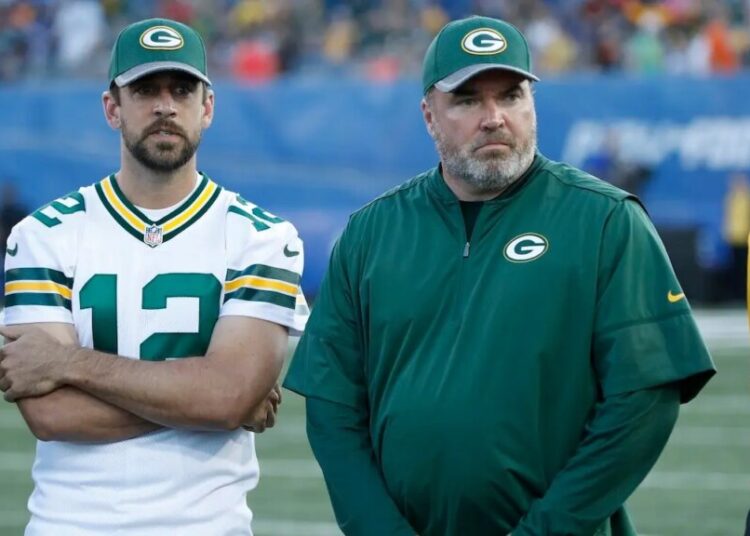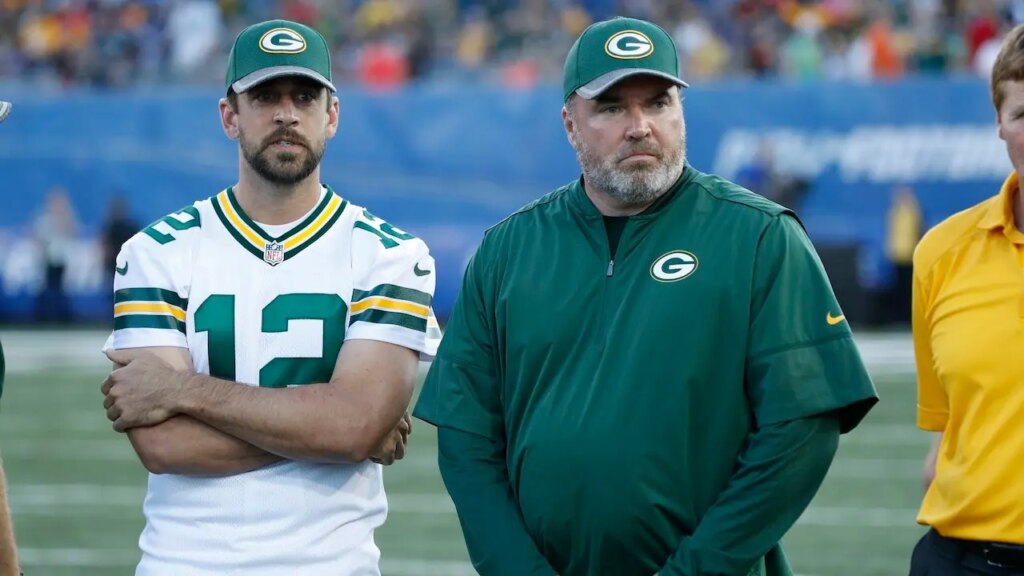
Aaron Rodgers and Mike McCarthy made divorce the theme of this Thanksgiving.
Rodgers accused McCarthy of falling asleep in meetings, skipping team activities and harboring resentment over his 2018 firing in Green Bay, even claiming he had covered for his coach for years. McCarthy denied holding a grudge against Rodgers.
But long before their reunion in Pittsburgh imploded, the two men shared a complicated 21-year history that included an NFL Draft rejection, a Super Bowl triumph, public confrontations and seemingly heartfelt reconciliations.
Before Rodgers ever played a snap in the NFL, McCarthy helped deny him a childhood dream.
McCarthy was the San Francisco 49ers’ offensive coordinator in 2005 and helped evaluate Rodgers, a Northern California native and lifelong 49ers fan who starred at nearby Cal. But San Francisco selected Utah quarterback Alex Smith with the No. 1 overall pick, leaving Rodgers to endure an infamous, hours-long wait in the NFL Draft green room on national television before Green Bay selected him 24th overall.
Former 49ers head coach Mike Nolan acknowledged McCarthy’s influence on the decision in Ian O’Connor’s 2024 biography of Rodgers, saying McCarthy was the most knowledgeable member of the group when it came to quarterbacks.
“It was my first head coaching job, and Mike was the guy who was most knowledgeable on quarterbacks of the group, and as a group that’s what we decided. … He had a lot to do with picking the other one (Smith), and in the end he got the one (Rodgers) that he didn’t pick, and it elevated his career,” Nolan said in the book.
McCarthy was quoted in the book giving his side of that story, saying “I was the offensive coordinator, and I did express my opinion. But those selections are made by a group of people, and ultimately a lot of information goes into that. I thought both quarterbacks were very young, talented guys who you could win with.”
Three years after passing on Rodgers in the draft, McCarthy publicly admitted he had misjudged the quarterback.
“Aaron is extremely athletic,” McCarthy said. “I’ve said it before, I did not evaluate him properly in the movement phase at quarterback coming out of college. I did not see the athletic ability that I have been able to witness since we’ve worked together.”
McCarthy had spent the previous two seasons developing Rodgers and was preparing him to take over as the Packers’ starting quarterback following Brett Favre’s retirement.
But when Favre came out of retirement that summer, Rodgers suddenly found himself facing the possibility of having to compete for the job he had waited three years to inherit.
Rodgers was met with boos from some Packers fans during the team’s annual Family Night scrimmage on Aug. 3, the night Favre returned to Green Bay.
“They’re booing all of us, probably me mostly. So, yeah, I take it personally,” Rodgers told reporters that night.
McCarthy met privately with Favre for several hours the following evening. The meeting ran so long that the Packers canceled a scheduled press conference, and a team spokesman said McCarthy had not spoken to Rodgers that day, according to The Washington Post.
But McCarthy ultimately stood by Rodgers, publicly defending the young quarterback amid the controversy.
“He’s done everything right to this point, so why would I put him through any more than he needs to go through?” McCarthy told reporters Aug. 5.
Favre was traded to the New York Jets the following day.
Around 2010, Rodgers and McCarthy began meeting privately on Thursday afternoons after practice.
“Some about football, but a lot about life. Lessons, thoughts and dreams,” Rodgers recalled in December 2018, shortly after McCarthy was fired.
McCarthy reminisced about those meetings during a 2019 interview with NFL.com, acknowledging how much he missed those conversations. In November 2022, McCarthy revealed how those encounters would typically end.
“And it always ended with a hug and, ‘I love ya,’” McCarthy told reporters.
Their partnership reached its pinnacle on Feb. 6, 2011, when the Packers defeated, ironically, the Pittsburgh Steelers 31-25 in Super Bowl XLV.
Rodgers was named Super Bowl MVP the following night. Neither man has won another Super Bowl since.
McCarthy briefly handed his play-calling duties over to Rodgers during the Packers’ 2011 regular-season finale against the Detroit Lions.
With Rodgers resting ahead of the playoffs, McCarthy tasked him with calling the offensive plays for backup quarterback Matt Flynn throughout the first half. Flynn went on to set franchise records with 480 passing yards and six touchdown passes in a 45-41 victory.
“He’s got a bright future in coaching,” McCarthy joked to reporters the following day.
McCarthy expanded Rodgers’ play-calling responsibilities in 2012 before scaling them back in 2013, determining he had put too much responsibility on his quarterback.
The tension between Rodgers and McCarthy spilled onto the sideline on national television during a Week 3 game against the Cincinnati Bengals.
Rodgers had been stopped at the 1-yard line on a third-down scramble in the second quarter, prompting the Packers to settle for a field goal. An animated Rodgers confronted McCarthy on the sideline over his play-calling, and Fox’s television cameras captured defensive tackle B.J. Raji extending an arm between the two men as they argued.
The Packers went on to squander a 16-point second-half lead, losing 34-30. Rodgers threw multiple interceptions in a regular-season game for the first time in nearly three years.
McCarthy downplayed the confrontation after the game, even suggesting Rodgers’ willingness to express his frustration was something he admired about his quarterback.
“He’s competitive, man. That’s what I love about him. I don’t think it’s that big of a deal,” McCarthy told reporters.
Rodgers confirmed the argument was over play-calling but refused to disclose the specifics of what was said between them.
Two days later, Rodgers addressed the incident again on his ESPN Milwaukee radio show, insisting the two had resolved their disagreement and emphasizing their history of success and mutual respect.
“There’s a lot of competitiveness and passion on both sides, and every now and then that passion collides,” Rodgers said.
As Rodgers and McCarthy prepared for another playoff run after a 12-4 regular season, some of Rodgers’ teammates revealed how intense the relationship between the two men could get behind the scenes.
Former Packers backup quarterback Seneca Wallace told NFL.com that McCarthy would become frustrated when Rodgers independently called plays without his knowledge, sometimes prompting the coach to blurt out, “What the f—? What is he calling?”
Wallace estimated Rodgers could call 40 of the team’s 70 offensive plays in a given game.
“Coach McCarthy always talks about alpha dogs — well, they’re like two alphas going at it,” Packers linebacker and close friend of Rodgers, A.J. Hawk, told NFL.com.
Rodgers suggested their occasional confrontations had only strengthened their relationship.
“But I think we both know each other well enough that the last thing that either of us want to do is disrespect each other,” Rodgers said.
Speculation about tension between Rodgers and McCarthy became so widespread among Packers fans that the two agreed to give separate interviews to Green Bay Press-Gazette reporter Pete Dougherty to address their relationship.
The Packers had just finished their worst regular season in total offense since Rodgers became the starting quarterback.
“This is the most frustrated I’ve ever seen him,” McCarthy said of Rodgers.
McCarthy suggested he was uniquely positioned to challenge Rodgers, while the quarterback maintained their disagreements had always been constructive and rooted in mutual respect.
Just two days after the interviews were published, television cameras captured Rodgers and McCarthy sharing playful moments on the sideline during a 35-18 playoff victory over Washington.
McCarthy acknowledged the significance of those images amid the speculation about their relationship.
“I enjoy our relationship. I guess it’s good everybody got to see good clips,” McCarthy told reporters the following day.
Four years after their heated sideline confrontation in Cincinnati, another game against the Bengals produced an awkward moment between Rodgers and McCarthy.
CBS cameras captured Rodgers looking toward the Packers’ sideline and appearing to mouth, “Stupid f—ing call!” twice after taking a sack late in the third quarter.
When Rodgers arrived for his individual meeting with McCarthy the following week, the head coach already had footage of the incident pulled up on a screen, according to a November 2018 Sports Illustrated report.
McCarthy had worked with Rodgers early in his career on controlling his body language when frustrated. More than a decade into their partnership, the two reportedly revisited those lessons.
The Packers ultimately won the game 27-24 in overtime.
Alex Van Pelt, who played quarterback at the University of Pittsburgh while McCarthy was a graduate assistant there, had served as Rodgers’ quarterbacks coach since 2014.
But McCarthy brought in a new quarterbacks coach after Van Pelt’s contract expired following the 2017 season.
Rodgers publicly expressed his displeasure during an appearance on ESPN Radio’s “Golic and Wingo” during Super Bowl week.
“Well, my quarterback coach didn’t get retained,” Rodgers said. “I thought that was an interesting change, really without consulting me.”
McCarthy had previously characterized Van Pelt’s departure as a mutual decision, as the assistant had aspirations of becoming an offensive coordinator.
However, several sources close to the Packers later told Sports Illustrated they believed McCarthy had come to view Van Pelt as a threat because of his close relationship with Rodgers.
Van Pelt ultimately took another quarterbacks coaching job with the Cincinnati Bengals.
Rodgers was celebrating his 35th birthday on Dec. 2, 2018, when he learned McCarthy had been fired.
“I was at home with my folks in town for my birthday. When I found out, I was as shocked as many of you were, I’m sure,” Rodgers said.
The Packers had fallen to 4-7-1 after an embarrassing 20-17 home loss to the Arizona Cardinals earlier that day, prompting the franchise to abruptly end McCarthy’s tenure after nearly 13 seasons.
Fox Sports’ Terry Bradshaw suggested Rodgers was responsible for McCarthy’s firing, an assertion Packers president Mark Murphy publicly disputed the following day.
Rodgers also pushed back against speculation about their deteriorating relationship, revealing that he and McCarthy had actually spent more time talking to each other during the 2018 season than in previous years.
But it was a chance encounter outside Lambeau Field in the days after the firing that made the separation particularly surreal for Rodgers.
While driving to work one morning, Rodgers looked across an intersection and spotted McCarthy sitting in his truck. Rodgers recounted the encounter to reporters four years later.
“It was a really weird feeling,” Rodgers said, recalling the moment it finally sank in that McCarthy was no longer his head coach.
Four months after their separation, an extensive Bleacher Report investigation exposed alleged dysfunction between Rodgers and McCarthy dating back to the early years of their partnership.
The report alleged McCarthy would miss team meetings to receive massages in his office, while Rodgers had privately questioned his coach’s football intelligence and harbored resentment dating back to the 2005 NFL Draft.
McCarthy denied the massage allegations, calling them “utterly absurd.”
But perhaps McCarthy’s most prominent defender was Rodgers himself.
During an April 8 appearance on ESPN Wisconsin’s “Wilde and Tausch,” Rodgers characterized the report as a “smear attack,” defended McCarthy’s character and revealed he regretted publicly criticizing his coach’s game plan after the Buffalo game the previous September.
“I love Mike McCarthy. He’s a great man, he has a huge heart,” Rodgers said.
Rodgers also pointed to his decision to sign a four-year, $134 million contract extension in August 2018 as evidence against the notion that he disliked playing for McCarthy, arguing he had anticipated spending the remainder of his career with him.
Rodgers even made a personal plea to Packers fans in Green Bay, where McCarthy and his family still lived.
“If you see Mike, shake his hand. Tell him thanks for the memories. Tell him thanks for the coaching job that he did,” Rodgers said.
Four years after their separation, McCarthy returned to Lambeau Field to face Rodgers as opponents for the first time, with McCarthy coaching the Dallas Cowboys.
The two men had been communicating more frequently over the previous year, according to Rodgers, and exchanged compliments publicly in the days leading up to the game.
Television cameras captured Rodgers and McCarthy sharing an embrace during pregame warmups. But Rodgers later revealed the two had arranged a private meeting well before kickoff, away from the cameras.
“We had a really beautiful conversation before the game. Just really thankful for that time,” Rodgers told reporters.
Rodgers then led the Packers to a 31-28 overtime victory, overcoming a 14-point fourth-quarter deficit and spoiling McCarthy’s return to Green Bay.
After the game, an emotional and visibly frustrated McCarthy was less inclined to discuss the sentimental significance of his homecoming.
“I’m not trying to be rude, (but) I’m humble pied out,” McCarthy told reporters.
Rodgers played a role in bringing McCarthy back to the NFL.
Following Mike Tomlin’s resignation in January, Rodgers encouraged Steelers general manager Omar Khan to interview McCarthy, later admitting he had not expected the franchise to seriously consider his former coach.
During a March 4 appearance on ESPN’s “The Pat McAfee Show,” Rodgers learned that McAfee had also vouched for McCarthy after working with him as a regular guest on the show throughout the 2025 season. McAfee specifically praised McCarthy’s preparation and work ethic.
Rodgers agreed with McAfee’s assessment and expressed enthusiasm about McCarthy returning to his hometown to coach the Steelers.
Meanwhile, McCarthy returned to Lambeau Field on March 23 for a tribute to former Packers president Bob Harlan. When asked about potentially coaching Rodgers again, McCarthy said, “Yes, it would be a great story.”
Rodgers officially re-signed with Pittsburgh on May 18, committing to playing his final NFL season under McCarthy.
Rodgers revealed two days later that sitting in McCarthy’s first morning meeting had transported him back to being a 22-year-old quarterback in Green Bay.
“It’s like a pinch-me moment,” Rodgers said.
However, Rodgers acknowledged that McCarthy had changed aspects of his offense during their eight years apart and indicated there were certain elements of his coach’s play-calling terminology he would push back on.
Just six months after describing his reunion with McCarthy as a “pinch-me moment,” Rodgers publicly aired grievances against his longtime coach that dated back more than a decade.
The Steelers announced late Tuesday night that Rodgers would be inactive for Friday’s game against the Denver Broncos in favor of Mason Rudolph. Rodgers claimed he learned of the decision during a phone conversation with teammate Pat Freiermuth, not from McCarthy himself.
During an explosive appearance on ESPN’s “The Pat McAfee Show” the following afternoon, Rodgers accused McCarthy of repeatedly falling asleep in meetings, missing walkthroughs and failing to adequately prepare for games.
Rodgers said one of the breaking points came during halftime of Pittsburgh’s 19-16 loss to the Philadelphia Eagles on Sunday, when McCarthy mistakenly broke down the team’s huddle by saying, “One, two, three, Packers.”
But Rodgers’ allegations extended well beyond their brief reunion in Pittsburgh. The quarterback claimed similar issues had persisted throughout much of their time together in Green Bay.
“I covered for him for a lot of years and we worked around it,” Rodgers said.
Rodgers also alleged McCarthy had privately expressed resentment over his firing in Green Bay eight years earlier, believing Rodgers was responsible for it.
Ultimately, the relationship came to a head over the same issue that had repeatedly generated friction between the two men over the previous 15 years: play-calling.
Rodgers said he told McCarthy the Steelers would be better off with someone else calling offensive plays and asked to be released if the team was unwilling to make that change.
The Steelers officially released Rodgers on Wednesday afternoon.
McCarthy subsequently told reporters the quarterback had issued an ultimatum that was “clearly out of his job description.” He acknowledged the embarrassing halftime incident in Philadelphia but denied harboring a grudge against Rodgers over his departure from Green Bay.
After 21 years, two franchises and a Super Bowl championship together, McCarthy was once again the coach who decided to move forward without Aaron Rodgers.
The post Aaron Rodgers vs Mike McCarthy: Timeline of beloved Super Bowl duo’s descent into baffling NFL soap opera appeared first on Fox News.