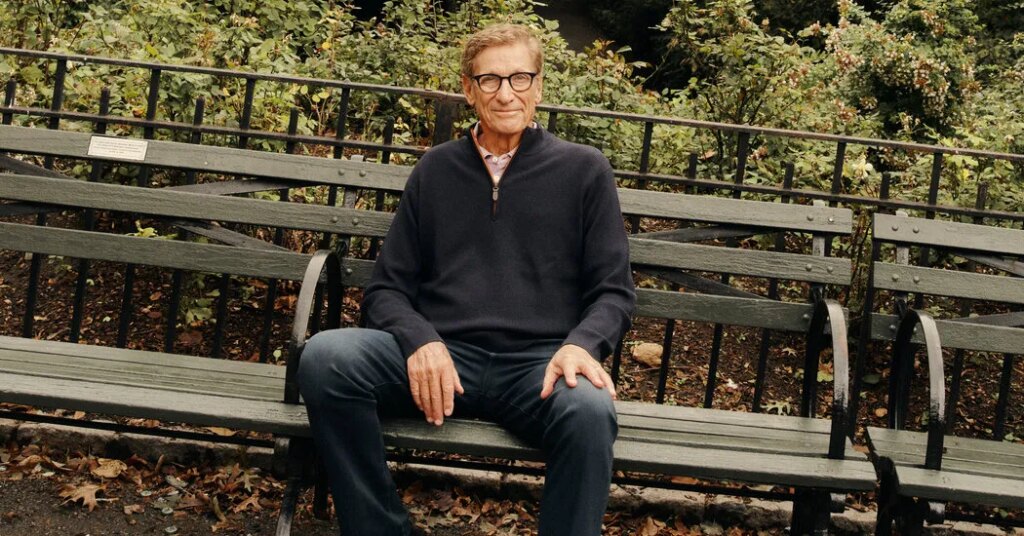
They gazed at each other from behind their microphones and smiled — the stately former host of a less stately daytime talk show and the internet-famous mustachioed comic who tells sex jokes in tracksuits.
Maury Povich, 87, and Stavros Halkias, 37, had been filming a recent episode of Povich’s post-daytime podcast, “On Par with Maury Povich,” inside a Midtown Manhattan recording studio, meditating on the guest’s favorite pursuits.
“You like weed,” Povich said, faux-interrogating, sounding something like the high-school principal who isn’t like those other high-school principals.
“I do like weed, Maury,” Halkias confirmed.
“Do you know that there’s a strain named after my wife?” Povich asked. “The Connie Chung weed.”
Halkias vowed, cackling, to “roll up a nice spliff of your wife tonight, Maury. Out of respect.”
And this respect makes some sense. It is not merely that a generation of pod-comics a half-century his junior once delighted in watching Povich deliver on-air paternity results (“You are NOT the father!”) while they were home sick from school.
It is that Povich registers clearly now, with the ring light of hindsight, as both their seen-it-all peer and their essential forerunner.
He is, in a sense, the father of an everything-is-content entertainment moment in which no consideration — expertise, relevance, good taste — is an industry obstacle for the right kind of talker.
Or, at minimum, he is not not the father.
“Look, everybody in the country is going to have a podcast,” Povich said in an interview, sitting cross-legged inside the Upper West Side apartment he shares with Chung, the pioneering broadcast journalist and his wife of more than 40 years. “It’s OK. It’s fine.”
In many ways, Povich’s career has doubled as a tour through more than six decades of media history and canny national pulse-reading.
He has toggled from smoke-on-the-air anchorman (“I wasn’t Ron Burgundy, but…”) to eponymous daytime talk show franchise (1991 to 2022) to the final form: podcaster.
He has reclaimed a place in the cultural firmament by doing a version of what he has always done, sensing where the audience was headed and steering himself there.
There was a time, not so long ago, when on-air paternity tests were considered by some to be society’s rock bottom, not a quaint and nostalgic relic of linear television.
In non-retirement, Povich is a still-talking reminder that everything and nothing has changed.
“The whole ‘Housewives’ franchise, the Kardashians, ‘Jersey Shore,’ you name the reality show — it all came out of those daytime shows,” he said. “These themes are so classic. I mean, they’re Shakespearean. They go all the way back centuries. People are interested in the same themes that Shakespeare was, whether it be betrayal or love or lust or greed.”
Povich is one of those interested people. He has stuck around long enough to be simultaneously ubiquitous in the manner of a 2026 celebrity and a 1996 celebrity while retaining the newsman’s timbre and resilient hairline of a 1966 celebrity.
He is a TikTok neophyte now TikTok-famous to users who have never touched a remote control.
Accounts for the daytime show and its host have more than 10 million followers across platforms like Facebook, Instagram and YouTube. Throwback clips still circulate, frequently and virally, exposing Povich to viewers whose parents watched him counsel parents, unruly teenagers, ecstatic non-fathers, guests with bespoke phobias.
“Millions and millions of views on the pickle lady and the olive lady,” Povich said approvingly, as his golden retriever, Taxi, pawed for attention.
Reruns also air the old-fashioned way on about 150 stations, he said.
The most popular episodes of the podcast, which airs weekly and began last year, draw a more modest six-figure viewership on YouTube, where ad breaks tend to proceed with a knowing wink:
“Throughout my career I’ve always been about the results. And so I demand that same level of truth when it comes to my own skin care …”
To admirers past and present, Povich’s durability is proof that the camera can keep rolling, that the ’90s daytime boom is not entirely through with us yet, that fatherhood is to be cherished, sure — he speaks warmly and often of his three children — but that not-the-fatherhood can move people to celebration, too.
“Legend,” said Adam Friedland, the consciously off-kilter comedian and podcaster who has sat with Povich as both host and guest.
“Iconic,” Justina Valentine, a television and internet personality, said of Povich, whom she labeled “White Chocolate” in a clip she posted of the two rapping together last year after her “On Par” appearance.
“It’s bizarre to me,” Chung said of Povich’s kinship with the millennial-and-younger podcast class.
But it is not unfamiliar. She recalled the recurring scenes through the years at airports, Knicks games, anywhere.
“These college students would come,” Chung said. “‘Maury, say it! Say it, Maury! Say it!’ And he’d agree to do it: ‘You are NOT the father.’”
To Povich, who will still say it, his podcast has two more basic functions.
The first is as his “great Alzheimer’s test,” he said, with the hope that the show might keep him as sharp and engaged as possible for as long as possible. (The disease runs in the family.)
The second purpose is perhaps more complicated.
“More than anything else,” Povich said flatly, “it’s an attempt to stay relevant.”
Asked why this mattered, he seemed confounded by the premise: “Well, because I’m alive.”
Some online commenters have professed surprise, if relief, to learn this.
“Maybe,” Povich wondered, saluting a departed peer, “they thought I was Jerry Springer.”
‘He Took It Seriously’
A few years ago, a stand-up comedy clip was making the internet rounds.
“Maury is such an ally to the Black community,” the comedian Josh Johnson began, to a burble of bemused chuckles.
In Povich’s decades on the air, the comic reasoned, he had never mispronounced a guest’s name.
“‘Dontuavius’?” asked Johnson, who is Black, as the room caught up with him. “Says it like it’s nothing!”
Povich’s daughter Susan saw the video and shared it. Soon enough, Povich and Chung were traveling to see Johnson perform in Connecticut. The men hit it off.
Povich said Johnson reminded him of George Carlin, whom he had interviewed many jobs ago. He invited Johnson on “On Par” for what would become one of the podcast’s most viewed episodes.
Johnson, a correspondent on “The Daily Show,” seemed to have an almost anthropological interest in Povich’s old show.
When it filmed, before a rollicking studio audience consistently stirred by the chaos arrayed before it, “Maury” had often betrayed a self-aware trashiness: “DNA Will Prove I Had a Baby With Your Uncle!” “I’m Terrified of Spiders, Lizards … and Olives!” “My Stepson Slept With My Wife … Is He My Daughter’s Father?”
“My favorite program was: ‘Is it a man or is it a woman?’” Chung said. “Or fat babies.”
That the guests were often Black had long provoked uncomfortable questions about whether the show was trafficking in exploitative stereotypes, especially in its paternity episodes.
Johnson saw it differently.
“At the end of the segment, he’s always like, ‘What are we going to do?’” Johnson said in an interview. “You could tell the arc of whatever the show was doing was resolution. The arc of a lot of reality TV that came after was imagined conflict.”
At times, Povich has likewise suggested that the show, and its host, were at least a little misunderstood.
He really was trying to make families whole, he still insists. If people enjoyed watching what that looked like in his hands, then that was nice, too.
“He took it seriously,” said Geraldo Rivera, a longtime TV counterpart. “Even if we didn’t.”
Povich recalled receiving letters from prisoners (who apparently had sufficient television access) wondering if they might be the father of certain guests’ children. He shared proudly that pro athletes had reported delaying practice to see a paternity question settled on their locker room screens. (Shaquille O’Neal has said he placed four-figure bets on the answers.)
The host was sent up on “Curb Your Enthusiasm” and “South Park,” cheered by 50 Cent, floated as the face of a national stamp campaign on “Saturday Night Live.”
“I know he’s white,” Michael Che, a “Weekend Update” anchor on “S.N.L.,” said of Povich years ago. “But he’s brought more Black families together than anyone I can think of. And he’s set more Black men free than Abraham Lincoln himself.”
Angela Yee, a radio personality who co-hosted “The Breakfast Club” for over a decade, said Povich’s appeal was rooted in a sort of reflexive non-judgment.
He “wasn’t trying to fix people,” she said. But there was something resonant about watching him watch them raise hell while remaining calm.
“He just wanted people to tell their stories,” Yee said, after appearing as an “On Par” guest. “We can never forget that he really is a journalist.”
Early on, Povich was a local reporter and anchorman in Washington, the area where he was raised. In 1986, he began hosting “A Current Affair,” a television newsmagazine whose topics included the tabloid doings of Donald J. Trump, a sporadic former golf companion of Povich’s.
Povich counts journalists of very different generations, like Tony Kornheiser and Pablo Torre, as friends. In 2007, he and Chung founded a newspaper, The Flathead Beacon, in the Flathead Valley of Montana, where they spend much of the year.
Straighter news ran in the family. Povich’s father, the sportswriter Shirley Povich, worked for most of the 20th century at The Washington Post.
Chung, a journalist’s journalist, is quick to remind her husband’s newer fans that he once had standing in that world, too: covering Kennedy’s funeral, conflict in Lebanon, the Berlin Wall.
“I want everybody out there in podcast-land to know,” she told “On Par” listeners last year, as his inaugural guest.
Povich sighed performatively.
“You were not determining the paternity of every child in America,” she continued.
“Oh, God.”
“You were interviewing everybody from world leaders to Watergate figures,” she said. “You were the go-to.”
At the end of the episode, which focused largely on Chung’s path and her 2024 memoir, Povich asked if there was anything she might like to ask him.
“Are you OK with retiring from your talk show?” she said.
“That was two years ago,” he said. “Don’t you think you could have asked me earlier?”
“Well,” she said, deadpanning, “you didn’t have a podcast.”
‘I Guess I’m Still Relevant’
Last month, Povich and his team set off on a well-worn bit: teaching an old man new words.
“Maury Povich Learns Gen Z Slang,” the video’s title read.
A young associate producer tried to define the term “stan” for him, describing an obsessive fan.
“For example, Maury, who is your favorite musical artist?” she asked.
“They’re all dead,” he said.
The lesson ended quickly.
When “Maury” stopped production, Povich said he assumed he would follow the example of a hero, Johnny Carson, who was scarcely heard from again after leaving “The Tonight Show.”
Povich has instead become the kind of person who talks to his guests about the power of reinvention.
“Why do you think I’m doing this podcast, huh?” he asked Valentine in their episode. “You think all I can do is read DNA tests?”
What he is doing, mostly, is conducting wandering conversations about his life and his guest’s, with a gimmick segment here or there (“On Par or off the rails!”) and a bit of improvisation.
It is, in short, a podcast.
“I know I made the right decision because I feel inspired,” he said. “It’s nice to be inspired at 87.”
If the guest roster has at times skewed toward younger comedians, Povich said he had always been fascinated by the profession, conducting long-ago interviews with Don Rickles, Richard Pryor and Mel Brooks.
He has become part of the loose affiliation of algorithmically linked comedy-adjacent podcasts, driving eyeballs to his show by appearing on more popular shows hosted by well-known internet figures like Friedland, Nick Cannon and Caleb Pressley.
Cannon and Friedland have in turn appeared on “On Par,” whose name comes from Povich’s golf fanaticism. “To them, I guess I’m still relevant,” he said of his younger counterparts, smiling again.
Chung said that she skips episodes only “if I’m not interested in the person or have never heard of the person,” which is not never.
She was asked if she and her husband had ever considered a joint podcast venture. This was a no. “When we work together,” she said, “I find him extremely annoying.”
Povich has found eager collaborators elsewhere. He is a regular fixture in Interview Magazine, a publication that pairs interviewers of note with interviewees of note in the hope that someone might say something of note. Earlier this year, Povich joined Friedland for a conversation that devolved into a worthy parable for the podcast age: Each man initially believed he was the interviewee.
The two merrily talked at each other before eventually diagnosing the confusion. (Povich was supposed to do the interviewing, they were told, but no one appeared to terribly mind the outcome.)
“Obviously this old guy got an email from something called Interview Magazine and his assumption was that he was being interviewed,” Friedland said. “So it wasn’t much of a stretch.”
Other sessions have been smoother, enshrining Povich as a common modern podcast creature: dishy, digressive, mining his own faults for the cause.
“Even in the talk show, it was about their stories,” Povich said. “I never revealed myself.” Now he cannot stop.
In a reciprocal appearance recently on Halkias’s podcast, “Stavvy’s World,” Povich detailed his college exploits at the University of Pennsylvania during a Philadelphia nurses’ convention (“What can I tell ya?”), noted the discrepancy in academic regard for him and Chung (“My wife’s got all these honorary degrees, I got bupkis”) and considered the host’s most sobering question.
“Maury,” Halkias said, sounding almost serious, “who was president the first time you saw breasts?”
Eisenhower, Povich ruled. “Thank god it wasn’t Kennedy.”
A short time later, Halkias said that Povich’s visit marked an important first:
“This might be the only time I’ve ever respected a guest.”
The post What Maury Povich Knew All Along appeared first on New York Times.