If a large asteroid were about to strike Earth, could we do something to stop it?
NASA is betting that the answer is yes. And newly unveiled pictures, courtesy of a European spacecraft, are showing exactly what happened when the space agency put its dramatic plan to the test.
In 2022, NASA announced that a car-size spacecraft had intentionally struck a (harmless) asteroid at 14,000 miles per hour and changed its orbit. The mission, called the Double Asteroid Redirection Test, or DART, showed that humans have the technology to swat away a dangerous space rock should it have our planet in its cross hairs.
But the mission also left scientists with a pile of questions about the impacted asteroid, and answers are needed to ensure that the triumph could be replicated during an actual cosmic emergency.
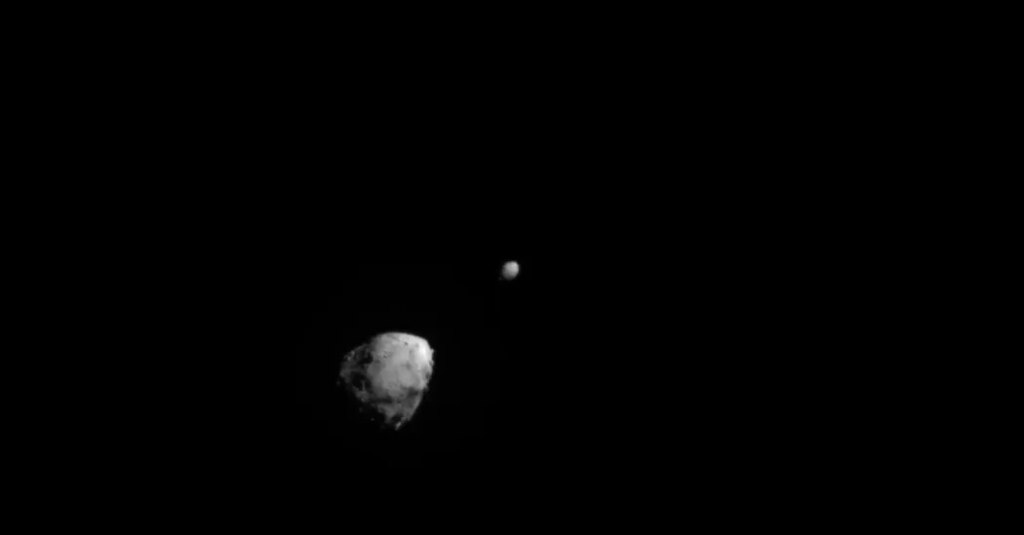
On Wednesday, the European Space Agency released the first images from Hera — its follow-up mission that was sent to survey the scene — at an event at the Museum of Natural History in Berlin. The stunningly detailed views of the post-impact asteroid have scientists awe-struck, but also have introduced fresh mysteries.
“The crash made a mess,” said Patrick Michel, the Hera principal investigator at the Côte d’Azur Observatory in Nice, France. “I couldn’t be more excited.”
Planetary defense has two prongs: spot dangerous asteroids well before a potential impact, and then work out how to deflect or vaporize them. DART was the first ever attempt to test whether humans could deflect an asteroid by smashing something into it.
The asteroid Dimorphos was an ideal target. It’s a common type of asteroid that, at about 495 feet long, is capable of taking out an entire city or a small country should it strike Earth.
The booster effect means that NASA got more bang for its buck — great news if you want to do this for real (and you’re a bit short on time).
Hera, which launched in 2024 and arrived at Dimorphos in early November, was designed to check NASA’s planet-protecting homework. Cameras will map out its surface, lasers will model its shape, a hyperspectral imager will perceive it in a kaleidoscope of colors to determine its composition, and a radio science experiment will narrow down its mass.
Before all of that, though, Hera had one all-important task: Find DART’s crater.
As the Hera spacecraft made its approach, Dimorphos looked “basically like a blob,” said Sabina Raducan, a researcher at the International Space Science Institute in Bern, Switzerland, and a Hera team member. “But it was a blob that seemed to be missing a piece.”
Oddly, there is a rocky object protruding from the heart of the crater, and scientists aren’t sure if it’s something unearthed from below, or a large rock that fell into the center from elsewhere.
The crater’s shape and size confirm that Dimorphos is a very loosely bound rubble pile, a jumble of rock and sand barely held together by its own gravity. It reacted to DART’s thwack by convulsing as if it were a fluid.
This underscores a key concern among planetary defenders: You don’t want to hit a rubble pile as hard as possible, because you risk shattering it into still-sizable pieces. This would turn a cannonball into a shotgun spray, which doesn’t exactly help if it’s still heading toward Earth. Although a decent chunk of Dimorphos is now missing, the asteroid itself is in one piece and on its changed post-DART orbit.
But Hera still has to contend with a troublesome debris swarm.
Various ground- and space-based telescopes had previously spotted reams of rocky debris streaming from Dimorphos not long after the blow. For months afterward, the asteroid sometimes resembled a comet with a giant tail. Only some of this matter was expected to still be hanging about in 2026.
Instead, “there are hundreds of boulders, all over the place,” said Harrison Agrusa, a planetary scientist at the Côte d’Azur Observatory and a Hera team member. The mission essentially transformed this corner of space into something akin to the asteroid field the Millennium Falcon flies through in “Star Wars Episode V: The Empire Strikes Back.”
“To see we have so much leftover debris from that impact is mind-blowing,” said Cristina Thomas, a DART team member and a planetary astronomer at Northern Arizona University.
Scientists are scrambling to make sure Hera can safely navigate through this shooting gallery. Dr. Agrusa said that he had lost considerable sleep charting out the trajectories of all these boulders and trying to “figure out what the hell is going on.”
A crucial moment for the mission will occur in early 2027, when Hera will deploy two small satellites to interrogate Dimorphos. One, Juventas, will use radar to probe the asteroid’s internal structure, while the other, Milani, will study its mineral makeup. Eventually, Juventas, and perhaps Milani, will land on Dimorphos — or die trying.
“We knew we’d have to operate in a pretty hostile environment,” said Margherita Cardi, the Milani project manager at Tyvak International, a space technology company with a headquarters in Turin, Italy. The boulder swarm, though, was entirely unexpected. “For me, it’s a nightmare,” she said. “There is a mix of excitement and panic.”
Assuming Hera doesn’t get ironically taken out by the wreckage that DART left behind, Europe’s spacecraft will continue its investigation of Dimorphos until at least June. Afterward, Hera may be commanded to fly to several other asteroids before eventually returning to Dimorphos.
For the European Space Agency, Hera’s rendezvous with Dimorphos represents a thrilling new chapter in the quest to defend our home. “This has been so exciting, and so fun,” Dr. Agrusa said.
For the DART team, seeing Dimorphos again — this time, as a world to be explored, not just a target to hit — is surreal. “It was, for me and a few other people, kind of emotional to see these first close-ups,” said Andy Rivkin, a DART team member and a planetary astronomer at the Johns Hopkins University Applied Physics Laboratory in Laurel, Md.
“They’re everything I hoped they would be,” Dr. Thomas said. “And then some.”
The post What Happened After NASA Slammed a Spacecraft Into an Asteroid? See for Yourself. appeared first on New York Times.