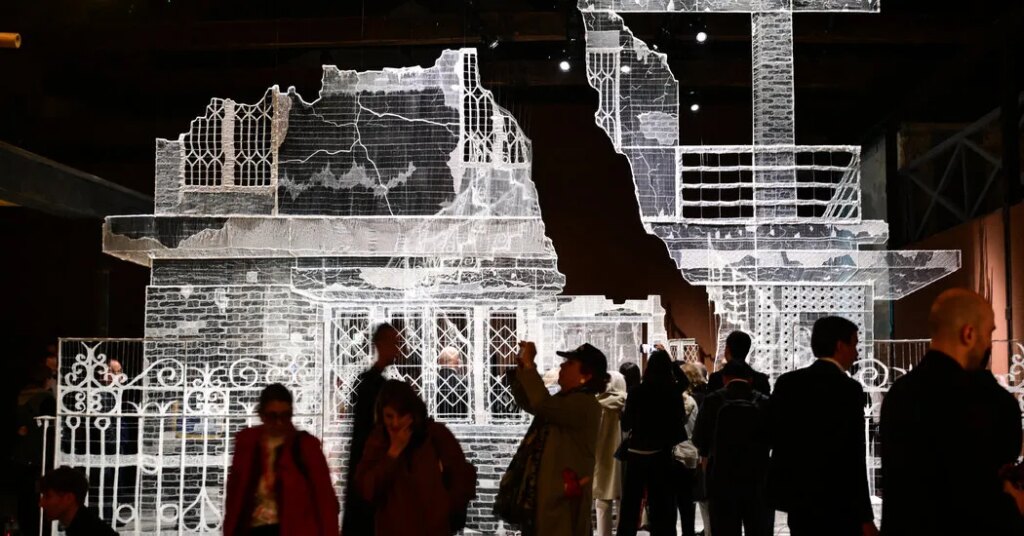
India on Wednesday won the Visitor’s Lion for the best national pavilion at the Venice Biennale, while the Chicago-born artist Nick Cave was named best artist in the Biennale’s main show — the top prizes at this year’s edition of the major art event.
At any other edition, the honors are called Golden Lions and awarded by a jury of art world insiders. But this year, the jury resigned shortly before the Biennale’s opening in May, and the organizers quickly pivoted to public votes.
Dozens of artists then ruled themselves out of the contests in solidarity with the jury, though their names continued to appear on the ballot — so it was unclear whether visitors actually chose India and Cave as their favorites.
A Biennale spokeswoman did not immediately respond to a request for a breakdown of the public votes.
The Venice Biennale, which had its first edition in 1895 and is one of the art world’s most important events, consists of two parts: a group show featuring over 100 artists, and dozens of exhibitions in national pavilions.
The jury usually awards two Golden Lion prizes: one to the best pavilion and another to the best participant in the group show. But things went off track when this edition’s five-person panel announced that it would not consider any artist representing a country whose leaders were under investigation by the International Criminal Court over accusations of crimes against humanity.
The jurors did not name any country, but both Israel and Russia were sending artists to Venice. In 2023, the International Criminal Court issued an arrest warrant for President Vladimir V. Putin of Russia over his country’s actions in Ukraine, and the following year it issued one for Prime Minister Benjamin Netanyahu of Israel on accusations of war crimes in Gaza.
Soon after the jury’s announcement, Belu-Simion Fainaru, the sculptor representing Israel, said in an interview with The New York Times that he had consulted lawyers over the jury’s decision. Its members then resigned without further explanation, and the Biennale announced the switch to a public vote.
Visitors to this year’s Biennale were later emailed a link so that they could vote for their favorite pavilion and artist.
In June, artists responsible for 39 of this year’s 100 national pavilions announced that they didn’t want to be considered for the prizes and asked the Biennale to remove their names from the running. Those included some of the highest-profile participants, like Miet Warlop, representing Belgium, and Florentina Holzinger, representing Austria with a pavilion featuring a naked woman riding a jet ski.
Over 60 of the 109 artists in the main show also joined the boycott.
The Biennale declined to alter its ballots, but said that it would ignore votes cast for boycotting artists when calculating the winners.
Some 714,000 people visited this year’s edition, which ran for from May 9 through Nov. 22, the Biennale said on Sunday in a news release.
The post U.S. Artist Nick Cave and India Win Venice Biennale Prizes After Artists Boycott appeared first on New York Times.