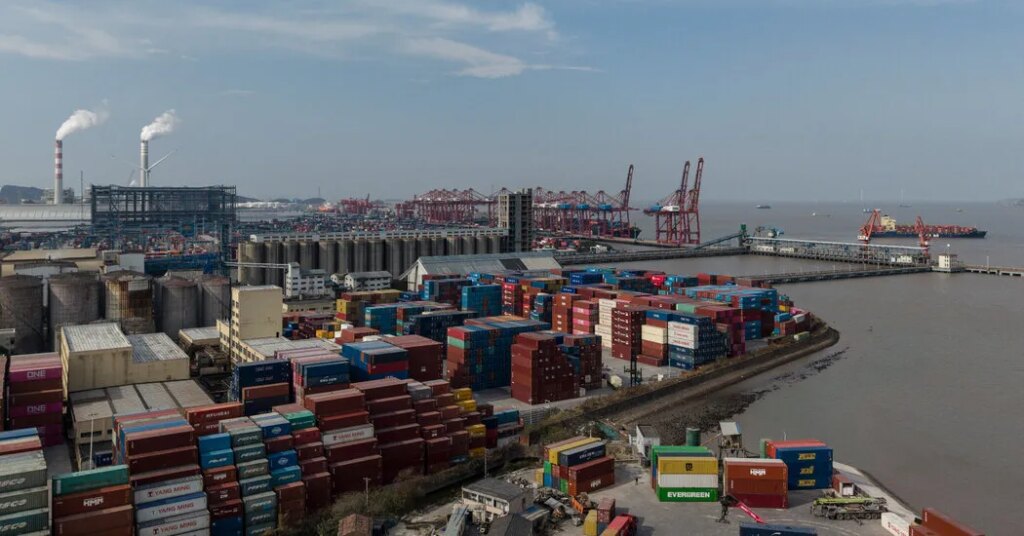
The Trump administration proposed a slate of new tariffs on Wednesday targeting imports from dozens of countries, including China, Japan and the members of the European Union, marking the latest expansion of a global trade war that faces mounting obstacles in Congress and the courts.
The administration framed the duties as a response to unfair trade practices, as it accused some of its closest economic partners of overproducing certain products, undercutting American businesses and contributing to a swelling U.S. trade deficit.
The newly unveiled roster of tariffs included a 20 percent tax on some imports from China, which the Trump administration signaled it could ratchet up — to 40 percent — if Beijing does not hew to the terms of a trade truce it has struck with Washington.
The Trump administration also proposed similarly high and potentially escalating rates on goods from the 27 members of the European Union and other trading partners including Cambodia, India, South Korea, Taiwan and Vietnam. Some of those duties could reach up to 20 percent as well. And it coupled the sweeping action with a separate, specific proposal seeking to raise rates on Brazil, targeting its sugar and aircraft exports.
Before the new tariffs take effect, the administration must fulfill a set of final regulatory requirements, which would include seeking public feedback, according to Jamieson Greer, the U.S. trade representative, who appeared Wednesday on CNBC. He described the approach as “targeted,” but noted that discussions continued with each of the affected trading partners.
In many cases, though, Mr. Greer said the tariffs would not stack on top of those that the administration had already put in place. That included duties that President Trump has applied on national security grounds to products such as steel and cars. He said the White House also sought to keep its tariffs in line with the trade agreements it had already brokered.
The battery of new tariffs nonetheless arrived at a precarious political moment for Mr. Trump, who has continued to engage in a strategy of aggressive trade brinkmanship even after the Supreme Court struck down his initial slate of country-by-country duties this year.
Mr. Trump has long portrayed tariffs as essential for boosting domestic manufacturing, raising revenue and fostering better trade deals. But his shifting policies have still counted among the many forces driving up prices for consumers and business, feeding a public backlash that ultimately stripped Republicans of their congressional majorities in the midterm election.
Still, the White House risked touching off a widespread backlash — angering Congress, as Democrats prepare to take control of the House and the Senate, and rattling Wall Street, where stocks fell sharply to open trading on Wednesday. It coincided with the government’s release of a key gauge of inflation, which showed that prices rose 3.8 percent in October from a year earlier, marking a pickup from September.
The announcement also appeared to rankle the country’s closest allies and trading partners. Some had already struck deals with Mr. Trump to avert higher tariffs — or were in the midst of negotiations — when the administration signaled Wednesday that it could raise rates even higher.
In the European Union, officials said they would study the Trump administration’s findings but disputed that Europe was the source of overproduction. Olof Gill, a spokesperson for the bloc, said E.U. members expected “any measure from this investigation to respect” the trade deal between Brussels and Washington.
Mr. Trump’s newly proposed tariffs on the European Union would be set at 15 percent, as the agreement between trans-Atlantic partners had stipulated. But the administration also warned it could raise rates as high as 25 percent if it found compliance was “unsatisfactory.”
In China, meanwhile, officials also reacted forcefully to the White House’s latest tariff actions, just days after the country’s leader, Xi Jinping, hosted Mr. Trump for another round of trade talks. “The so-called overcapacity is a false proposition, and China opposes using it as a pretext for political manipulation,” said Guo Jiakun, spokesman for China’s foreign ministry.
The Trump administration said it would enforce the new duties under Section 301 of the Trade Act of 1974, which permits the U.S. government to investigate unfair trade practices abroad and impose tariffs in response to its findings. It is a power that presidents of both parties, including Mr. Trump, have invoked successfully in the past.
Under Section 301, the government can impose tariffs only after investigating and uncovering evidence that other countries discriminated or impeded U.S. industries. The administration announced two such inquiries in March, as it sought ways to resuscitate the tariffs that the Supreme Court had invalidated.
One of those inquiries focused on dozens of countries for failing to crack down on forced labor. Those tariffs, which took effect in July, sparked a swift court challenge — and now await a verdict from a panel of judges that recently seemed poised to rule against the administration.
The second investigation targeted what the administration has described as “excess capacity.” At the time, Jamieson Greer, the U.S. trade representative, said the inquiry would focus on the extent to which dozens of countries had unfairly boosted their manufacturing sectors and overproduced goods to the detriment of American industry.
On Mr. Greer’s radar was a wide range of foreign practices, including other countries’ use of state subsidies; their currency management; their support for state-owned enterprises; and their economic, labor and environmental regulations. For the administration, the main concern was that these practices gave foreign industry an unfair advantage over American manufacturers while driving up the nation’s trade deficit, which Mr. Trump has struggled to reduce.
This month, the government reported that the deficit reached $105 billion in September, a slight decrease from August yet still the second-largest total since Mr. Trump returned to office. A key force behind that imbalance is artificial intelligence, a priority for Mr. Trump, as U.S. firms snap up expensive semiconductors and other computing components from abroad.
Some business owners criticized the tariffs, saying that Americans were already struggling with affordability concerns and that new tariffs could force them to raise prices again.
Anne-Marie De Witt, the chief executive of Fireside Games, a board game publisher in Austin, Texas, said the move was “especially disheartening after the electorate spoke extremely clearly about the hardship tariffs are placing on the budgets of all Americans.”
She issued the criticism alongside We Pay the Tariffs, a coalition of small businesses that has fought Mr. Trump’s trade policies. In response to the announcement on Wednesday, Ms. De Witt added, “We have all suffered enough.”
Other groups welcomed the move. In a release, the United Steelworkers union called the crackdown “long overdue” and said that extended global dialogues in recent years had failed to make progress on excess capacity in a range of industries, from steel and aluminum to chemicals, tires and ships.
“America’s manufacturing workers have been under attack for far too long, and now we have an opportunity to start restoring fair markets,” said Roxanne Brown, the president of United Steelworkers International.
Absent from the tariffs unveiled on Wednesday were Norway and Mexico, which had been among the countries that the Trump administration investigated. A senior official said reviews continued with respect to both trading partners.
“The problem of global structural overcapacity is very real for many American companies and industries,” said Timothy Brightbill, a top trade lawyer at the law firm Wiley Rein. He explained that other countries’ overproduced goods also affected global markets “where U.S. companies would like to be able to export but can’t due to unfair competition.”
“There are likely challenges in quantifying the amount of structural overcapacity in particular industries, but there is no doubt that this problem is real and growing,” Mr. Brightbill continued.
Sui-Lee Wee and Jeanna Smialek contributed reporting.
The post Trump Administration Unveils New Tariffs for Dozens of Countries, Citing Unfair Practices appeared first on New York Times.