What will the web look like in the future — if it exists at all?
Over the past two years, this has become an increasingly frequent question, with many technologists unsure whether the web will continue to exist as we know it. Google’s prioritizing of artificial-intelligence summaries over listings of specific websites, and the popularization of A.I. tools like ChatGPT and Claude — which let users bypass direct interaction with websites — have raised the possibility that the very idea of surfing the web, or even publishing a website, may soon become obsolete.
Just two weeks ago, A.I.-assisted cyberattacks disrupted the operations of the websites of so many companies that it became possible to imagine a previously far-fetched doomsday scenario: a temporary or even permanent crippling of the information superhighway.
It was against this backdrop that the Whitney Museum opened its latest exhibition, “artport: A History of Internet Art,” last weekend. It is a sprawling presentation, on view through March 28, 2027, that surveys the more than 100 internet-based artworks that have been commissioned for the museum’s website since 2001.
In looking back at the first 25 years of artport — the Whitney’s platform for these works — the exhibition raises the question of whether this art form will exist for another 25 years, and if so, what it will look like. In this light, the stakes of the exhibition are much higher than introducing new audiences to the aesthetic possibilities of internet art or canonizing this underappreciated movement. The whole exhibition can be read as a kind of assessment, through artists’ eyes, of what the internet has been, and soon may be.
Although artists began experimenting with telecommunication networks like Telex or Minitel in the 1970s and ’80s, internet art, or “net art,” took shape in the 1990s, when artists realized that the emergent World Wide Web could be a platform not just for circulating photographic reproductions of physical objects but also for presenting new artworks that could be seen by anyone with an internet connection.
In the wake of a century of dynamic modern and contemporary artworks, from the kinetic sculptures of the 1920s to the conceptual installations of the 1960s, these artists used code to create web pages that would function as live animations, interactive experiences or real-time systems that changed with new input.
Although it may look like a video, “The Line,” commissioned by the Whitney in 2017 from the artist duo eteam (Hajoe Moderegger and Franziska Lamprecht), is a simulation of a line of adults, all garbed in casual clothing; the figures sit or stand in place, holding themselves relatively still or fidgeting, while the “camera” continuously pans to the right.
In the show, the work is generated in real-time by code running in a browser on a hidden computer. (Finding out how long you are willing to stand around to watch people standing around in a line that never ends is very much the joke; projected on the title wall at the beginning of the survey, it gently lampoons the idea of a group show, while throwing down the gauntlet to its audience.)
Caught up in the dot-com boom, museums began creating their own websites, with some even hosting net art projects, including the Guggenheim Museum and Dia in New York, the Walker Art Center in Minneapolis and SFMOMA in San Francisco; the 1997 edition of Documenta and the 2000 edition of the Whitney Biennial included net art.
Then the dot-com bubble burst. In its immediate aftermath, Christiane Paul — who had been hired as the Whitney’s adjunct curator of new media art in 2000 — created artport as a subdomain of the Whitney’s website. “Net art was really getting attention at the time the bubble burst, which seems to be counterintuitive,” Paul, 65, said in a recent interview. “It also gave the art more of a serious stage for coming into being and developing” on a path that was relatively independent from Silicon Valley.
Paul initially focused on two initiatives: the monthly Gate Pages, which linked to artists’ own external home pages or online projects (posted from March 2001 to February 2006); and the larger, now biannual Commissions, artworks created specifically to live on artport.
In 2009, she created Sunrise/Sunset, commissioning artworks that took over the Whitney’s homepage for up to 30 seconds twice a day; it was replaced in 2024 by On the Hour. (The latest commission, Frank Wang Yefeng’s “The Levitating Perils #2,” interrupts whitney.org throughout the day with grotesque animations that include references to the century-old history of anti-Asian caricatures in Western media.)
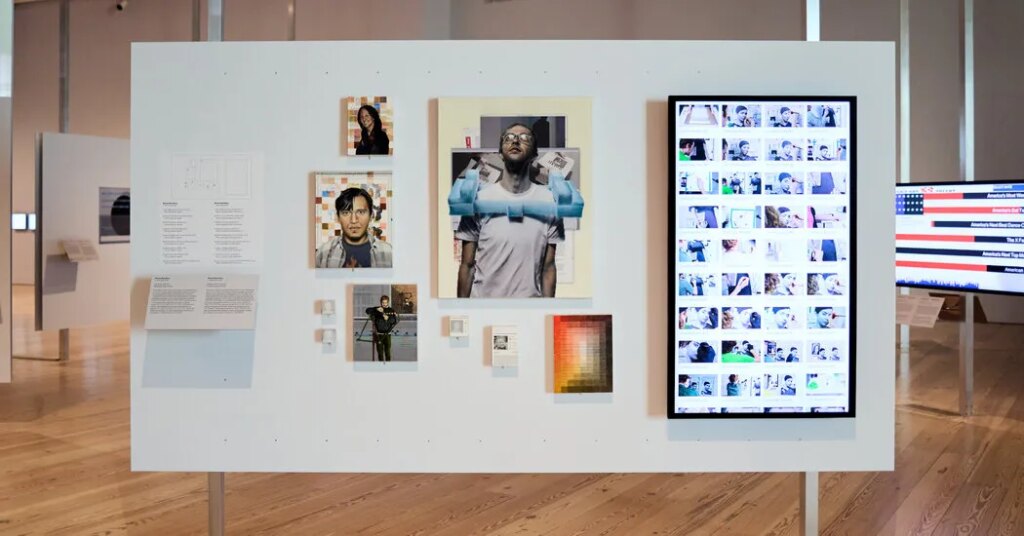
On the sixth floor of the museum, works are displayed on floating walls (overlapping to suggest open browser windows), some in thematic groupings, like surveillance, data visualization or institutional critique; but they also can be seen on artport’s site, which was newly conserved to coincide with the show’s opening.
By the mid-2000s, most museums had abandoned net art. Its audience has remained relatively small, even as its aesthetics have reverberated across popular culture, heralding phenomena including livestreaming (exemplified by Tina LaPorta’s 2001 Gate Page “voyeur_web,” which displayed live feeds from cameras that people had installed in their homes) to deepfakes (anticipated by Brody Condon’s “Fake Screenshot Contest,” a Gate Page from 2003 that invited visitors to submit doctored screenshot images, which Condon then himself doctored).
This marginalization is partly because of net art’s negligible market value before the NFT boom, as the Whitney’s director, Scott Rothkopf, explained in a phone interview, adding that “the museum has an even greater responsibility to nurture along the way” those art forms with a smaller market. Furthermore, the technical challenges and costs involved in caring for these dynamic, interactive works can be enormous: They constantly have to be migrated to new coding languages, software programs and hardware systems, requiring an investment in specialized staff and protocols.
Yet Paul managed to keep artport running, commissioning 107 new works — mostly by American artists, given the Whitney’s purview — over the past 25 years. Many have become canonical in the field, in no small part because of her initiatives.
In addition to helping keep the flame of net art alive through artport, Paul has organized exhibitions in the Whitney’s physical galleries and lectured around the world — essentially becoming the institutional face of an entire movement, rather like the Museum of Modern Art’s founding director, Alfred H. Barr Jr., who defined midcentury modernism. (Now in its fourth edition, Paul’s book “Digital Art” remains the most accessible introduction to the field.) One of her curatorial peers, Jon Ippolito, who oversaw the Guggenheim’s net art projects in the 1990s, said that “she is hands-down the pre-eminent expert on digital art working today, and has been for three decades.”
During Paul’s tenure, the Whitney has been more dedicated than any other major institution to using its online real estate as a kind of public gallery — one that is free, always open and globally accessible. The result is a collection that charts the evolution of the web and frames net art as a vibrant medium that is no less relevant than it was in the ’90s, even if — or perhaps precisely because — the web has lost most of its utopian shine.
In its early days, the net art community gathered via online mailing lists. The sending of emails may seem outmoded to some now but it remains a reliable way to distribute semipublic communications between members of a self-selected community, without relying on corporate platforms. Jonah Brucker-Cohen’s Gate Page from 2003, “BumpList: An Email Community for the Determined,” is a mailing list that can have only six members at a time (when a new member subscribes, the first is bumped from the list), cheekily raising the still-pertinent question of whether, and how, online communities should be gated.
The show also tracks the subsequent emergence of social media, or Web 2.0. TikTok users may be drawn to Maya Man’s On the Hour commission from 2024, “A Realistic Day in My Life Living in New York City,” in the Whitney’s lobby; the work parodies the genre of short-format internet video in which people performatively expose “a day in my life,” highlighting the slippery distinction between public and private selves.
Also included are works that tackle the introduction of decentralized blockchains, marketed as Web3, upon which non-fungible tokens (NFTs) are based. Jennifer and Kevin McCoy’s 2019 commission, “Public Key/Private Key,” is a kind of conceptual performance about digital ownership (Kevin is credited with coinventing NFTs in 2014). It doubles as a critique of the lack of transparency at museums: The artists donated a 16-millimeter film to the Whitney that is debuting in the show — and gave 50 people the chance to register on-chain as a “donor” of the work.
Although A.I. is not a new phenomenon — Paul’s most recent Whitney exhibition was devoted to the artist Harold Cohen, who pioneered A.I. art in the 1960s — its appearances here draw the show into dialogue with today’s headlines. Holly Herndon and Mat Dryhurst’s “xhairymutantx,” which was commissioned for the 2024 Whitney Biennial, is a text-to-image A.I. model that hallucinates cartoonish versions of Herndon’s red-haired avatar. Publicly stored on artport, these images can become training data for other A.I. models.
Although the artport exhibit acknowledges recent trends like NFTs and A.I., one of the main contributions of the show is to provide a more historical perspective — however partial — on the many different ways that people can interact with networks, from creating their own tools to controlling their own data and managing their own algorithms, just as Paul did when she created the platform. No wonder a D.I.Y., punk ethos emerges throughout the show, whether artists are inventing their own drawing software, visualizing public databases, building ecological models or subverting online spaces.
Three decades into the history of net art, the question now is whether our networks are so compromised by centralization that not even artists can visualize different futures. “In 1995, 8 percent of all websites were made by artists, so they had an outsized role in, for example, steering the web away from static pages and toward dynamic, participatory sites,” Ippolito said. He remains hopeful: “Artists have been reimagining alternative uses for technology since Jackson Pollock dripped paint off a stick and Nam June Paik lugged a magnet onto a TV. Artport is a trove of ideas for what the next internet could be.”
The post The Web May Be Dying. Can Net Art Save It? appeared first on New York Times.