An American-led investor group has signed a $10 billion agreement to buy the international assets of one of Russia’s largest oil companies, a piece of the deal-making plan that the Trump administration has pushed as part of its peace talks with the Kremlin.
But the tentative deal announced on Wednesday, in a nod to the changed political environment in Washington, excludes business partners of the families of Jared Kushner and Steve Witkoff, the Trump administration’s two main envoys to President Vladimir V. Putin of Russia. The involvement of the two envoys in talks regarding Lukoil, even as their families’ business partners stood to benefit from the deal, drew bipartisan criticism.
The partnership announced on Wednesday is led by the billionaire investor Todd Boehly, a major donor to President Trump’s political causes, and his Eldridge holding company; along with Catena Investment Holding, a United Arab Emirates-based energy investor; and Xtellus Partners, a Miami-based energy trading company. The U.S. International Development Finance Corporation, a federal agency, is also a partner in the deal.
But the announcement on Wednesday excluded any mention of the Syrian-born, Qatari-based brothers Moutaz Al-Khayyat and Ramez Al-Khayyat, who are business partners with Ivanka Trump and Jared Kushner on a planned luxury resort project in Albania, and who participants last month had told The New York Times were a part of the partnership.
The final partnership announcement also no longer includes International Holding Company, an Abu Dhabi-based investment consortium led by Sheikh Tahnoon bin Zayed Al Nahyan, the national security leader of the United Arab Emirates, who controls other funds that invested in a cryptocurrency firm, World Liberty Financial, started by the Witkoff and Trump families in 2024.
One person close to the negotiations said on Wednesday that conflict-of-interest questions — whether they were justified or not — played a role in the change in the makeup of the investment group and that the Khayyat brothers and Tahnoon-led investment firm are now out of the partnership.
When Mr. Trump’s envoys, Mr. Kushner and Mr. Witkoff, met with Mr. Putin at the Kremlin in September, he asked them to get the Lukoil deal done as a way of showing Russians they can do business with the United States, The Times reported. The Trump administration has long argued that discussing business deals with Mr. Putin could help persuade him to mend ties with the West and end his war on Ukraine.
In the weeks after the Times article, people close to the Lukoil negotiations said that questions about the appearance of a conflict of interest — this deal could bring billions of dollars worth of profits to the buyers — created a cloud around the transaction.
There were also calls by Democrats in Congress to investigate the deal, among others involving the Trump and Witkoff families, once the change in power takes place in January.
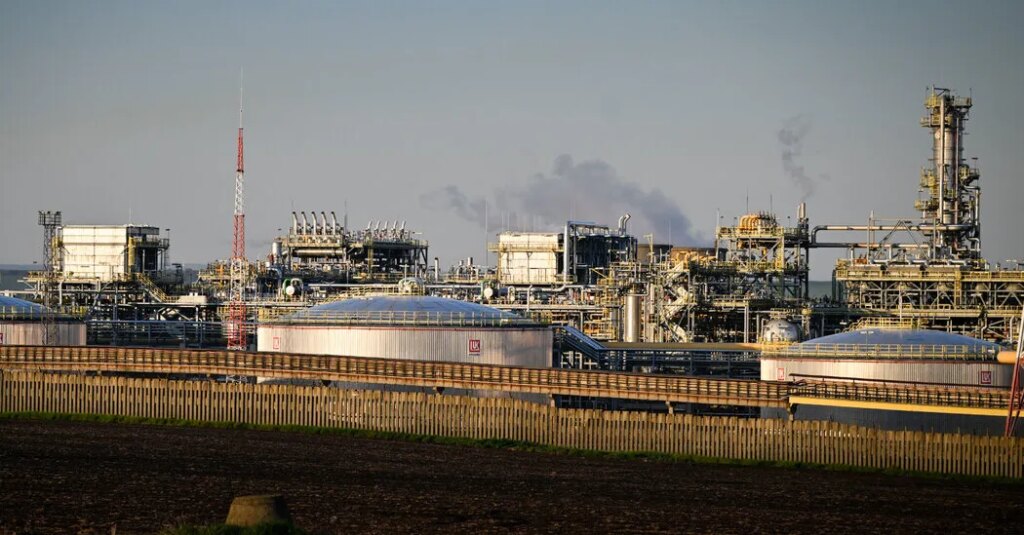
The Treasury Department in October 2025 imposed sanctions on Lukoil in an effort to try to force Mr. Putin to end the war in Ukraine. The company’s international division operates in 11 countries worldwide and currently produces approximately 350,000 barrels of oil equivalent per day.
Its most important assets include three refineries, including Burgas in Bulgaria, the largest refinery in the Balkans; Zeeland in the Netherlands; and Petrotel in Romania. It also owns hundreds of gas stations in New York, Pennsylvania and New Jersey.
The deal must still be approved by U.S. Treasury Department’s Office of Foreign Assets Control. It is structured so that at least for now no cash payments go directly to the Russian owners of Lukoil or to the Russian government, a requirement set by the Treasury. Instead, the Boehly group has bought up stock in Lukoil and other Russian companies owned by non-Russian parties to take control of the certain pieces of the company’s international assets.
The involvement of the Khayyat brothers and Tahnoon had become a major target for Democrats in Congress, including Senator Jon Ossoff of Georgia, who repeatedly highlighted the proposed Lukoil deal in his campaign, citing reporting by The Times.
“Amidst a global energy crisis, the president’s son-in-law and the president’s business partner are brokering the sale of Russian oil fields to the first family’s friends,” Mr. Ossoff said at an October rally in Georgia. “The same friends who have poured hundreds of millions of dollars into Trump family businesses.”
Representatives for International Holding and the Khayyat brothers did not respond on Wednesday to requests for comment.
The post Lukoil to Sell Foreign Assets, but Not to Kushner and Witkoff Associates appeared first on New York Times.