Miklos Beer, a retired Roman Catholic bishop, has spent days fielding an insistent and unpleasant question from his room in an 18th-century mansion converted into a home for elderly clergy: Was he really an agent for Hungary’s communist-era secret police?
He wasn’t, he has responded to a barrage of queries by phone and email. Few doubt him, but he and many others are still shadowed by the recent opening of files compiled by Hungary’s long disbanded version of the K.G.B.
The bishop, 84, is just one of around 60,000 Hungarians fingered as informers by the release of file cards and magnetic tapes that recorded the names of people registered as secret police snitches between the end of World War II and 1990.
“I feel no stigma myself because I know what I did, but others have stigmatized me because they are confused. They don’t understand,” Father Beer said in an interview at a retirement home for priests in Veroce, a forested village along the Danube north of Budapest, Hungary’s capital.
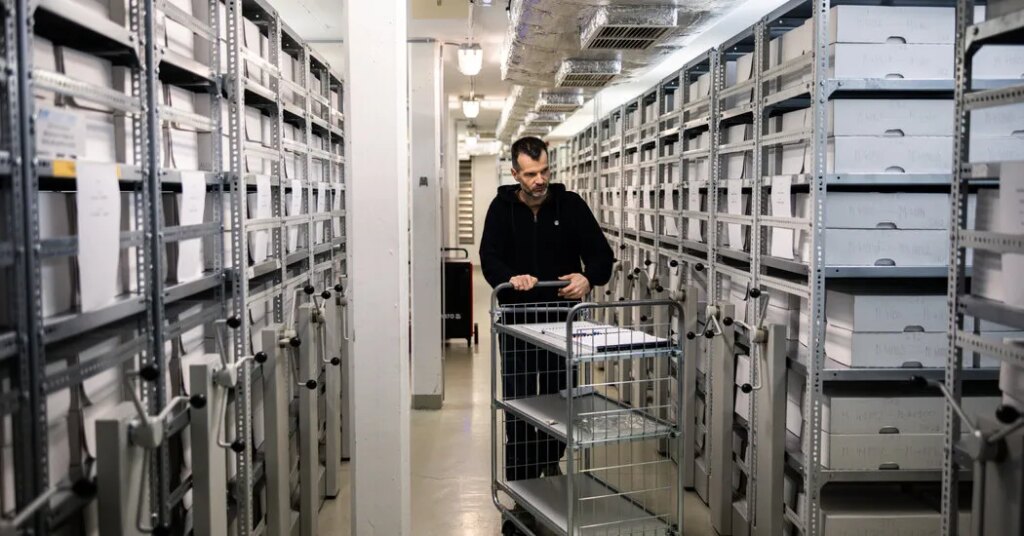
The files giving the names of people classified as agents have been long sealed, despite the collapse of the communist system that created them. They surged into public view on Nov. 4 when the Historical Archive of State Security Services launched a searchable database online.
The registry is far from comprehensive in explaining the names. The list was pruned of some people over the years, and also padded with the names of others whom security officers wanted to recruit but never really did. It gives scant information about whether those registered did any informing, and if they did, then how frequently or why.
Among those recently outed as agents are a judge on the constitutional court, an aging pop star, several senior churchmen and prominent cultural figures. But relatively few members of Hungary’s elite appear in the files, which suggests many names were deleted either before or after the collapse of Communism.
“One big problem is the most important agents are not in the database,” said Reka Foldvaryne Kiss, head of the Committee of National Remembrance, a state-funded group that researches Hungary’s communist past.
The opening of the archive was long overdue, she said, but, with many of the people named now dead and unable to defend themselves, the exercise risks giving communist secret policemen, now nearly all dead, the last word from the grave.
“We have inherited a very dark story from communist secret services,” she said, adding that the released files should be approached with great caution so as not to just “retell the dictatorship’s story by accepting all the information it left to us.”
A Painful Necessity
Researchers have had some access to the archive for decades and exposed a string of prominent Hungarians, including an Oscar-winning film director, as onetime informers.
Kati Marton, a Hungarian-born American writer who in 2009 published a memoir about her parents based largely on material from the archive, said the recent online release was a painful but necessary step.
“No doubt the content of the files will inflict pain. My parents’ files certainly did as they revealed that most everyone in our circle was informing on them — from cleaning ladies to close friends to — most treacherously — our babysitter,” she said.
But, she added, “Hungary needs to move forward and cannot do so until it confronts and assimilates the sometimes painful lessons of its recent past.”
The online database has allowed the whole country to see the roles family members, friends and colleagues played in that past, albeit in an incomplete form.
More than a million people logged on in the first day to see whether people they know and trust are “in the network,” a phrase used by the secret police to describe a vast web of Hungarians they registered as informers.
Father Beer, the retired bishop, insists he never collaborated and thinks he may have been registered as an agent after furtive men he didn’t know started visiting his home uninvited in the 1980s. He said he spoke with them out of courtesy two or three times but was never asked to inform on anyone.
With the exception of Russia and Belarus, Europe’s formerly communist countries began opening their security agency files decades ago, starting with the opening in 1992 of material collected by East Germany’s Stasi.
For Prime Minister Peter Magyar, who defeated Hungary’s longtime leader, Viktor Orban, in an election in April, the belated opening of the archive delivers on a campaign promise to finally come clean about the past.
Mr. Orban’s party, Fidesz, which governed Hungary for a total of 20 years, repeatedly blocked efforts by liberal lawmakers to make the names public.
Mr. Magyar’s political foes have dismissed the release of agent registration data as a political stunt aimed at smearing Fidesz and its supporters.
That view took off in right-wing media when, shortly after the online database went live, the archive announced that an I.T. error had mistakenly identified 164 people, including the former vice chairman of Fidesz, as secret police collaborators. They were “in the network,” but as victims, not perpetrators. Mr. Magyar quickly apologized for the error.
In a sarcastic post on Facebook, Mark Radnai, the vice president of Mr. Magyar’s Tisza party, mocked claims of innocence by many of those branded as snitches. “In Hungary, the socialist state security failed, because, according to the informers, none of them reported on anyone. Interesting,” he wrote.
From Trauma to Stigma
Worried about the “psychological consequences” on people named as agents, their families and the country as a whole, Noemi Orvos-Toth, a clinical psychologist, joined a committee advising the government on “how we should digest these files.”
Keeping them secret so long, she said, had deepened the country’s hidden traumas and allowed politicians with access to the archive to use its secrets to shame and blackmail their opponents.
The author of “Inherited Fate,” a book examining how repressed trauma passes from generation to generation, she said trauma is “transmitted in silence.” Opening the files “breaks the silence,” she said, though it also spreads “the stigma of being involved in oppression.”
“We think of these people as spies but in most cases they were just ordinary people put under terrible pressure,” Ms Orvos-Toth said, adding that “shame is the heaviest burden you can carry.”
Istvan Papp, the head of the security archive’s history research department, said that outright fake agent registrations were rare. But, he added, the security officers “wanted to demonstrate they were diligent” to their superiors and so exaggerated their recruitment successes.
He said he was disappointed to discover the name of a childhood neighbor in eastern Hungary he remembered as “a kind old man whom I liked very much” but who cooperated with the security apparatus to help it crush an anti-communist uprising in 1956.
Attila Pok, a respected historian, said he “had no idea” why his own name figured in the registry but recalled that security officers had asked him to report on an American diplomat he knew and on colleagues with whom he traveled abroad for academic conferences. “I told them, ‘No, this is not something I would do,’” Professor Pok said.
Reports filed by informers who did actually inform are contained in a separate and still secret set of material known as M files. Most of these were destroyed years ago during periodic culling of the files, the biggest of which happened in 1956 when anti-communist insurgents attacked secret police offices and security officers rushed to destroy evidence of their work.
There are no plans to release the 13,000 M files that still exist because they contain sensitive information about extramarital affairs, sexual habits and other personal details about people being spied on.
A separate batch of files containing each informer’s recruitment dossier was scheduled to be released in February but the files already released have created such a stir, said Janos Rainer, a historian advising the government, that releasing yet more material risks “another wave of indignation and conflict.”
The aim of the exercise, he said, is not to create “a wall of shame” but to help “society understand the dimensions and character” of communist-era security services and their lingering legacy. Someone’s name on a recruitment card, he added, “is not proof of being a perpetrator or even a collaborator.”
Janos Arva contributed reporting.
The post Hungary Threw Open Its Secret Police Files. Let the Finger Pointing Begin. appeared first on New York Times.