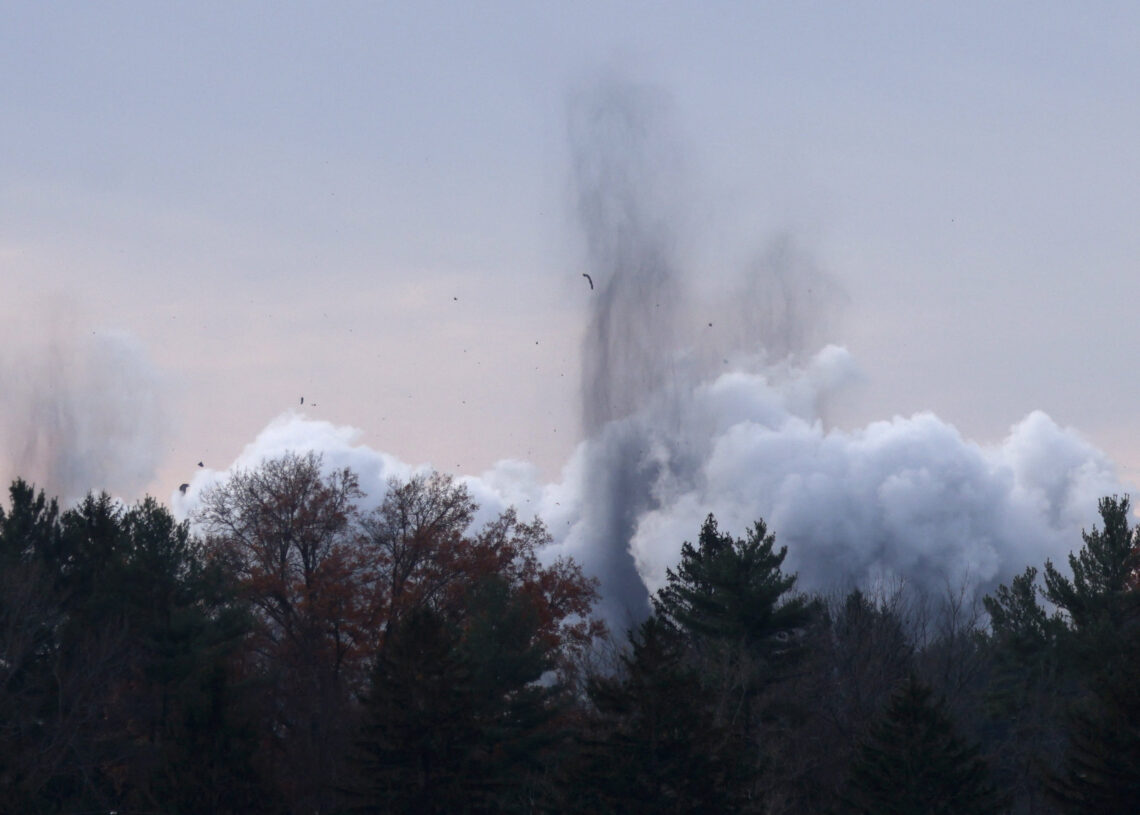
The U.S. military’s decision to detonate almost five tons of unstable explosives at an ammunition plant in Iowa on Wednesday, potentially sending a plume of toxic lead dust across the region a day before Thanksgiving, raises many pressing questions. Why were nearby residents unaware of the crisis until recent weeks? Did the government exhaust safer disposal options? Perhaps most important: How in the world did the U.S. military end up responding to such an unnecessary emergency?
Army officials said they learned in March that lead azide stored at the Iowa Army Ammunition Plant had dangerously deteriorated. The explosive was kept in 68 drums with a mixture of water and ethanol to prevent it from becoming reactive. As the stabilizing liquid evaporated, explosive crystals formed.
But documents obtained by The Post challenge that timeline. American Ordnance, the contractor that operates the plant, asked a disposal company in September 2025 to develop a plan to neutralize and dispose of the same 68 drums — nearly six months before the Army says it learned they posed a danger. In February, the contractor told the company that the government had decided to pursue another approach based on safety concerns.
The Army nevertheless hired the company, MuniRem Environmental, in March to develop a chemical treatment plan, then canceled the contract two months later. Army experts concluded that opening and treating the barrels created too great a risk of triggering an accidental explosion. MuniRem’s founder maintains that chemical treatment remained viable.
Officials faced a genuinely difficult choice. Lead is a neurotoxin, especially dangerous to children and pregnant women. At the same time, experts have said concentrations should dilute rapidly away from the site and serious effects on farmland and waterways are unlikely. The Army concluded that an accidental explosion posed the greater danger. A federal appeals court this week allowed the operation to proceed.
The harder question is why officials allowed the danger to reach this point. An Army press release from 2014 said the military began researching alternatives to lead azide in 2004 because the Defense Department was concerned about a 40-year-old stockpile of the explosive “deteriorating” at this same Iowa facility. The 68 barrels detonated on Wednesday arrived from another Army facility in Texas in 2009, according to the Army, but clearly the military had ample warning about the dangers.
American Ordnance performed monthly visual inspections of the storage magazines and each September opened the barrels to check and replenish their stabilizing fluid as needed, according to a sworn declaration from an Army explosives specialist. What did inspectors find in September 2025? Why was the contractor seeking to dispose of the 68 drums that month if the Army did not learn they were dangerous until March?
No private manufacturer could expect such questions to disappear after exposing surrounding communities to this sort of hazard. The military should not get a pass, either.
The Iowa plant dates to World War II, as do many Army facilities that manage the nation’s munitions. Aging infrastructure is a common problem across government properties. The Army has been pouring money into modernizing its industrial base, including more than $1 billion in fiscal 2025.
Given those investments, basic competence in managing dangerous materials is not too much to expect. Democrats have promised aggressive oversight when they take control of Congress. Investigating what went wrong in Iowa — and whether similar dangers lurk elsewhere in the military’s aging munitions infrastructure — would be a worthwhile place to start.
The post Five tons of explosives. A toxic plume. What went wrong in Iowa? appeared first on Washington Post.