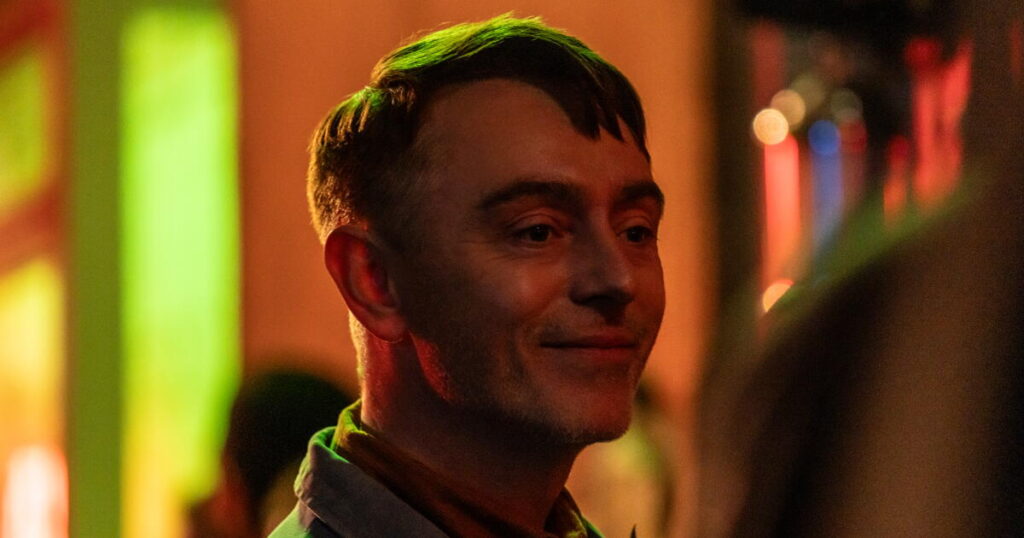
Like Hamlet, the final role he played, Ian Charleson was visited by a spirit of his past.
At least, that’s the supposition made in “Elsinore,” a biographical drama about the real-life Scottish actor’s final years, from director Simon Stone and screenwriter Stephen Beresford. The film follows Charleson (Andrew Scott) as he performs “Hamlet” at London’s National Theatre while secretly dying from AIDS. In the movie’s plot, he has several tempestuous encounters with gay director and activist Derek Jarman (David Dawson).
“For me, Derek is Hamlet’s ghost,” Beresford, 54, says, speaking over Zoom from London. “He is haunting Ian. He haunts him three times because all ghosts have to come three times.”
Jarman, who died from complications of AIDS in 1994, was a prolific artist and filmmaker, immensely respected, even if his unconventional, homespun and often defiant work existed on the margins of the mainstream. He began his career as a production designer, notably for Ken Russell’s 1971 psychological horror film “The Devils,” which recently was rereleased. Jarman’s debut feature, “Sebastiane,” a homoerotic religious drama told entirely in Latin, came out in 1976. Its raucous, off-kilter successor, “Jubilee,” has been dubbed Britain’s first punk rock film. Charleson played queer character Angel, his first onscreen role and only collaboration with Jarman.
“Nobody knows how they met,” Beresford says. “I asked a lot of people who were in ‘Jubilee,’ including Toyah Willcox and Karl Johnson. I would imagine it was from the gay scene in London. But we don’t know for sure.”
A few years after “Jubilee” came out in 1978, Charleson broke through with a starring role in Hugh Hudson’s “Chariots of Fire.” He was advised to remove “Jubilee” from his résumé to avoid queer connotations.
“Derek adored working with Ian and hoped that they would continue to collaborate and make more films in the future, which is why that hurt him so deeply,” actor Dawson says, speaking separately over Zoom. “He was disillusioned with the industry as a whole, so I think it summed up how the industry turned its back on Derek.”
After their rift, Charleson and Jarman never reconnected. The meetings in “Elsinore” are dramatizations based on diary entries written by Jarman after Charleson’s death in 1990 at age 40.
“Derek had an operatic response to things,” Beresford says. “He was a fan of full-blooded vendettas, and Ian certainly was not the only one. We can’t possibly know what their relationship was before, but whatever slight Derek felt after Ian removed that from his résumé was particularly painful to Derek. I wanted Derek to say it to his face. And then I gave Ian the right to reply.”
Beresford spent years researching and writing “Elsinore.” Early on, he discovered the crossover between Charleson’s life and Jarman’s with “Julilee.” It was that discovery that led him to “Modern Nature,” a collection of Jarman’s diary entries published in 1991.
In a particularly savage passage written shortly after learning of Charleson’s death in phone call, Jarman wrote, “Today everyone praises his strength and honesty. I’m the only dissenting voice.”
“I was always a real Jarman fan,” Beresford says. “His work has been personally very important to me. I was so excited to find this connection. Derek wrote this very angry, vituperative passage about how Ian had betrayed him. It was about turning the table over and setting fire to the building rather than negotiating in the building. That gave me an interesting question to put in the center of the screenplay.”
It was important to both Beresford and Scott that a queer actor play Jarman. Dawson, 44, best known for the 2022 drama film “My Policeman,” had performed with Scott in West End play “The Dazzle” in late 2015 and early 2016.
“We felt very strongly that an out gay man should be playing Derek,” Beresford says. “David has this wonderful intensity, and there’s something about David when he says the lines where they blaze with the authority of truth. You know he absolutely believes what he’s saying, and that was very important because what he’s saying is against the hero of the film.”
Unlike Jarman, Charleson kept his AIDS diagnosis private. It was only after his death that his family revealed the cause. Jarman was far more forthright. He tested positive for HIV in 1986 and spoke publicly about his battle with the disease.
For Beresford, Charleson and Jarman represent two sides of the same civil rights movement, as depicted during their second meeting outside the Royal Free Hospital where Charleson is being treated.
Dawson says the actors didn’t rehearse. “Andrew and I already had that fizzy dynamic and friendship to build upon,” he says. “We didn’t discuss it. Simon is very playful and free in the way he directs, so I couldn’t wait to get on that set and for us to just go at it.”
“They trusted each other completely,” Beresford adds. “We did several takes, but they have such a close relationship that they really made that dynamic work.”
In the scene, Jarman urges Charleson to speak out truthfully. Charleson argues that the public wants to see him play a role, not deal with his actual identity.
“Even if they didn’t have that confrontation in real life, it’s certainly the way Derek felt about the fact that Ian wasn’t coming forward publicly,” Dawson says. “What I love about that scene is both men are completely right. I empathize with both of them. Derek felt it was his responsibility for people to have someone to look up to.”
“There’s nothing more fun than having two brilliant people having a proper fight,” Beresford adds.
The duo’s final meeting comes toward the end of the film. Charleson visits Jarman at his home of Prospect Cottage in coastal Dungeness, Kent. The scene was filmed at the real Prospect Cottage, which is now a museum. “Elsinore” is the first movie to be allowed to shoot inside the building. Jarman’s longtime collaborator Tilda Swinton, who starred in his 1986 artist biopic “Caravaggio” and his 1991 historical drama “Edward II,” was sent a copy of the script as a member of Prospect Cottage’s board.
“He made his film ‘The Garden’ there,” Beresford says. “Tilda once said there was a wonderful feeling of the school play about Derek’s filmmaking, and I think that was true. You feel that when you go to the cottage. There’s an energy of creativity. It’s a stunning place, and only someone like Derek could have had the vision to see it as beautiful.”
Charleson likely never went to Prospect Cottage. Jarman bought the house after their friendship broke apart. But dramatically it felt like the right place for them to have a reconciliation of sorts, although in the film, Derek tells Ian he hasn’t forgiven him.
“Standing there as two people battered by this disease, there can be some concord or mutual understanding,” Beresford says.
“Even though they are at a loggerhead, you see there’s a history between these two men and there’s a great love and friendship and admiration, which makes what they’re discussing even harder,” Dawson adds. “They’re both artists who deeply care about the work they’re creating and know that they want to use the time they have left to to the best of their abilities.”
In the scene, Derek reveals to Ian, “I’m going blind.” That is a nod to Jarman’s final film, “Blue,” released in 1993 only months before his death. The complications of his disease caused Jarman to be able to see only in shades of blue, an experience he shared with the viewer by constructing the film with an unchanging blue screen accompanied by voice-over narration.
“In that scene, they’re both acknowledging that what is facing them is bigger than either of their arguments,” Beresford says. “Derek is going blind, and they both know Ian will die from playing Hamlet. It’s game recognize game. It’s the way two mortal enemies can stop just before the end of a battle and look at each other and say, ‘You’re a great fighter’ before they chop each other to bits.”
“There’s love there between them, but Derek can’t fully forgive,” Dawson adds. “I find it so sad and complex and beautiful.”
In the film, Derek is bitter about being rejected by the film industry. In reality, he was considered somewhat controversial, although Beresford remembers watching his film late at night on BBC Two, a public channel in the United Kingdom. Today, Jarman is broadly lauded.
“English culture has a tendency to take its rebels and put them through a machine and they come out as national treasures,” Beresford says. “That happened to Derek. He’s very revered now as a filmmaker and as an artist. I think his books sell very well. He was absorbed into the culture. But it often takes death for people to realize the value of an artist.”
In “Elsinore,” Charleson and Jarman represent the gap left by the AIDS pandemic. Jarman, who died at 52, wrote about future films he hoped to make in his diaries.
“That’s what makes this film the most heartbreaking for me,” Dawson says. “Ian and Derek are symbols of that generation of talent and beauty that was cut short. Think of all the things Derek could have gone on to achieve and that Ian could have gone on to achieve.”
Beresford hopes “Elsinore” will introduce more people to Jarman’s work.
“His films are hugely influential,” he says. “If you ever talk to Tilda Swinton or any of the other people he worked with, they’ll tell you their way of working has been informed by working with Derek. If Americans would take him under their wing, that would be a wonderful effect.”
The post ‘Elsinore’ brings to life a queer cinema icon. How do you honor the spirit of Derek Jarman? appeared first on Los Angeles Times.