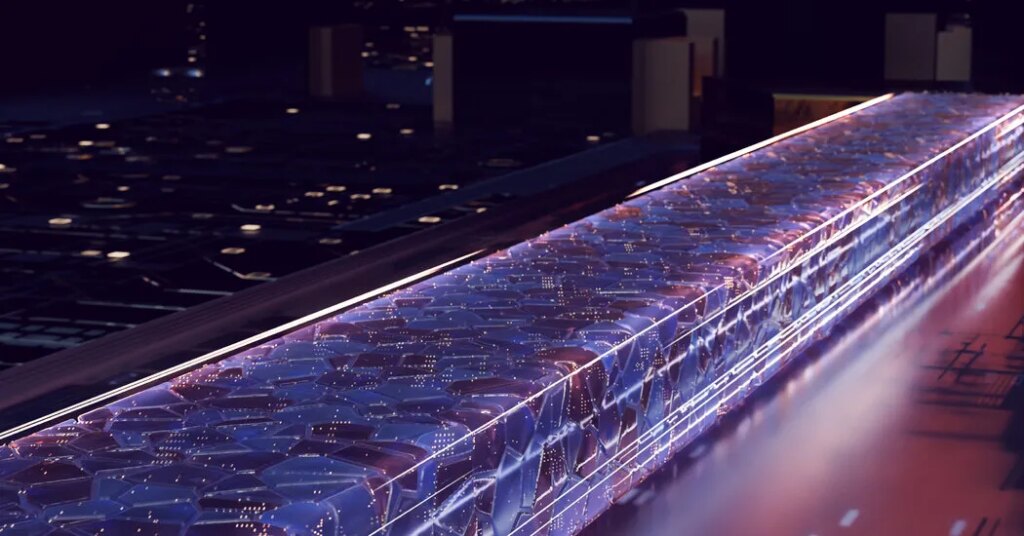
The modern world runs on copper. Today, miles of thin copper wires link up the tens of billions of transistors that empower silicon microchips in things like cellphones and artificial intelligence data centers.
Making the chips even more powerful has historically relied on miniaturization. But standard copper wiring gets worse at conducting electricity as it gets smaller, creating a bottleneck to progress.
Now, a new generation of microchips is taking shape. If perfected, the chips could hold a trillion transistors each, researchers reported on Wednesday in the journal Nature. The key is swapping out copper wires for a type of “nanoribbon” that, in a twist, conducts electricity even better as it shrinks in size.
If refined in the coming years, the newly developed wire, made of niobium phosphide, could lead to chips that are smaller, faster, more powerful and, by reducing their heat emissions, less wasteful.
Ultimately, experts say, the new material might help to shrink the size of A.I. data centers and decrease their need for cooling water, reducing their environmental footprints.
“This could be a game changer,” said Laura H. Greene, the chief scientist at the National High Magnetic Field Laboratory and a past president of the American Physical Society who was not involved in the research.
Eric Pop, the senior author on the Nature paper and a professor of electrical engineering at Stanford University, characterized his team’s finding as “a breakthrough,” partly because its fabrication steps align with existing industry methods, making it easier to commercialize.
“We’ve taken some really cool physics and ported it into the applied electronics world,” Dr. Pop said last year while giving the public a glimpse of his team’s research.
In an interview, he added that after that brief look, “our phones started ringing from industry people” eager to learn more about the new method of wire miniaturization.
The subject of the Stanford research is a material known as a topological semimetal. It possesses bizarre qualities that were presaged a decade ago by a Nobel Prize in Physics, which went to three scientists who found that extreme states of matter could produce strange effects that overpower the constant jostling of atoms in normal states.
The odd but defining characteristic of the niobium wire is that its outer parts conduct electricity better than its innards. So, if miniaturized, its outer parts contribute more to the electrical flow and, overall, the minuscule wire conducts better. Its behavior, in other words, is the exact opposite that of copper.
Last year, Dr. Pop’s team released a report in the journal Science that told of turning the niobium into thin films that had low electrical resistance. The Nature paper takes things a step further by achieving the same reduction in actual wires, which the team called nanoribbons because they’re flat.
The new report pushes back the frontiers of “nanoscale” engineering, in which the dimensions range from 1 nanometer to 100 nanometers, or billionths of a meter. The width of a human hair is about 100,000 nanometers.
Today, the smallest widths of copper wires in microchips run from roughly 16 to 10 nanometers. Dr. Pop’s team used its new material to produce nanowires that had widths as small as roughly six nanometers — considered the start of industry goals for the miniaturization of microchip wires in the next decade.
Dr. Pop sees the research as potentially leading to a new chip generation.
Judy J. Cha, a materials scientist at Cornell University who also studies chip miniaturization, cautioned that “many questions remain” in the field’s implementation of its rudimentary ideas.
“It requires further study,” Dr. Cha said of the Stanford work. “Students might think it’s all proven.” Asked if China, which is racing ahead in materials science, had developed an edge over America in such esoteric research, she said no. “The United States still leads.”
In an interview, Dr. Pop said the production of practical results in the form of a new generation of factory-made chips might take another five to 10 years. But he said such predictions were inherently imprecise.
“That’s the part that’s really hard to say,” he remarked. “If I had a solution today, they’d want it yesterday,” referring to the industry’s appetite for miniaturization. Overall, Dr. Pop added, the use of copper in microchips is “creating more and more headaches.”
A current frontier of his team’s research, he said, is to better understand the mechanism at work behind the material’s resistance drop.
“We keep asking ourselves, ‘What’s going on?’” he noted. Learning the details of the invisible process, Dr. Pop added, “will tell us how to improve the mechanism,” and that in turn may ultimately make the trillion-transistor chip a reality.
The post Bizarre Material May Herald the Future of Computer Chips appeared first on New York Times.