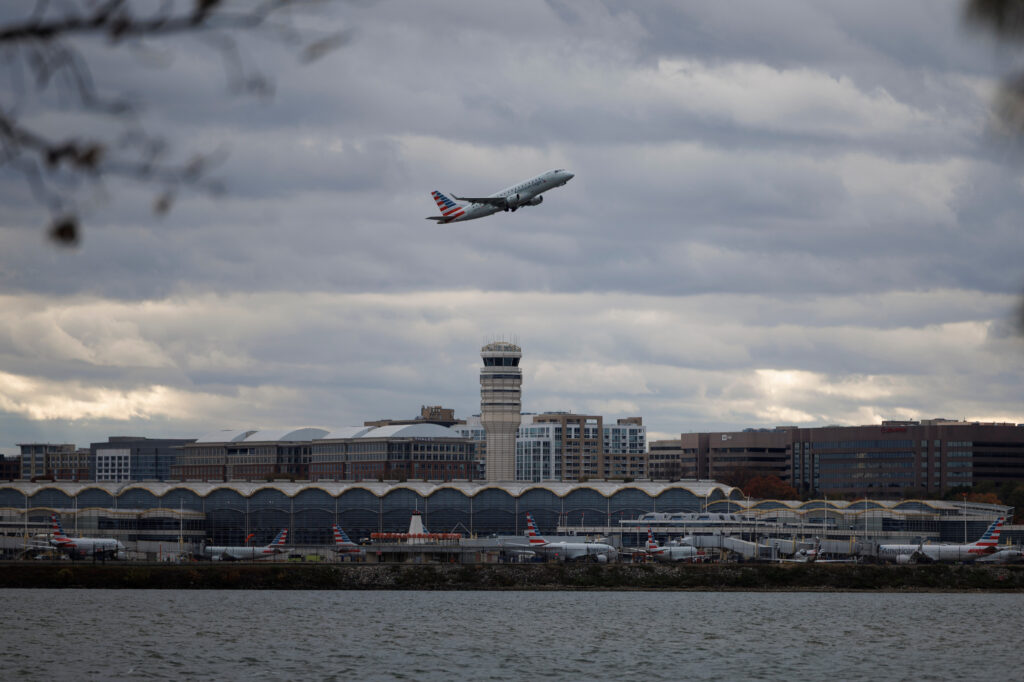
The Federal Aviation Administration rolled out a nationwide policy change Tuesday that may affect when departing planes can taxi to the runway, a change it says will enhance safety.
But some air traffic controllers worry it may lead to delays. The change is being launched days before Thanksgiving, during one of the busiest travel weeks of the year in the United States.
The policy, announced in October, restricts when air traffic controllers can conduct “line up and wait” operations, according to a Transportation Department memo. “Line up and wait” operations allow departing aircraft to taxi into takeoff position on the runway and hold, after an arriving aircraft has landed but before it has exited the runway. Those operations are intended to help expedite departures during periods of high demand, the FAA said.
Under the change, air traffic controllers will have to wait for landing aircraft to completely exit the runway before clearing a departing aircraft from the holding bay next to the runway, said two air traffic controllers who spoke on the condition of anonymity because they were not authorized to comment.
“Line up and wait” operations can now be conducted only when a stand-alone supervisor who is not also handling other roles is available, according to the memo. The two air traffic controllers who spoke to The Washington Post said it’s common for supervisors to take on additional roles, especially during mornings and nights.
Understaffing is a perennial problem with the air traffic control system in the U.S. Last year, the FAA published a report indicating it needed 14,633 controllers to be fully staffed. Earlier this year, it reduced that estimate by more than 2,000 positions, emphasizing that more efficient scheduling could offset the need for more controllers. The FAA said about 11,000 certified controllers were deployed across its air traffic facilities as of April.
The Transportation Department memo said the policy change ensures that personnel providing watch supervision “are fully dedicated to overseeing the safety of the operation without the distraction of simultaneously managing other operational tasks.”
An FAA spokesperson confirmed the policy change was effective nationwide Tuesday.
“The FAA is taking proactive steps to further strengthen runway safety by enhancing staffing and supervisory requirements for Line Up and Wait,” the spokesperson said in a statement.
The two controllers said they expect the policy could lead to flight delays if staffing is insufficient. “Negligible safety increase for significant efficiency decrease,” one of them said.
The FAA spokesperson said the new measures “will not impact airport operations.”
The launch of the policy change comes less than two weeks after a nationwide ground stop led to the cancellation of thousands of flights and even more delays.
Transportation Secretary Sean P. Duffy said the nearly 4½-hour halt was caused by either bad equipment or human error, as a contractor worked to upgrade outdated systems by replacing old copper telecommunications lines with fiber-optic cables at a remote FAA facility.
Thanksgiving air travel is expected to reach a 16-year high, with 417,775 flights forecast between Nov. 23 and Dec. 1, according to the FAA. American Airlines alone said it expects to serve more than 8 million customers across nearly 85,000 flights between Nov. 19 and Dec. 1.
Air traffic controllers and pilots discussed the policy change at Albuquerque’s airport Monday.
“Just a heads up: Tomorrow we’re going to lose ‘line up and wait’ unless we have adequate staffing, so possible delays starting tomorrow,” an air traffic controller at Albuquerque International Sunport told pilots, according to recordings on ATC, a mobile app.
“Will that policy extend through the whole holiday?” a pilot asked. An air traffic controller replied: “It lasts forever.”
The post Why your Thanksgiving flight may wait longer on the tarmac appeared first on Washington Post.