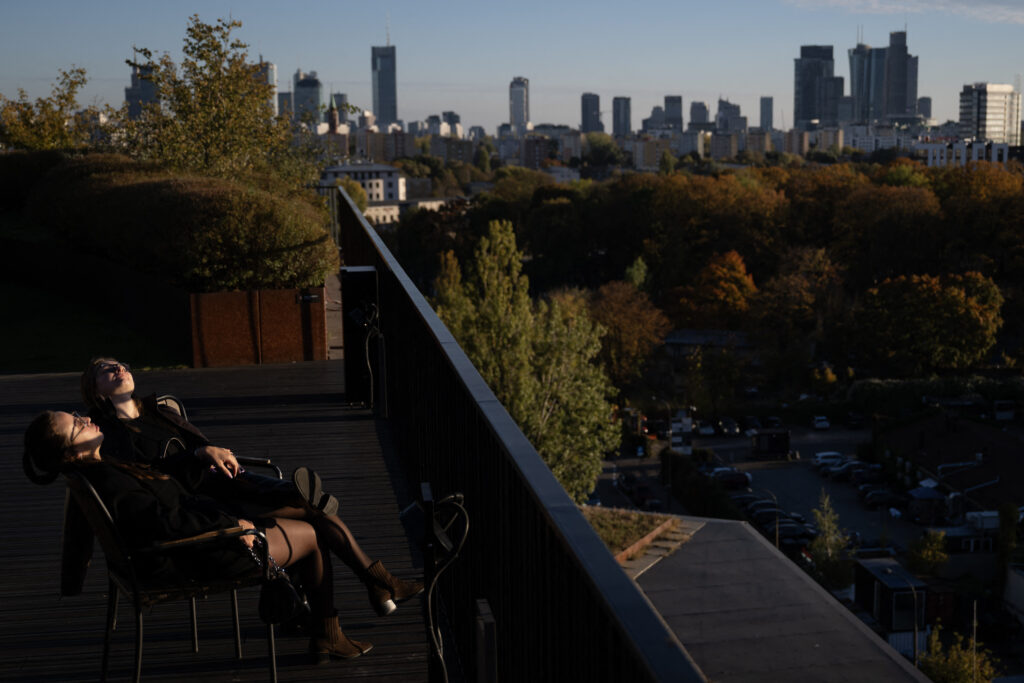
WARSAW — This city should not be here.
After the Warsaw Uprising in 1944, the Nazis flattened Poland’s capital in retribution, destroying nearly all the buildings and reducing the population from more than a million to mere thousands. After the war, the capital briefly relocated to Lodz.
Today, Warsaw is home to more people than ever. The skyline is dotted with modern skyscrapers, including the tallest building in the European Union. It’s a symbol of the country’s overall rise from desolation to a fast-growing major economy.
How did they build all this housing? Two approaches: communism, then free markets. And it shouldn’t be a huge surprise which one worked better.
Trapped behind the Iron Curtain, Poland initially used central planning to rebuild its housing. In 1959, the communist government issued Resolution 364 to prescribe how much housing each family should have. It rationed housing nationwide to ensure equality.
The government allotted an average of 11 square meters (118 square feet) to each person and mandated that this average be preserved. It created apartment categories based on the number of occupants — M1 through M7. It mandated ceiling heights, soundproofing, ventilation and utilities, down to saying that at least one room had to receive 1.5 hours of direct sunlight on Dec. 21.
Rather than landlords leasing to tenants — too capitalist, comrade! — housing was mostly organized in cooperatives. People would make contributions, tracked in savings books, that would eventually grant them membership in a housing cooperative that would guarantee an apartment.
As usual with communism, what was written on paper did not match what happened in the real world. When people saved enough to qualify, they would often get a spot on a waiting list rather than an apartment. Because if people can’t profit from building housing, they aren’t going to build enough of it. And because much of the rest of the Polish economy was centrally planned, people were also waiting in line for cars, appliances, telephones and food and had little money to save toward housing.
The Museum of Life Under Communism here — located above a KFC on the second floor of a Stalin-era socialist realism-style building — has a mock apartment showcasing some of the luxuries that Poles enjoyed in the workers’ paradise. They could pour water from the sink into the “Frania” washing machine, a small drum that could get stains out of clothing alongside off-label uses such as churning butter or making moonshine. There was a surge in innovation in multipurpose furniture to allow the living room to serve as the dining room as well as the kids’ bedroom.
When communism ended in 1989, Poland went all in on its transition to a market economy. It unlocked residential possibilities that the communist mind could not comprehend.
Rather than trying to distribute housing from the top down, Poland began to allow markets to allocate it. Poland has no rent controls apart from a loose cap on annual rent increases (the European Court of Human Rights struck down rent controls inherited from the communist regime), no national standards for a decent dwelling, and very low levels of government spending for private housing subsidies or public housing.
Until 2023, most land was not covered by comprehensive zoning plans, allowing for development with few government restrictions. Poland doesn’t have greenbelts or urban growth boundaries, so housing can expand around cities, where many jobs are found.
Light-touch regulation, combined with property rights and rapidly rising incomes, has allowed Poland to build lots of new housing in the 21st century. Between 2011 and 2021, the number of dwelling units rose by 12.8 percent, even though the population hardly changed. The rate of individual ownership — much to communists’ chagrin — rose from 64 percent to 76 percent. Residential construction has remained strong since then.
Compared with residents in most developed countries, Poles spend a lower percentage of their income on housing. That’s true even for those in the middle and bottom quintiles of the income distribution. The percentage of people overburdened by housing costs, defined as spending more than 40 percent of disposable income on it, is below the average among member countries of the Organization for Economic Cooperation and Development and the E.U. While stipulating that homelessness is difficult to measure, international data shows that Poland has a lower homelessness rate than the United States, Germany, France or Britain.
Housing in Poland isn’t perfect. On average, residences are much smaller than in other developed countries, the long legacy of the communist mandates. And a 2023 law created more zoning rules that, while adding more coherence to local planning, could introduce more of the land-use restrictions that drive up costs in the U.S. or Britain.
When Poland had to basically start from scratch on housing, the communist government treated it as a right and tried to distribute it evenly. The democratic government since 1990 has treated it as private property subject to market forces. It’s obvious from looking around that this approach has provided more people with better housing — and made Warsaw a great city once more.
The post Warsaw is booming. Here’s how a devastated city built itself back up. appeared first on Washington Post.